
Resources
Explore a wide range of valuable resources on GCED to deepen your understanding and enhance your research, advocacy, teaching, and learning.
1,322 Results found
 Évaluation des besoins en intelligence artificielle en Afrique Year of publication: 2021 Author: Prateek Sibal | Bhanu Neupane Corporate author: UNESCO Le continent africain enregistre des signes encourageants en matière d’innovation et de développement dans le domaine de l’intelligence artificielle (IA) : cours dans des structures de quartier le week-end, formations intensives pour étudiants et jeunes chercheurs, création de pôles d’innovation transnationaux publics ou privés… Cependant, malgré un fort potentiel de développement, des défis subsistent quant à la disponibilité des infrastructures. De même, le développement et la gestion de l’IA dans le but d’optimiser les avantages et de minimiser les dommages se heurtent à des problèmes de compétences humaines et institutionnelles. Les conclusions de cette enquête, qui s’appuient sur les recommandations du rapport de l’UNESCO Piloter l’IA et les TIC avancées pour les sociétés du savoir visent à pallier le déficit d’informations sur les priorités stratégiques, les mesures politiques, les défis relatifs au développement, les cadres juridiques et les besoins de compétences humaines et institutionnelles en matière d’IA dans les pays africains.
  Evaluation de la riposte de l’UNESCO à la pandémie de COVID-19 Year of publication: 2023 Corporate author: Organisation des Nations Unies pour l'éducation, la science et la culture (UNESCO) Le présent rapport d’évaluation contient les conclusions tirées d’une évaluation complète de la manière dont l’Organisation des Nations Unies pour l’éducation, la science et la culture (UNESCO) s’est adaptée et a répondu à la pandémie de coronavirus 2019 (COVID-19). Il rend compte de la réponse programmatique de l’UNESCO dans tous ses secteurs, et en évalue la pertinence et l’efficacité. Il examine également l’efficacité avec laquelle l’Organisation s’est adaptée pour assurer la continuité de ses opérations tout au long de la pandémie. Axée sur l’apprentissage, l’évaluation a permis de dégager une série d’enseignements et de mettre en évidence les innovations les plus précieuses apportées durant la pandémie. Le présent rapport énonce cinq recommandations visant à guider l’UNESCO vers la pérennisation des innovations les plus efficaces et le renforcement de la résilience de ses activités et de ses programmes en cas de crise. Evaluation of UNESCO’s response to the Covid-19 pandemic Year of publication: 2023 Corporate author: UNESCO This evaluation report summarises the findings of a comprehensive evaluation on how UNESCO has adapted and responded to the Covid-19 pandemic. It describes and assesses the relevance and effectiveness of UNESCO’s programmatic response across all of its Sectors, and reviews how efficiently the Organization adapted itself to ensure business continuity during the pandemic. With an overall focus on learning, the evaluation identified a series of lessons and useful innovations made during the pandemic. The report’s five recommendations aim to guide UNESCO towards sustaining useful innovations and further increasing the crisis resilience of its operations and programme.
  World Heritage Online Map Platform: Technical Note on the Provision of Geospatial Data Year of publication: 2023 Corporate author: UNESCO UNESCO’s World Heritage Online Map Platform (WHOMP) is a Geographic Information System (GIS) developed with the support of the Government of Flanders (Belgium), aiming at the creation of a comprehensive and accessible geodatabase for World Heritage properties worldwide. This platform is hosted and managed by UNESCO which ensures that the data presented correspond exactly to the boundaries of the World Heritage properties and their buffer zones as inscribed in the World Heritage List, including any changes adopted by the World Heritage Committee after the initial inscription of a property. Plateforme de cartes en ligne du patrimoine mondial: Note technique sur la mise à disposition de données géospatiales Year of publication: 2023 Corporate author: UNESCO La Plateforme de cartes en ligne du patrimoine mondial de l’UNESCO est un système d’information géographique (SIG) développé avec le soutien du Gouvernement flamand (Belgique) visant à créer une base de données géospatiales complète et accessible pour les biens du patrimoine mondial du monde entier. Cette plateforme est hébergée et gérée par le Centre du patrimoine mondial de l’UNESCO, qui veille à ce que les données présentées correspondent exactement aux limites des biens du patrimoine mondial et de leurs zones tampons, telles qu’inscrites dans la Liste du patrimoine mondial, en tenant compte de toute éventuelle modification adoptée par le Comité du patrimoine mondial après l’inscription initiale du bien.
 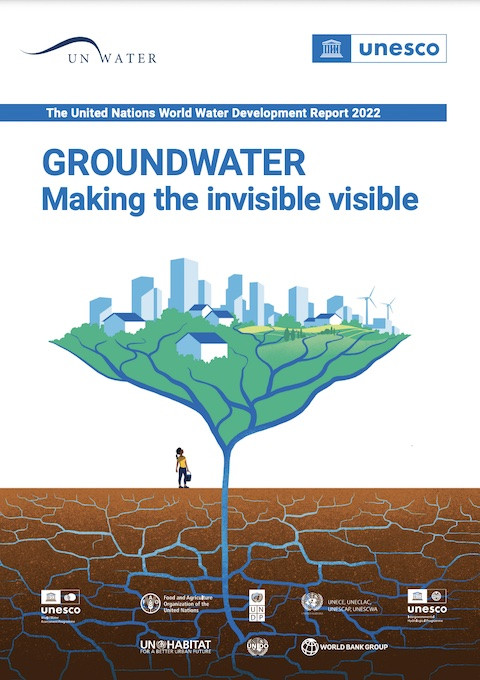 The United Nations World Water Development Report 2022: Groundwater; Making the Invisible Visible Year of publication: 2022 Corporate author: UNESCO The 2022 edition of the United Nations World Water Development Report, titled “Groundwater: Making the invisible visible”, describes the challenges and opportunities associated with the development, management and governance of groundwater across the world. The report addresses groundwater-related issues from the perspective of the three main water use sectors (agriculture, human settlements and industry), as well as its interactions with ecosystems and its relation with climate change. It highlights different regional perspectives and presents a number of response options concerning data and information, policy and planning, management and governance, as well as financing.The United Nations World Water Development Report is UN-Water’s flagship report on water and sanitation issues, focusing on a different theme each year. The report is published by UNESCO, on behalf of UN-Water and its production is coordinated by the UNESCO World Water Assessment Programme. The report gives insight on main trends concerning the state, use and management of freshwater and sanitation, based on work done by the Members and Partners of UN-Water. Launched in conjunction with World Water Day, the report provides decision-makers with knowledge and tools to formulate and implement sustainable water policies. It also offers best practices and in-depth analyses to stimulate ideas and actions for better stewardship in the water sector and beyond. Rapport mondial des Nations Unies sur la mise en valeur des ressources en eau 2022: Eaux souterraines; Rendre visible l’invisible Year of publication: 2022 Corporate author: UNESCO L’édition 2022 du Rapport mondial des Nations Unies sur la mise en valeur des ressources en eau, intitulée Eaux souterraines : rendre visible l’invisible, décrit les défis et les opportunités que présentent l’exploitation, la gestion et la gouvernance des eaux souterraines dans le monde. Le rapport examine les questions relatives aux eaux souterraines sous l’angle des trois principaux secteurs d’utilisation de l’eau (agriculture, établissements humains et industrie) ainsi que leurs interactions avec les écosystèmes et leur relation au changement climatique. Il met également en avant différentes perspectives régionales et présente un certain nombre de solutions possibles en matière de données et d’informations, de politiques et de planification, de gestion et de gouvernance ainsi que de financement.Abordant un thème différent chaque année, le Rapport mondial des Nations Unies sur la mise en valeur des ressources en eau est le rapport phare d’ONU-Eau sur les questions d’eau et d’assainissement. Le rapport est publié par l’UNESCO, au nom d’ONU-Eau, et sa production est coordonnée par le Programme mondial de l’UNESCO pour l’évaluation des ressources en eau. Le rapport expose les principales évolutions de l’état, de l’utilisation et de la gestion de l’eau douce et de l’assainissement sur la base des travaux réalisés par les membres et les partenaires d’ONU-Eau. Publié à l’occasion de la Journée mondiale de l’eau, le rapport met à disposition des décideurs des connaissances et des outils pour leur permettre de concevoir et de mettre en œuvre des politiques durables. Il présente aussi certaines des meilleures pratiques ainsi que des analyses approfondies, qui stimuleront les idées et galvaniseront les actions aux fins d’une meilleure gestion dans le secteur de l’eau et au-delà.
  Youth of Central Asia, Challenges for Peacebuilding: A Comprehensive Research Review Year of publication: 2021 Author: Laura Yerekesheva Corporate author: UNESCO The estimations are that by 2030, the world will be home to 1.3 billion young people. This speaks about the importance of the youth for development in various parts of the globe, particularly in developing countries which constitute 90% of the global youth population. From comprehensive holistic perspective peace, peacebuilding and dialogue embrace all aspects and dimensions of life – inter-generational, social, economic, political, ethnic, religious, civic, ideological, cultural, and natural. The youth related issues are directly linked with the SDGs agenda. Central Asian states are also on the list of developing countries, with an increasing demographic share of the youth in the general population, meaning that the countries of the region are “young.” As of 2020, the total population of the four countries of Central Asia (Kazakhstan, Kyrgyzstan, Tajikistan and Uzbekistan) was 68.46 million, of which youth comprised 16.55 million or 24,1%. What Challenges for Peacebuilding the Youth of Central Asia Face? This highlights the urgency required for elaborating and implementing special policies on youth development. For Central Asia, the peace and peacebuilding agenda is the development agenda, and vice versa, as neither is possible without the other, and these in turn are intrinsically linked with youth-related issues. This report provides a detailed overview of the existing challenges to the youth of the 4 countries of the region – Kazakhstan, Kyrgyzstan Tajikistan, Uzbekistan – structured around three main themes of peacebuilding: (1) an education and learning environment; (2) economic and social participation; and (3) civic engagement. Governments, international organizations, professionals and policymakers in the youth, peacebuilding and development sectors, academia and NGOs are invited to join forces to accelerate the achievement of youth development for a more just, sustainable and peaceful future. Молодежь Центральной Азии, Вызовы миростроительству : Комплексный исследовательский обзор Year of publication: 2021 Author: Laura Yerekesheva Corporate author: Организация Объединенных Наций по вопросам образования, науки и культуры (UNESCO) По оценкам, к 2030 году в мире будут проживать 1,3 миллиарда молодых людей. Это говорит о важной роли, которую будет играть молодежь, особенно в развивающихся странах, в которых проживает 90% общего мирового населения молодежи. В рамках всеобъемлющего системного подхода, мир, миростроительство и диалог подразумевают все аспекты и измерения жизни - межпоколенческие, социальные, экономические, политические, этнические, религиозные, гражданские, идеологические, культурные и природные. Вопросы, связанные с молодежью, напрямую связаны с повесткой в области достижения Целей устойчивого развития (ЦУР). Государства Центральной Азии относятся к развивающимся странам с высокой долей молодежи в общем составе населения, что делает эти страны «молодыми». По состоянию на 2020 год общая численность населения четырех стран Централь ной Азии (Казахстана, Кыргызстана, Таджикистана и Узбекистана) - 68,46 миллиона человек, из которых молодежь составляла 16,55 миллиона человек или 24,1%.Это свидетельствует о важности разработки и реализации специальных стратегий и мер по развитию молодежи. Для Центральной Азии повестка дня в области мира и миростроительства – это, прежде всего, повестка дня в области развития, и наоборот, поскольку обе они взаимосвязаны между собой, а также с проблемами молодежи.В данном отчете представлен подробный обзор существующих вызовов, с которыми сталкивается молодежь четырех стран региона - Казахстана, Кыргызстана, Таджикистана, Узбекистана. Данные вызовы структурированы вокруг трех основных тем миростроительства: (1) образование и обучающая среда; (2) экономическое и социальное участие; и (3) гражданское участие.Правительствам, международным организациям, специалистам и политикам, работающим в сферах молодежи, миростроительства и развития, академическим кругам и неправительственным организациям предлагается объединить усилия для ускорения достижения целей развития молодежи для более справедливого, устойчивого и мирного будущего.
  Leave No Child Behind: Global Report on Boys’ Disengagement From Education Year of publication: 2022 Corporate author: 유네스코 The 2030 Agenda for Sustainable Development makes the promise to leave no one behind. While improving educational opportunities for girls globally continues to be of paramount importance to achieve gender equality in and through education, this focus on achieving gender parity and equality must not ignore boys. No less than 132 million boys of primary and secondary school age are out of school. To leave no child behind, UNESCO developed the first global report of this scope on boys’ disengagement from education, bringing together qualitative and quantitative evidence from over 140 countries. As this report shows, addressing boys’ disengagement from and disadvantage in education is not a zero-sum game. Supporting boys does not mean that girls lose out and vice versa. Addressing boys’ disengagement from and disadvantage in education not only benefits boys’ learning, employment opportunities, income and well-being, but it also benefits girls and the broader society.