
Resources
Explore a wide range of valuable resources on GCED to deepen your understanding and enhance your research, advocacy, teaching, and learning.
130 Results found
 Educación para el desarrollo sostenible: aportes didácticos para docentes del Caribe Year of publication: 2008 Author: Gillian Cambers | Grace Chapman | Paul Diamond | Lorna Down | Anthony D. Griffith | Winthrop Wiltshire Corporate author: UNESCO Santiago The publication “Teachers’ Guide for Education for Sustainable Development in the Caribbean” is geared towards regional teacher-trainers and teachers active at every level of education. Its purpose is two-fold: contribute to the integration of education for sustainable development into teaching practices through education initiatives, originally implemented in the Caribbean that may be feasible to replicate in the various classrooms, schools and communities; promote reflection, discussion and creation of innovative practices that involve all teachers in Decade activities and contribute to the making of sustainable societies. This document illustrates how different wills can come together moved by a desire to materialise common projects. Thus, this effort represents the work of regional specialists working in close cooperation with UNESCO Regional Bureau for Education in Latin America and the Caribbean, as well as the financial support of the Government of Japan.
  Non-Formal Education, Sustainable Development and the Education 2030 Agenda: Study of Civil Society Practices in Latin America and the Caribbean Year of publication: 2020 Corporate author: UNESCO Santiago | UNESCO Mexico This publication shows 27 civil society initiatives from various countries in Latin America and the Caribbean that work to promote actions and programs to comply with Target 4.7 within non-formal education. The study seeks that these organizations show their work, the challenges they face as regards the implementation of their programs and their greatest achievements. Educación no formal, desarrollo sostenible y la Agenda de Educación 2030: Estudio de prácticas de la sociedad civil en América Latina y el Caribe Year of publication: 2020 Corporate author: Organización de las Naciones Unidas para la Educación, la Ciencia y la Cultura (UNESCO) En esta publicación, se muestran 27 iniciativas de la sociedad civil de diversos países de la región de América Latina y el Caribe que trabajan promoviendo acciones y programas para lograr el cumplimiento de la Meta 4.7 desde la educación no formal. En el estudio, se busca que las propias organizaciones expongan su trabajo, los retos que enfrentan en la implementación de sus programas y sus mayores logros.
  Gender Inequality in Learning Achievement in Primary Education: What can TERCE Tell Us? Year of publication: 2016 Corporate author: UNESCO Santiago Existing research identifies several significant, subject-based gender inequalities in education. Male learners have significant advantages in mathematics and female learners have no less significant advantages in reading and writin. Such considerable differences in achievement may have important consequences for the future wellbeing of students. In order to shed light on this phenomenon in Latin America, this report analyzes the gender gaps in educational achievement in the Third Regional Comparative and Explanatory Study (TERCE) led by the Latin American Laboratory for Assessment of the Quality of Education (LLECE). Inequidad de género en los logros de aprendizaje en educación primaria ¿Qué nos puede decir TERCE? Year of publication: 2016 Corporate author: UNESCO Santiago Existing research identifies several significant, subject-based gender inequalities in education. Male learners have significant advantages in mathematics and female learners have no less significant advantages in reading and writin. Such considerable differences in achievement may have important consequences for the future wellbeing of students. In order to shed light on this phenomenon in Latin America, this report analyzes the gender gaps in educational achievement in the Third Regional Comparative and Explanatory Study (TERCE) led by the Latin American Laboratory for Assessment of the Quality of Education (LLECE).
 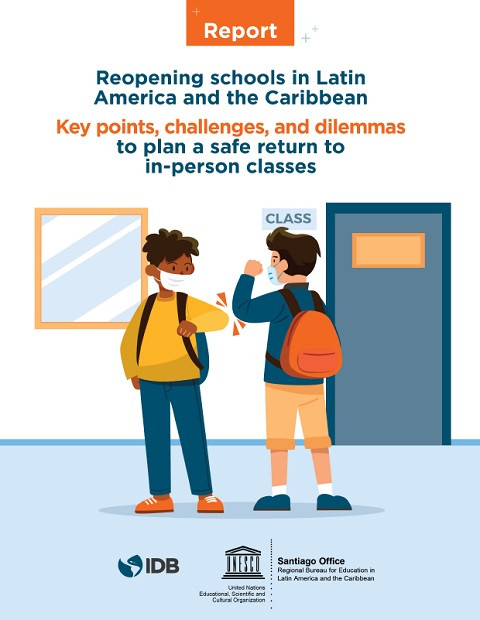 Reopening Schools in Latin America and the Caribbean: Keys, Challenges, and Dilemmas to Plan for a Safe Return to in-Person Classes Year of publication: 2021 Author: Alejandro Vera | Martín Scasso | Alejandro Morduchowicz | Cecilia Berlanga Alessio Robles Corporate author: UNESCO Santiago | Inter-American Development Bank The suspension of in-person classes as a consequence of the COVID-19 pandemic profoundly affected the education systems in Latin America and the Caribbean (LAC) and compromised the achievements reached around the goals established in the SDG4-Education 2030 Agenda. The most vulnerable people have been the most affected by this situation, which widened the preexisting gaps. The countries of the region have carried out great efforts to guarantee the continuity of learning. However, these have been limited by the challenges that this unprecedented crisis brought, aggravated by unequal conditions in access to infrastructure and other resources that affect broad sectors of the population.This report analyzes the possibilities, restrictions and needs that the countries of the region will face during the process of returning to in-person classes, considering five dimensions: (i) safe schools (school infrastructure, access to water and sanitation); (ii) human resources (principals and teachers); (iii) access to ITC and connectivity; (iv) education financing and (v) information and planning. Reabrir las escuelas en América Latina y el Caribe: Claves, desafíos y dilemas para planificar el retorono seguro a las clases presenciales; Reporte Year of publication: 2021 Author: Alejandro Vera | Martín Scasso | Alejandro Morduchowicz | Cecilia Berlanga Alessio Robles Corporate author: UNESCO La suspensión de clases presenciales como consecuencia de la pandemia de COVID-19 afectó profundamente los sistemas educativos de América Latina y el Caribe, y puso en riesgo los avances alcanzados en torno al cumplimiento de las metas establecidas en la Agenda ODS 4-Educación 2030. Las poblaciones más vulnerables se han visto más afectadas por esta situación, lo cual acrecentó las brechas preexistentes. Los países de la región llevaron a cabo enormes esfuerzos para garantizar la continuidad de los aprendizajes. Sin embargo, se ven limitados por los desafíos que presenta este contexto inédito de crisis y agravados por las desiguales condiciones de acceso a infraestructura y otros recursos que afectan a vastos sectores de la población.El reporte analiza las posibilidades, restricciones y necesidades que enfrentarán los países de la región durante el proceso del regreso a las clases presenciales, considerando cinco dimensiones: (i) escuelas seguras (infraestructura escolar, acceso al agua y saneamiento); (ii) recursos humanos (directores y docentes); (iii) acceso a TIC y conectividad, (iv) financiamiento de la educación y (v) información y planificación. National curricular guidelines and citizenship education in schools in Latin American countries Year of publication: 2013 Author: Martín Bascopé | Macarena Bonhomme | Cristián Cox | Juan Carlos Castillo | Daniel Miranda Corporate author: Centro de Estudios de Políticas y Prácticas en Educación (CEPPE) The aim of this study is to contrast two different sources of information regarding citizenship education in Latin America: curricular guidelines, and students’ civic attitudes and practices. When analyzing curricular guidelines, we consider the official national documents of the respective Ministries of Education, whereas regarding civic practices and attitudes, we analyze the results of the 2009 ICCS study. By using quantitative methods, we contrast the curricular emphasis and students’ results for each of the six countries considered. Our findings show that several curricular absences are associated with students’ low achievement in civic and citizenship knowledge and attitudes. Therefore, these results provide some guidelines for improving the official curricular documents and developing more empirical research on less-covered civic topics. Finally we encourage further research on classroom practices, especially on the topics highlighted in this research, such as authoritarianism, peaceful coexistence, national and regional identity, and accountability. Inside classroom research is very important to have a complete view of civic/citizenship curricular guidelines and practices, considering the limitations implied by looking at the intended curriculum (official documents) rather than the one implemented. Critical and Reflective Digital Literacy: Digital Citizenship Year of publication: 2024 Corporate author: Innovation Center Mineduc Coni helps her grandfather do the online shopping for the house and her grandfather helps her understand how apps work and become more aware of her privacy. Join Coni and her friends to discover what digital citizenship is and how they exercise it from home and school. This is the first of a series of four capsules that introduces us to the dimension of “Critical and reflective digital literacy”, which is understood as the acquisition of knowledge and the development of skills and attitudes to autonomously use, understand and evaluate digital technologies. Alfabetización digital crítica y reflexiva: Ciudadanía digital Year of publication: 2024 Corporate author: Innovation Center Mineduc Coni ayuda a su abuelo a hacer las compras de la casa en línea y su abuelo la ayuda a entender cómo funcionan las apps y a estar más consciente de su privacidad. Acompaña a Coni y a sus amigos y amigas a descubrir lo qué es la ciudadanía digital y cómo la ejercen desde su casa y colegio. Esta es la primera de una serie de cuatro cápsulas nos introduce en la dimensión de la “Alfabetización digital crítica y reflexiva”, la que se entiende como la adquisición de conocimientos y el desarrollo de habilidades y actitudes para usar, comprender y evaluar autónomamente las tecnologías digitales.