
Resources
Explore a wide range of valuable resources on GCED to deepen your understanding and enhance your research, advocacy, teaching, and learning.
328 Results found
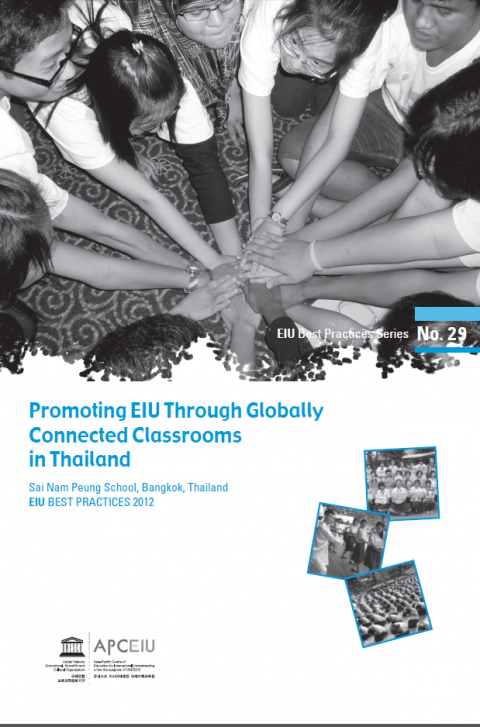 Promouvoir ECI travers les salles de classe branchés sur le monde en Thaïlande (ECI Série des Meilleures Pratiques no.29) Year of publication: 2012 Author: Ajarn Kanchaphat Chaoplaina Corporate author: Centre Asie-Pacifique d'éducation pour la compréhension internationale (APCEIU) Cette question présente un projet multilatéral en Thaïlande, qui interconnectée étudiants en provenance de Thaïlande, Royaume-Uni, la Corée, l'Indonésie, la Malaisie, Taïwan et le Vietnam pour partager leurs valeurs et leurs réflexions sur les questions ECI. A travers les portails de connexion, les étudiants de différentes régions ont été en mesure de collaborer à faire des travaux et des activités de groupe, qui ont été axées sur le partage des idées sur l'intérêt des élèves et expériences quotidiennes. Ce cas met en lumière la pratique spécifique qui a encouragé les élèves à apprendre activement les uns des autres et de comprendre la diversité culturelle, qui a optimisé le résultat de la capacité des étudiants en techniques de communication, les compétences linguistiques et le développement personnel en tant que citoyens. En plus de renforcer le réseau entre les écoles participantes, l'impact du projet multilatéral étendu aux enseignants alors qu'ils étaient engagés dans l'échange de méthodes et de connaissances pédagogiques pour soutenir et inspirer les uns des autres.
 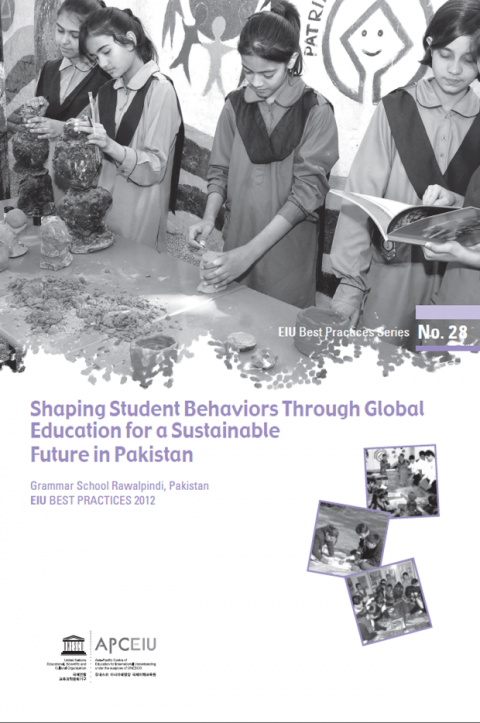 EIU Best Practice Series No. 28: Shaping student behaviors through global education for a sustainable future in Pakistan Year of publication: 2012 Author: Nasreen Iqbal Corporate author: APCEIU Issue No. 28 introduces a Global Education programme with its various activities from Grammar School Rawalpindi in Pakistan. It aims to enable and empower young people to become responsible and humane citizens to achieve a peaceful and sustainable future. It is targeted at all levels of students, including preschool level, to increase their awareness of social and civic values. The programme mainly focuses on EIU while equipping learners with conflict resolution skills, cultural and national identities and global citizenship. Also, it incorporates issues such as universal values, human rights, health, sustainable development, gender, multiculturalism, respect for minority groups, identity and self-worth, tolerance, etc. into the school ethos and curriculum so that the students will be able to perform positive changes on national as well as on international level. Façonner le comportement des élèves par le biais de l'éducation mondiale pour un avenir durable au Pakistan (ECI Série des Meilleures Pratiques no.28) Year of publication: 2012 Author: Nasreen Iqbal Corporate author: Centre Asie-Pacifique d'éducation pour la compréhension internationale (APCEIU) Question n ° 28 introduit un programme d’Éducation Mondiale avec ses diverses activités de Grammar School Rawalpindi au Pakistan. Il vise à permettre et permettre aux jeunes de devenir des citoyens responsables et humains pour parvenir à un avenir pacifique et durable. Il est destiné à tous les niveaux des élèves, y compris le niveau préscolaire, afin d'accroître leur prise de conscience des valeurs sociales et civiques. Le programme se concentre principalement sur ECI tout aux apprenants des compétences de résolution des conflits, des identités culturelles et nationales et la citoyenneté mondiale. En outre, il intègre des questions telles que les valeurs universelles, les droits de l'homme, la santé, le développement durable, l'égalité, le multiculturalisme, le respect pour les groupes minoritaires, l'identité et l'estime de soi, la tolérance, etc. dans l'ethos et le curriculum de sorte que les étudiants seront en mesure école pour effectuer des changements positifs sur le national et au niveau international.
 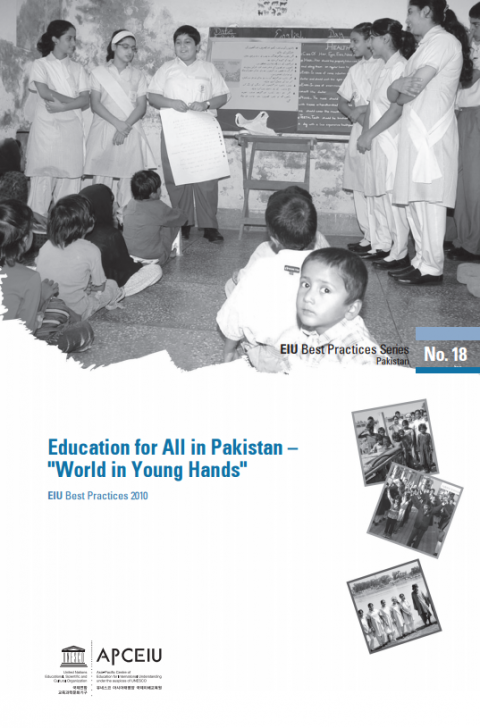 EIU Best Practices Series No.18: Education for All in Pakistan - "world in young hands" Year of publication: 2010 Author: Ayesha Saqib Corporate author: APCEIU The programme provides a student-participatory approach to face local problems that stem from ignorance and have roots in poverty. Bridging the school with the local community, Social Action Program (SAP) aims to inspire students with keen awareness on problems that threaten our community as well as to equip them with necessary tools to deal with challenges they may face. Through practices, SAP integrates EIU into curriculum that emphasizes maintaining peace and harmony among different folds of religions, ethnicity, and sects, dissipating the elements of hate and intolerance. The major areas of concern are Literacy for All, Sustainable Development, Cultural Diversity, and Peace Education. Éducation pour tous au Pakistan - «monde aux mains des jeunes» (ECI Série des Meilleures Pratiques no.18) Year of publication: 2010 Author: Ayesha Saqib Corporate author: Centre Asie-Pacifique d'éducation pour la compréhension internationale (APCEIU) Le programme offre une approche étudiant-participative pour faire face à des problèmes locaux qui découlent de l'ignorance et ont des racines dans la pauvreté. Combler l'école avec la communauté locale, le programme d'action sociale (PAS) vise à inspirer les élèves ayant conscience aiguë des problèmes qui menacent notre communauté ainsi que de les doter des outils nécessaires pour faire face aux défis auxquels ils peuvent être confrontés. Grâce à des pratiques, PAS intègre EIU dans les programmes qui met l'accent maintenir la paix et l'harmonie entre les différents plis de religions, l'origine ethnique, et les sectes, dissipant les éléments de la haine et de l'intolérance. Les principaux domaines de préoccupation sont l'alphabétisation pour tous, le développement durable, la diversité culturelle et éducation à la paix.
 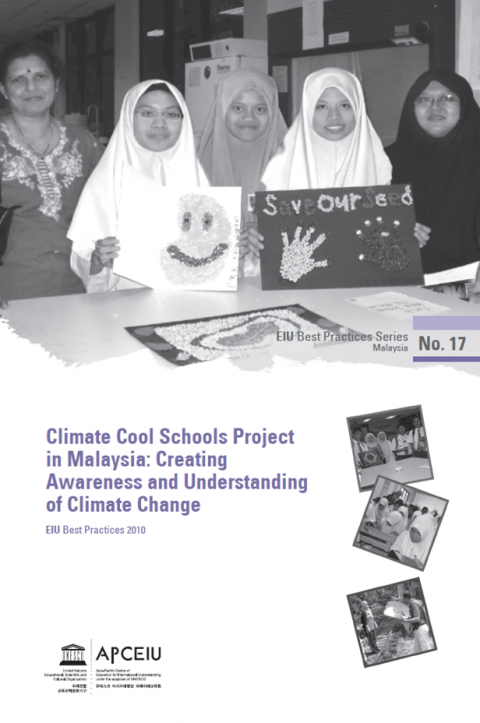 EIU Best Practice Series No. 17: Climate cool schools project in Malaysia: creating awareness and understanding of climate change Year of publication: 2010 Author: Maria Salih Corporate author: APCEIU The Climate Cool Schools (CCS)-Global Platform project is a multilateral learning portal for students in Malaysia, the UK, and Hong Kong to work together to explore local and global climate change issues. The learning portal enables these students to learn from each other about what actions are possible, and to find a voice to advocate wider actions at the local and global levels. The project was initiated in late 2007 and in early 2008 embarked on a two year trial basis with the British Council (BC), Sultan Idris Education University (SIEU), and the Perak State Education Department (JPN, Perak) as the partners. This project is a follow-up from the ZeroCarbonCity project launched in 2005 by the British Council. Projet d’Écoles Fraîches Climatique en Malaisie: la sensibilisation et la compréhension des changements climatiques (ECI Série des Meilleures Pratiques n ° 17 ) Year of publication: 2010 Author: Maria Salih Corporate author: Centre Asie-Pacifique d'éducation pour la compréhension internationale (APCEIU) Le Projet d'Écoles Fraîches Climatique (EFC)) - Plate-Forme Mondiale est un portail d'apprentissage multilatéral pour les étudiants en Malaisie, au Royaume-Uni, et à Hong Kong à travailler ensemble pour explorer les enjeux locaux et mondiaux du changement climatique. Le portail d'apprentissage permet à ces étudiants d'apprendre les uns des autres sur les actions sont possibles, et de trouver une voix pour préconiser des actions plus larges aux niveaux local et mondial. Le projet a été lancé à la fin de 2007 et au début de 2008 a lancé à titre d'essai de deux ans avec le British Council (BC), Sultan Idris Université Education (SIEU), et l'État de Perak Département de l'éducation (JPN, Perak) que les partenaires. Ce projet est un suivi du projet ZeroCarbonCity lancé en 2005 par le British Council.
 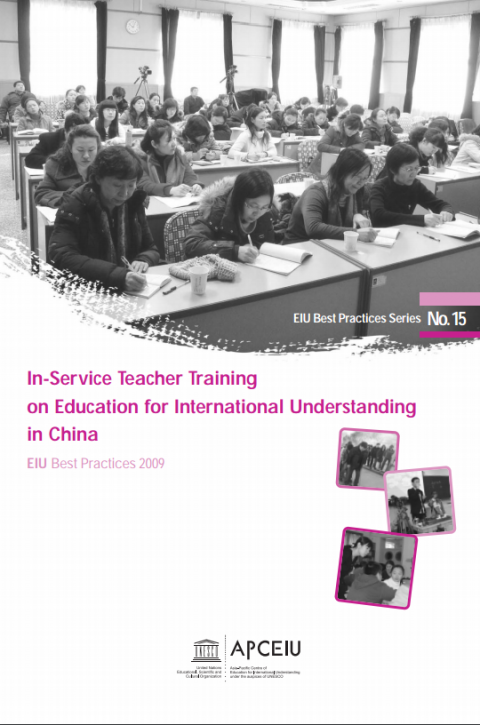 EIU Best Practices Series No.15: In-service teacher training on education for international understanding in China Year of publication: 2009 Author: Yu Xin Corporate author: APCEIU This document introduces an effective and systematic in-service teacher training programme on Education for International Understanding (EIU) in Beijing, China. In order for this training to take place, the Beijing Institute of Education (BIE) has been working to develop a school-based curriculum on EIU to be implemented in local schools. Through this effort, the in-service teacher training programme on EIU motivated and strengthened the capacity of teachers to incorporate EIU curriculum into various subjects they teach in schools. As a result of this practice, schools in which EIU have been implemented, raised the level of global awareness among their teachers and students. This effort to promote EIU in Beijing is an excellent model for policy makers, curriculum developers and educators to learn the effective strategies to promote EIU in schools. La formation continue des enseignants sur l'éducation pour la compréhension internationale en Chine (ECI Série des Meilleures Pratiques no.15) Year of publication: 2009 Author: Yu Xin Corporate author: Centre Asie-Pacifique d'éducation pour la compréhension internationale (APCEIU) Ce document présente un programme de formation des enseignants efficace et systématique en service sur l'éducation pour la compréhension internationale (ECI) à Beijing, en Chine. Pour que cette formation ait lieu, le Beijing Institute of Education (BIE) a travaillé pour élaborer un programme scolaire sur ECI à mettre en œuvre dans les écoles locales. Grâce à cet effort, le programme de formation des enseignants en service sur ECI motivé et renforcé la capacité des enseignants à intégrer curriculum ECI dans diverses matières qu'ils enseignent dans les écoles. En raison de cette pratique, les écoles dans lesquelles ECI ont été mises en œuvre, a soulevé le niveau de sensibilisation mondiale parmi leurs enseignants et les étudiants. Cet effort de promouvoir ECI à Beijing est un excellent modèle pour les décideurs, les concepteurs de programmes et les éducateurs à apprendre les stratégies efficaces pour promouvoir ECI dans les écoles.
 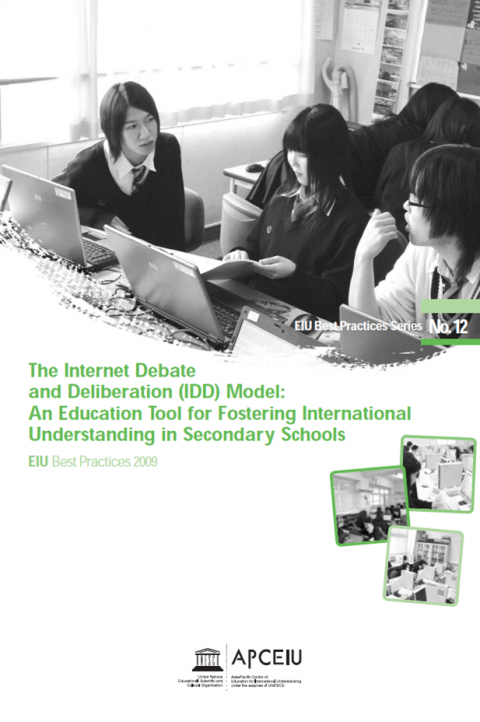 EIU Best Practice Series No. 12: The Internet Debate and Deliberation (IDD) Model: An Education Tool for Fostering International Understanding in Secondary Schools Year of publication: 2009 Author: Rose Sabanal Corporate author: APCEIU This document introduces a case of the internet-based debate and deliberation with an aim to strengthen critical and integrated thinking among high school students from various countries. The case demonstrates that the school in case has been making a devoted effort to develop effective methods of communication among young people with different cultural backgrounds and perspectives, eventually leading to the development of educational content that will enable young learners to critically reflect on highly contending issues of EIU.