
Resources
Explore a wide range of valuable resources on GCED to deepen your understanding and enhance your research, advocacy, teaching, and learning.
875 Results found
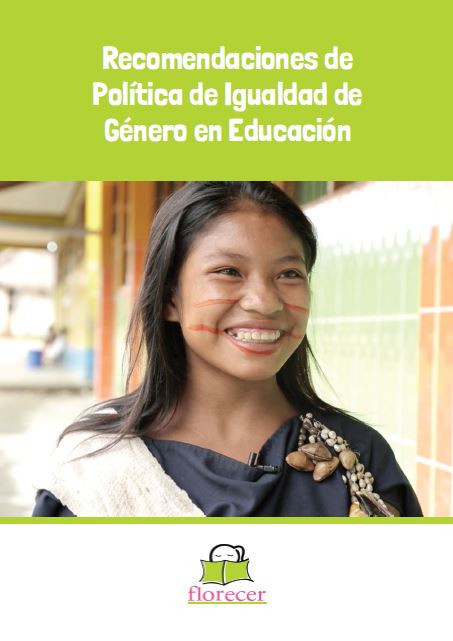 Recomendaciones de Política de Igualdad de Género en Educación Year of publication: 2015 Author: Teresa Tovar Samanez Corporate author: United Nations Children's Fund (UNICEF) Este documento sintetiza las propuestas de la Red Florecer para avanzar en la igualdad de género, porque estamos convencidas y convencidos de que la apuesta por un mundo más justo y más humano implica necesariamente por la asunción de la igualdad entre hombres y mujeres.
 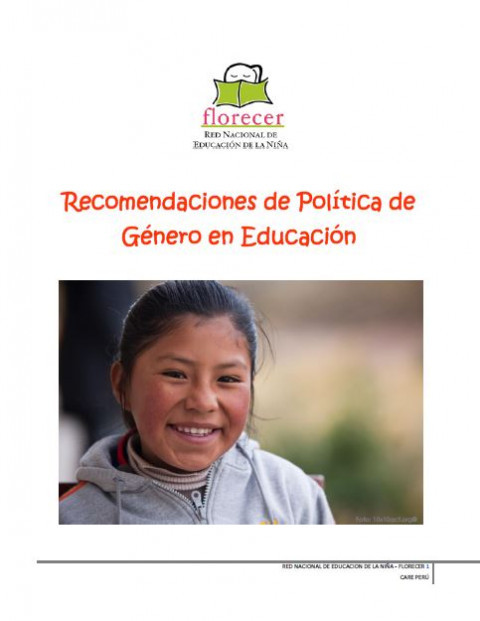 Gender Policy Recommendations in Education Year of publication: 2015 Corporate author: Red Nacional de Educación de la Niña This document synthesizes the proposals of the Florecer Network to advance in gender equality, convinced that the commitment to a more just and more human world necessarily involves the assumption of equality between men and women. The principle that the rights of women and girls are an integral, inalienable and indivisible part of universal human rights has been reaffirmed from the various international forums. Greater equity between men and women is also beneficial for the development of the country. A country with educated girls and women has a lower birth rate, improves their health and productivity conditions. This document synthesizes the main proposals of the Gender and Citizenship Forum: imperative for a quality education, organized by Red Florecer in May 2013 year. We want to put them in the hands of decision-makers and citizens in general to help concretize the mandates of equality between men and women in education. It is time not to give up dreams because they have become possible. Recomendaciones de Política de Género en Educación Year of publication: 2015 Corporate author: Red Nacional de Educación de la Niña Este documento sintetiza las propuestas de la Red Florecer para avanzar en la igualdad de género, convencidos de que la apuesta por un mundo más justo y más humano pasa necesariamente por la asunción de la igualdad entre hombres y mujeres. Desde los diversos foros internacionales se ha reafirmado el principio que los derechos de las mujeres y las niñas son parte integral, inalienable e indivisible de los derechos humanos universales. Una mayor equidad entre hombres y mujeres es además beneficiosa para el desarrollo del país. Un país con niñas y mujeres educadas tiene menor tasa de natalidad, mejora sus condiciones de salud y productividad.Este documento sintetiza las principales propuestas del Foro Género y Ciudadanía: imperativo para una educación de calidad, organizado por la Red Florecer en mayo del 2013 año. Queremos ponerlas en manos de los decisores y de la ciudadanía en general para contribuir a concretar los mandatos de igualdad entre hombres y mujeres en la educación. Es el momento de no desistir de los sueños porque estos se han tornado posibles.
  IX and X Days of Educational Cooperation with Iberoamerica on Special Education and Educational Inclusion Year of publication: 2015 Corporate author: UNESCO Santiago This publication includes the main presentations made by experts in educational inclusion presented at the IX and X Conference on Educational Cooperation with Ibero-America on special education and educational inclusion, held in Cartagena de Indias, Colombia (2012) and Santa Cruz, Bolivia ( 2013), respectively. The workshops have been organized by the Ministry of Education of Spain with the support of the Regional Office of Education for Latin America and the Caribbean (OREALC / UNESCO Santiago). We hope that this publication will contribute to the dissemination of the reflections that RIINEE has developed on critical issues in the field of the educational inclusion of people with disabilities and / or special educational needs, and in this way, constitute a contribution to advance in the guarantee of the rights indicated in the Convention on the Rights of Persons with Disabilities, approved in 2006 by the Member States of the United Nations Organization. IX y X Jornadas de Cooperación Educativa con Iberoamérica sobre Educación Especial e Inclusión Educativa Year of publication: 2015 Corporate author: UNESCO Santiago En esta publicación se incluyen las principales ponencias realizadas por personas expertas en inclusión educativa presentadas en las IX y X Jornadas de Cooperación Educativa con Iberoamérica sobre educación especial e inclusión educativa, realizadas en Cartagena de Indias, Colombia (2012) y Santa Cruz, Bolivia (2013), respectivamente. Las jornadas han sido organizadas por el Ministerio de Educación de España con el apoyo de la Oficina Regional de Educación para América Latina y el Caribe (OREALC/UNESCO Santiago). Esperamos que con esta publicación se contribuya a la difusión de las reflexiones que la RIINEE ha desarrollado sobre nudos críticos en el ámbito de la inclusión educativa de personas con discapacidades y/o necesidades educativas especiales, y de esta forma, constituya un aporte para avanzar en la garantía de los derechos señalados en la Convención sobre los Derechos de las Personas con Discapacidad, aprobada el año 2006 por los Estados Miembro de la Organización de las Naciones Unidas.
  Collected: Educational Project about “Learning from Biographies” in General Sciences in Primary School Year of publication: 2006 Author: A. Becher Original Title: Eingesammelt: Ein Unterrichtsprojekt zum‚ “Lernen an Biographien” im Sachunterricht der Grundschule(In D. Pech, M. Rauterberg, & K. Stocklas, (Eds.). Möglichkeiten und Relevanz der Auseinandersetzung mit dem Holocaust im Sachunterricht der Grundschule, Supplement 3, pp. 17–34) The article presents a project aimed at developing suitable methods for Holocaust Education already in the German primary school. Based on Ido Abram’s three-step-program as well as Wolfgang Klafki’s critical didactics, the project has developed a biographical approach to create possibilities for identification among the students. This is tested in a 3rd grade class and is thereafter evaluated.The above abstract is taken from the International Holocaust Remembrance Alliance Education Research Project. Please also consult the full list of abstracts in 15 languages and the accompanying publication Research in Teaching and Learning about the Holocaust: A Dialogue Beyond Borders. Ed: IHRA, Monique Eckmann, Doyle Stevick, Jolanta Ambrosewicz-Jacobs, 2017, Metropol Verlag at www.holocaustremembrance.com/resources/publications.
  Construction of Citizenship: Experience of Implementing an Index of Citizen Participation in Latin America Year of publication: 2006 Author: Isidro Adúriz | Pablo Ava Corporate author: Universidad de Salamanca The aim of this paper is to establish the main conceptual and methodological lines in order to carry out an investigation about levels and forms of citizen participation. This paper is the result of the formation of a Citizen Participation Index in Latin America in its 2005 edition. It was promoted by the Inter-American Network for Democracy and implemented by the Economic and Social Research Foundation. Construcción de Ciudadanía: Experiencia de Implementación de un Índice de Participación Ciudadana en América Latina Year of publication: 2006 Author: Isidro Adúriz | Pablo Ava Corporate author: Universidad de Salamanca El objetivo del presente documento es establecer los principales lineamientos conceptuales y metodológicos para llevar a cabo una investigación que dé cuenta de los niveles y modalidades de participación ciudadana. El mismo está basado en la experiencia de la construcción del Índice de Participación Ciudadana en América Latina en su edición del año 2005 impulsado por la Red Interamericana para la Democracia e implementado por la Fundación de Investigaciones Económicas y Sociales.
  Anthropology of Citizenship? ... Ethnic. Under Construction from Latin America Year of publication: 2007 Author: Xochitl Leyva Solano The main argument of this article develops around the concept of citizenship which I will examine taking as a starting point contributions made in the fields of law studies, philosophy and anthropology. There have been considerable advances in the social sciences with the proposition and discussion of new composite concepts such as “multicultural citizenship”, “intercultural citizenship”, and “ethnic citizenship”. With “ethnic citizenship” in particular, scholars have been trying to respond to the history and nature of the demands, claims and struggles that indigenous organizations and communities, movements and their leaders have made in Latin America over the past three decades. ¿Who proposed this concept, and when, where and for what purposes was it developed? What are the advantages and limits of “ethnic citizenship”? Who is using this concept now and in what social and political contexts? This discussion leads me to ask whether it is possible to speak of an emerging, alternative Latin American model of interpretation. ¿Antropología de la Ciudadanía?... Étnica. En Construcción desde América Latina Year of publication: 2007 Author: Xochitl Leyva Solano En este artículo tomo como hilo conductor el concepto de ciudadanía haciéndolo cruzar desde los campos de interés propios del derecho y la filosofía hacia el de la antropología. Ello es posible hacerlo hoy gracias a que científicos sociales de varias latitudes han acuñado términos como “ciudadanía cultural”, “ciudadanía multicultural”, “ciudadanía intercultural” y “ciudadanía étnica”. Este último concepto ha sido acuñado atendiendo principalmente la historia y la naturaleza de las demandas, los reclamos y las luchas que han llevado a cabo, desde el último cuarto del siglo XX, las comunidades, líderes, organizaciones y movimientos indígenas de América Latina. ¿Quiénes lo acuñaron? ¿Cuándo, dónde y para qué? ¿Qué aportes y qué límites encontramos al usarlo? ¿Quiénes lo están utilizando y bajo qué contextos? Tomando como punto de partida dicho término ¿se podría hablar de la existencia de un modelo interpretativo alternativo, emergente y propiamente latinoamericano?