
Resources
Explore a wide range of valuable resources on GCED to deepen your understanding and enhance your research, advocacy, teaching, and learning.
3,433 Results found
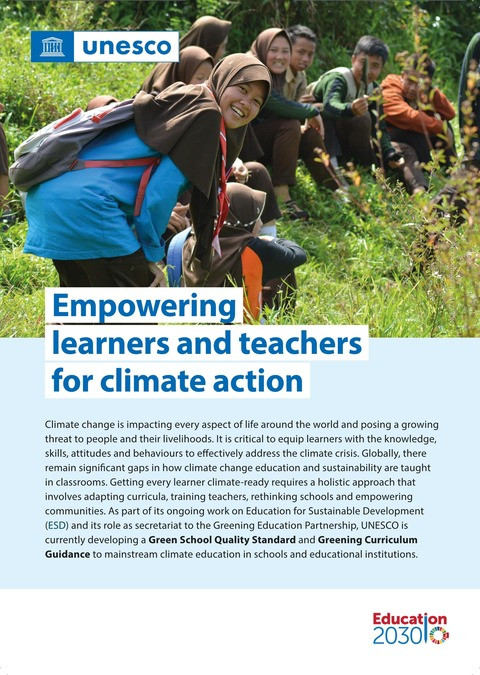 Empowering Learners and Teachers for Climate Action Year of publication: 2023 Corporate author: UNESCO Climate change is impacting every aspect of life around the world and posing a growing threat to people and their livelihoods. It is critical to equip learners with the knowledge, skills, attitudes and behaviours to effectively address the climate crisis. Globally, there remain significant gaps in how climate change education and sustainability are taught in classrooms. Getting every learner climate-ready requires a holistic approach that involves adapting curricula, training teachers, rethinking schools and empowering communities. As part of its ongoing work on Education for Sustainable Development (ESD) and its role as secretariat to the Greening Education Partnership, UNESCO is currently developing a Green School Quality Standard and Greening Curriculum Guidance to mainstream climate education in schools and educational institutions.
  The Climate Dictionary: Speak Climate Fluently Year of publication: 2023 Corporate author: United Nations Development Programme (UNDP) The Climate Dictionary is a guide to understanding climate change. It aims to bridge the gap between complex scientific jargon and the general public, making climate concepts accessible and understandable to people of different backgrounds and levels of expertise. It is based on the belief that empowering people with knowledge is crucial to fostering collective action and responsibility in the face of climate change. Using a creative combination of engaging images, concise explanations and engaging storytelling, The Climate Dictionary effectively communicates complex climate concepts in a visual and easy-to-consume way. El diccionario climático: Una guía práctica para el cambio climático Year of publication: 2023 Corporate author: United Nations Development Programme (UNDP) El Diccionario Climático es una guía para entender el cambio climático. El objetivo de la misma es tender un puente entre la compleja jerga científica y el público en general, haciendo que los conceptos sobre el clima sean accesibles y comprensibles para personas de distintos orígenes y niveles de especialización. Se basa en la creencia de que dotar a la gente de conocimientos es crucial para fomentar la acción y la responsabilidad colectiva frente al cambio climático. Utilizando una combinación creativa de imágenes atractivas, explicaciones concisas y una narración interesante, El Diccionario Climático comunica con eficacia conceptos complejos sobre el clima de una manera visual y fácil de consumir.
  الإرشادات التوجيهية لتخضير مناهج التعليم والتعلّم من أجل العمل المناخيّ Year of publication: 2024 Corporate author: UNESCO This Guidance responds to the calls from young people for a holistic approach to climate change and sustainability in the curriculum. It outlines a common language on how quality climate change and sustainability can be reflected in the curriculum by setting expected learning outcomes per age group (from 5-year olds and up to 18+ age group, including a lifelong learning approach).This is crucial for accelerating country-level action and ensuring joint monitoring of progress. The objective is to have 90 per cent of all countries include climate change in their curricula by 2030, as established by the Greening Education Partnership.This Guidance aims to support countries, schools or individual practitioners in reassessing their ongoing practices to adopt a more action-oriented, holistic, scientifically accurate, justice-driven and lifelong learning approach to climate change.
 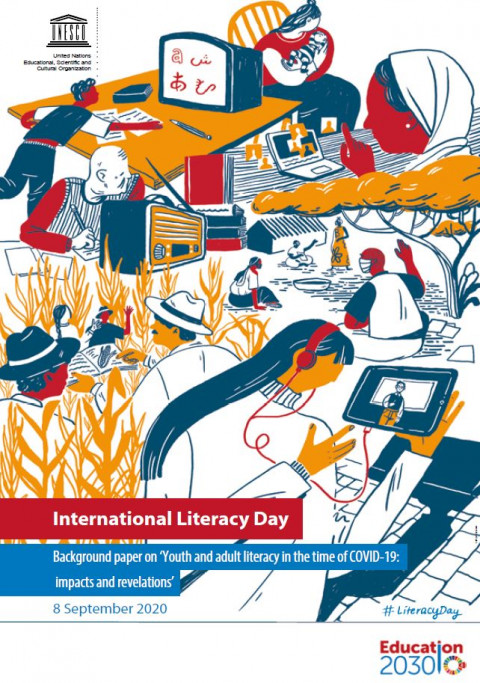 International Literacy Day: Background Paper on 'Youth and Adult Literacy in the Time of COVID-19; Impacts and Revelations' Year of publication: 2020 Corporate author: UNESCO Specially prepared on the occasion of International Literacy Day 2020, this background paper illustrates the impact of the COVID-19 crisis on youth and adult literacy, based on the limited information that is currently available. It provides five regional snapshots and identifies preliminary lessons learned thus far, while aiming to inspire continued reflection and subsequent action. It also makes the case for the ongoing importance of advancing youth and adult literacy, a priority that was already neglected even before the pandemic but which deserves all our attention. ILD 2020 thus seeks to trigger reimaginations of literacy teaching and learning in the COVID-19 crisis and beyond, with a particular focus on the role of educators.
  In the Age of Lifelong Education, a Study on the Meaning of Teachers: Focused on the Plato’s Thought (The Journal of Korean Teacher Education; Vol. 36, No. 3) Year of publication: 2019 Author: 허지숙 Corporate author: 한국교원교육학회 The purpose of this study is to explore the essential meaning and role of teachers through Plato's educational thought. For this purpose, based on the four principles of UNESCO Lifelong Education, we examine how changes in and out of school and the role of teachers are required. Then, after reviewing Sophist, Socrates, Plato's Philosopher, and the metaphors of Cave from Plato's point of view, it reveals what meaning and value of the teacher image presented by Plato in today's lifelong education.Research shows that the role of teachers in the age of lifelong education is becoming more and more important, but this does not mean simply changing roles as guides and advisors. the changed face of the teacher is an ethical trainer to enrich their lives from a knowledge transferer, a collaborative learner through conversations and discussions outside the teacher-student relationship, a practitioner of inclusive teaching among learning alienation, learning inequality, a teacher as a lifelong learner who loves wisdom. This suggests implications for teachers 'new possibilities and meanings beyond the existing teacher' s role in the fall of the ruling right and the right of learning. 평생교육시대, 교사의 의미 탐색: 플라톤의 교육사상을 중심으로 (한국교원교육연구 제36권 제3호) Year of publication: 2019 Author: JiSuk Huh Corporate author: Korean Society for the Study of Teacher Education 본 연구는 평생교육시대의 변화에 부합하는 교사의 모습에 대한 재탐색이 필요하다는 문제의식 하에, 플라톤의 교육사상을 중심으로 교사의 본질적 의미와 역할에 대해 탐구하는데 목적이 있다. 이를 위해 먼저 UNESCO 평생교육의 네 가지 원리를 근거로 학교의 안팎의 변화와 교사의 역할이 어떻게 요구되고 있는지를 고찰하였다. 다음으로 플라톤의 관점에서 바라본 소피스트, 소크라테스, 플라톤의 철인, 동굴의 비유에 대해 살펴본 후, 플라톤이 제시한 교사상이 오늘날 평생교육시대에서 어떤 의미와 가치가 있는지 밝히고, 그 속에 내포된 교사로서의 역할과 의미를 구체적으로 탐색하였다.연구결과, 평생교육시대의 교사의 역할은 점점 더 중요해지고 있으나 이는 단순히 안내자, 조언자로서의 단순한 역할 변화를 의미하는 것이 아니다. 평생교육시대 교사의 변화된 모습은 지식전달자로부터 삶을 풍성하게 살아가기 위한 윤리적 훈련가로, 교사-학생의 관계에서 벗어나 대화와 토론을 통한 공동의 학습자로, 학습소외, 학습 불평등 가운데 포용적 교수의 실천가로, 열망을 가지고 끊임없이 배우는 생성적 존재로 모색된다. 이를 통해 오늘날 추락하는 교권과 학습권의 자리다툼 가운데 기존 교사의 역할을 넘어 교사가 지닌 새로운 가능성과 의미에 대해 시사점을 제안하였다.
  Teaching Students How to Learn: Setting the Stage for Lifelong Learning (Educational Practices Series No. 33) Year of publication: 2021 Author: Stella Vosniadou | Michael J. Lawson | Helen Stephenson | Erin Bodner Corporate author: UNESCO International Bureau of Education (IBE) | International Academy of Education In this Teaching How to Learn booklet, teachers can find information about some of the cognitive, metacognitive, emotional, and motivational capabilities that characterise self-regulated learners, and some of the actions that teachers can take to promote self-regulated learning in their students. These include giving students time to engage in constructive tasks independently or in collaboration with their peers and providing them with the knowledge and strategies that they can use to manage their learning and control their motivation and emotions while they complete these tasks successfully.
  AI Competency Framework for Students Year of publication: 2024 Author: Fengchun Miao | Kelly Shiohira Corporate author: UNESCO Artificial intelligence is increasingly integral to our lives, necessitating proactive education systems to prepare students as responsible users and co-creators of AI. Integrating AI learning objectives into official school curricula is crucial for students globally to engage with AI safely and meaningfully.The UNESCO AI Competency Framework for Students aims to help educators in this integration, outlining 12 competncies across four dimensions:- A human-centred mindset- Ethics of AI- AI techniques and applications- AI system designThese competencies span three progression levels:- Understand- Apply- Create The framework details curricular goals and domain-specific pedagogical methodologies.Grounded in the vision of students as AI co-creators and responsible citizens, the publication emphasizes critical judgement of AI solutions, awareness of citizenship responsibilities in the AI era, foundational AI knowledge for lifelong learning, and inclusive, sustainable AI design.
  AI Competency Framework for Students Year of publication: 2025 Author: Fengchun Miao | Kelly Shiohira Corporate author: UNESCO Préparer les apprenants à devenir des citoyens responsables et créatifs à l’ère de l’IAL’intelligence artificielle (IA) fait tous les jours davantage partie intégrante de nos vies, ce qui implique d’avoir des systèmes éducatifs proactifs en mesure de préparer les élèves et les étudiants à être des utilisateurs responsables et des cocréateurs de l’IA. L’intégration d’objectifs d’apprentissage de l’IA dans les programmes scolaires officiels est essentielle pour que les apprenants du monde entier puissent s’intéresser en toute sécurité et de manière pertinente à l’IA.Le Référentiel de compétences en IA pour les apprenants de l’UNESCO vise à aider les éducateurs dans cette démarche, en décrivant 12 compétences réparties en quatre dimensions, à savoir une perspective centrée sur l’humain, l’éthique de l’IA, les techniques et applications de l’IA, et la conception de systèmes d’IA. Ces compétences se déploient selon trois niveaux de progression : Comprendre, Appliquer et Créer. Le référentiel détaille les objectifs du programme d’études et les méthodes pédagogiques spécifiques au domaine.Fondé sur une vision des élèves et des étudiants considérés comme cocréateurs de l’IA et citoyens responsables, le référentiel met l’accent sur le jugement critique vis-à-vis des solutions d’IA, la prise de conscience des responsabilités citoyennes à l’ère de l’IA, les connaissances fondamentales en matière d’IA pour l’apprentissage tout au long de la vie, ainsi que la conception d’une IA inclusive et durable.