
Resources
Explore a wide range of valuable resources on GCED to deepen your understanding and enhance your research, advocacy, teaching, and learning.
3,376 Results found
 Schools and war: urgent agendas for comparative and international education Year of publication: 2005 Author: Lynn Davies Corporate author: Taylor & Francis This paper looks first at the contributions that education makes to conflict, through the reproduction of inequality and exclusion, through perpetuation of ethnic or religious divisions, through its acceptance of dominant aggressive masculinities, through selection, competition and fear, and through distorted curricular emphases on narrow cognitive areas of learning. However, the paper also outlines some ‘possibilities for hope’, such as resilient schools, the impact of peace education initiatives and the rise of global citizenship education.
  Final report of the roundtable: challenges of education for peace, intercultural and inter-religious dialogue in Georgia, Armenia and Azerbaijan Year of publication: 2007 Corporate author: Union Century 21 (Georgia) The Roundtable Meeting was organized in Tbilisi in June, (24 -27) 2007. The meeting gathered participants of the ToT course in all three countries of the Caucasus, which happened to be a sort of “première” given the region’s tensions. It was important to bring together teachers and social workers from 18 regions of Georgia as well as from the neighboring countries like Azerbaijan and Armenia ( a total amount of 40 persons (some travelled at their own expenses). Civil Society was thus well represented and will be involved in project realization with a multiplier effect once they get back to the regions or countries. The tentative programme of the meeting identifies common challenges in this field and setting up of common action plan in addressing them. This was possible with the notable participation of a facilitator and the openness of those who attended this workshop. They were also keen to draw attention to the authorities from their educational systems to implement these grassroots activities so as to attract attention not only on a regional level but on the international level too and inform international organizations about the outcomes as well as the further steps planned. Inter-agency peace education programme: skills for constructive living; overview of the programme Year of publication: 2005 Author: Antonella Verdiani Corporate author: UN. Office of the United Nations High Commissioner for Refugees (UNHCR) | Inter-agency Network for Education in Emergencies (INEE) This manual is one of the components of the “Inter-Agency Peace Education Programme”. The programme is designed for education managers of ministries dealing with both formal and non-formal education and for agencies which implement education activities on behalf of the government. The implementation structure is based on the experience acquired over the eight years the programme has been in use, from 1998 to 2005. The programme has been evaluated by external experts and the new revised materials (2005) incorporate both the suggestions made in the evaluation and the feedback from the specialists who implemented it in the field. Programme Interinstitution d'éducation pour la paix: compétences pour la vie constructive; aperçu du programme Year of publication: 2005 Author: Antonella Verdiani Corporate author: UN. Office of the United Nations High Commissioner for Refugees (UNHCR) | Inter-agency Network for Education in Emergencies (INEE) Ce manuel est l'une des composantes du «Programme Interinstitution d'éducation pour la paix». Le programme est conçu pour les gestionnaires de l'éducation des ministères chargés de l'éducation formelle et non-formelle et pour les organismes qui mettent en œuvre des activités d'éducation au nom du gouvernement. La structure de mise en œuvre est basée sur l'expérience acquise au cours des huit années, le programme a été utilisé, de 1998 à 2005. Le programme a été évalué par des experts externes et les nouveaux matériaux révisés (2005) intègrent à la fois les suggestions formulées dans l'évaluation et les réactions des spécialistes qui œuvre dans le domaine.
 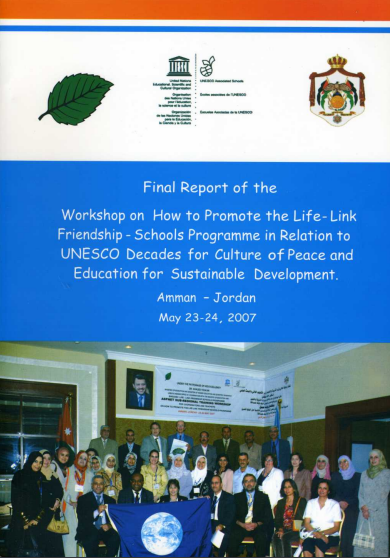 Final report of the workshop on how to promote the life-link friendship-schools programme in relation to UNESCO decades for culture of peace and education for sustainable development, Amman, Jordan, May 23-24, 2007 Year of publication: 2007 Corporate author: UNESCO Amman This chapter provides a brief summary of the speeches presented at the official opening and closing ceremonies as well as presentations delivered by the experts of Life-Link and UNESCO staff at the two day workshop The sub-regional workshop for ASPnet National Coordinators and Life-Link Friendship Schools Programme, organized in close collaboration with the Ministry of Education, was constructed according to the following format: (i). An organizing Committee was formed comprising of staff from the Ministry of Education and UNESCO Amman Office and Chairperson of Life-Link Programme. The committee oversaw the organization, preparation of documentation, venue, draft agenda, logistic and procedural aspects of the workshop. (ii). The selection of participants for the workshop was done by the National Commissions for UNESCO to Lebanon, Palestine, Iraq, Egypt, Oman and Jordan. The participating Arab Countries were selected by UNESCO Office-Amman and Life-Link. (iii).The selected participants comprised the National Coordinators and teachers for ASPnet in their countries. A member from Life-Link in Jordan was invited as an observer for the workshop. (iv).The resource persons (trainers) for the workshop were carefully selected on the basis of their expertise, experience and relevance to the main subjects of the workshop. The experts came from the Ministry of Education, Life-Link, UNESCO and UNRWA. (v). The format of the workshop was basically structured to firstly provide an overview and background of the Life-Link Friendship Schools Programme and ASPnet, followed by experts' presentations relevant to the main subjects of Life-Link Programme. The workshop also had three sessions of discussion on the different aspects of Life Link Programme. Participants were circulated to these sessions one after another. The workshop also had a session on how to plan for implementing peace actions as Extra Curricula Activities in schools. (vi). The ASPnet national workshop was organized under the patronage of his Excellency Dr. Khaled Toukan, the Minister of Education and the Minister of Higher Education & Scientific Research and Chairman of the Jordan National Commission for UNESCO. Rapport final de l'atelier sur la façon de promouvoir le programme de liaison de vie amitié écoles par rapport aux décennies UNESCO pour la culture de la paix et de l'éducation pour le développement durable, Amman, Jordanie, 23 au 24 mai 2007 Year of publication: 2007 Corporate author: UNESCO Amman Ce chapitre présente un bref résumé des discours présentés lors de l'ouverture officielle et de clôture ainsi que les présentations faites par les experts de Life-Link et personnel de l'UNESCO à l'atelier de deux jours. L'atelier sous-régional pour réseau des coordonnateurs nationaux et de Life-Link Programme des Écoles Amitié, organisée en étroite collaboration avec le Ministère de l'éducation, a été construit selon le format suivant: (i). Un comité d'organisation a été formé, comprenant des membres du personnel du ministère de l'Education et le Bureau UNESCO à Amman et présidente programme Life-Link. Le comité a supervisé l'organisation, la préparation de la documentation, le lieu, le projet de l'ordre du jour, la logistique et les aspects procéduraux de l'atelier. (Ii). La sélection des participants de l'atelier a été fait par les Commissions nationales pour l'UNESCO au Liban, en Palestine, en Irak, en Egypte, à Oman et en Jordanie. Les pays arabes participants ont été sélectionnés par l'UNESCO Bureau-Amman et Life-Link. (Iii). Les participants sélectionnés comprennent les coordonnateurs nationaux et les enseignants pour Réseau dans leur pays. Un membre de la Life-Link en Jordanie a été invité à titre d'observateur à l'atelier. (Iv). Les personnes ressources (formateurs) pour l'atelier ont été soigneusement sélectionnés sur la base de leur expertise, de l'expérience et de la pertinence des principaux sujets de l'atelier. Les experts provenaient du ministère de l'Education, Life-Link, l'UNESCO et l'UNRWA. (V). Le format de l'atelier a été essentiellement structuré pour fournir d'abord une vue d'ensemble et contexte de Life-Link Programme Amitié Ecoles et Reseau, suivie par les présentations des experts compétents pour les sujets principaux programme Life-Link de. L'atelier a également eu trois séances de discussion sur les différents aspects du Programme Life Link. Les participants ont été distribués à ces sessions un après l'autre. L'atelier a également eu une séance sur la façon de planifier la mise en œuvre des actions de paix en tant Activités extra curricula dans les écoles. (Vi). L'atelier national a été organisé reseau sous le patronage de son excellence Dr. Khaled Toukan, Ministre de l'Éducation et le Ministre de l'Enseignement Supérieur et de la Recherche et Président de la Commission Nationale Jordanienne pour l'UNESCO Scientifique. Schools and war: urgent agendas for comparative and international education Year of publication: 2005 Author: Lynn Davies Corporate author: Taylor & Francis Cet article examine en premier lieu les contributions de l'éducation aux conflits, à travers la reproduction de l'inégalité et de l’exclusion, la perpétuation des divisions ethniques ou religieuses, l’acceptation de la dominance de l’agressivité masculine ; à travers la sélection, la compétition et la peur, et à travers une déformation des programmes scolaires mettant l’accent sur des zones cognitives étroites de l'apprentissage. Toutefois, le document décrit également quelques « notes positives », telles que les écoles de la résilience, l'impact des initiatives de l'éducation à la paix et l’importance croissante donnée à l'éducation à la citoyenneté mondiale.
  Lessons Learned from Mental Health and Education: Identifying Best Practices for Addressing Violent Extremism Year of publication: 2015 Author: Stevan Weine | B. Heidi Ellis | Ron Haddad | Alisa B. Miller | Rebecca Lowenhaupt | Chloe Polutnik Corporate author: National Consortium for the Study of Terrorism and Responses to Terrorism (START) The overall purpose of this research was to identify assets from the mental health and education fields that could contribute to best practices for preventing and intervening against violent extremism. Specifically we aimed to address the following questions:1) What prior knowledge, programmes or interventions within the mental health and education fields could contribute to best practices and other strategies that could help stop violent extremism? 2) How can professionals from the mental health and education fields best become involved in stopping violent extremism? Lessons Learned from Mental Health and Education: Identifying Best Practices for Addressing Violent Extremism Year of publication: 2015 Author: Stevan Weine | B. Heidi Ellis | Ron Haddad | Alisa B. Miller | Rebecca Lowenhaupt | Chloe Polutnik Corporate author: National Consortium for the Study of Terrorism and Responses to Terrorism (START) Il s’agit dans cette recherche d'identifier des ressources dans le domaine de l'éducation à la santé mentale qui pourraient contribuer aux meilleures pratiques dans la prévention et l'intervention contre l'extrémisme violent. Plus précisément, les auteurs ont cherché à répondre aux questions suivantes : 1) Quelles sont les connaissances, les programmes ou les interventions requis dans le domaine de l'éducation à la santé mentale pouvant contribuer aux meilleures pratiques et autres stratégies dans la lutte contre l'extrémisme violent ? 2) Comment les professionnels de l'éducation à la santé mentale peuvent s’impliquer davantage dans la lutte contre l'extrémisme violent ?
  Education Reform in Pakistan Year of publication: 2014 Corporate author: International Crisis Group In April 2010, the eighteenth constitutional amendment committed Pakistan to free and compulsory education for all children between the ages of five and sixteen. Yet millions are still out of school, and the education system remains alarmingly impoverished. The madrasa (religious school) sector flourishes, with no meaningful efforts made to regulate the seminaries, many of which propagate religious and sectarian hatred. Militant violence and natural disasters have exacerbated the dismal state of education. The public education system needs to foster a tolerant citizenry, capable of competing in the labour market and supportive of democratic norms within the country and peace with the outside world.