
Resources
Explore a wide range of valuable resources on GCED to deepen your understanding and enhance your research, advocacy, teaching, and learning.
3,451 Results found
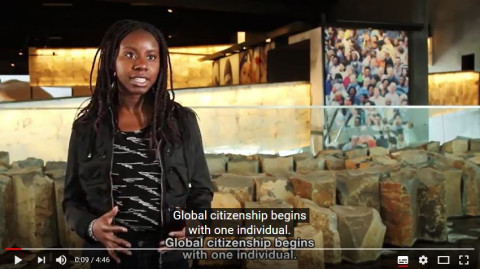 [Vidéo] Citoyenneté mondiale: citoyens du monde au 21e siècle Year of publication: 2016 Corporate author: Canadian Commission for UNESCO Des participants de la Conférence nationale des écoles UNESCO se sont exprimés sur la définition de la citoyenneté mondiale et sur les qualités d'un citoyen du monde. L’événement avait lieu dans le cadre de la 56e Assemblée générale annuelle de la Commission canadienne pour l’UNESCO et avait pour but de promouvoir le rôle de chef de file de l'UNESCO dans l'Agenda 2030 pour l'éducation. Cette vidéo a été produite au Musée canadien pour les droits de la personne, à Winnipeg, au Manitoba.
 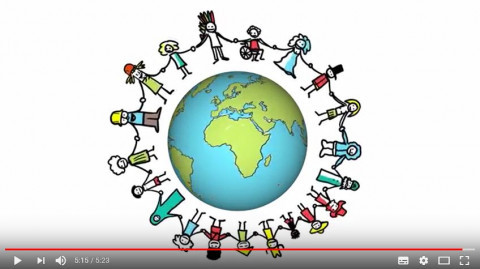 [Vidéo] L'éducation à la citoyenneté mondiale et solidaire Year of publication: 2015 Corporate author: Îles de Paix Iles de Paix a produit ce petit film pour présenter ce qu’est l’éducation à la citoyenneté mondiale et solidaire aux futurs enseignants. Ceux-ci n’ont toutefois pas le monopole de l’action en cette matière. Chacun – qu’il soit enseignant ou non – peut en prendre connaissance avant d’agir, agir, et encore agir, sans relâche.
  Mission Impossible? Creating a Monitoring Framework for Education for Global Citizenship Year of publication: 2015 Author: Amy Skinner Corporate author: Éducation des Adultes et Développement Global Citizenship Education (GCED) must be understood as a complex and multilayered process. It can be a force for transformation on the personal, local and system level. It would be a great help to be able to monitor the impact of GCED taking this complexity into account. The article presents some research results on monitoring and explains the challenges in setting up a monitoring framework. ¿Misión imposible? Crear un marco de seguimiento destinado a la educación para la ciudadanía mundial Year of publication: 2015 Author: Amy Skinner Corporate author: Éducation des Adultes et Développement La educación para la ciudadanía mundial (ECM) debe entenderse como un proceso complejo y de varios niveles. Puede ser una fuerza de transformación a nivel personal, local y sistémico. Sería muy útil poder realizar un seguimiento del impacto de la ECM, teniendo en cuenta su complejidad. En el artículo se presentan algunas conclusiones de investigaciones sobre el seguimiento, y se explican los desafíos que plantea la creación de un marco para llevarlo a cabo.
  La citoyenneté des adolescents du 21e siècle dans une perspective de justice sociale : pourquoi et comment ? Year of publication: 2018 Author: Caroline Caron Corporate author: Lien social et Politiques Comment sait-on ce que l’on sait sur la citoyenneté des adolescents et leurs pratiques de participation civique ? Cette question épistémologique a été négligée dans les écrits traitant de l’engagement civique et de la participation politique des jeunes. Cet article utilise la perspective théorique de la justice sociale pour examiner le rôle que jouent les rapports sociaux fondés sur l’âge dans la production de connaissances qui offrent un portrait pessimiste du rapport des jeunes à la politique. L’analyse montre que l’injustice épistémique et la validation empirique déficiente des connaissances à propos de la compétence civique appellent une théorisation alternative, précisément inclusive, de la citoyenneté des jeunes. L’analyse souligne aussi que l’avènement du Web social a créé de nouveaux besoins de connaissances que les cadres de recherche établis par tradition peinent à satisfaire. Un premier pas vers la production de connaissances socialement justes au sujet des compétences civiques des adolescents à l’ère du Web social consiste à analyser les fondements épistémologiques des approches de recherche prédominantes afin de susciter des échanges fructueux au sujet des critères normatifs qui devraient guider la confection des protocoles de recherche dans le futur.
  Authentic Pedagogy and the Holocaust: A Critical Review of State Sponsored Holocaust Curricula Year of publication: 2005 Author: Samuel Totten | Karen L. Riley Over the past decade and a half, states in all regions of the United States have formed Holocaust councils, advisory groups, and other agencies for the purpose of developing educational programs in response to a growing interest in the Holocaust. Some states have called upon educators and Holocaust agencies within the state to develop curricula and/or resource materials for use in social studies and English classrooms. Furthermore, many states now either strongly recommend the teaching of the Holocaust or mandate that it be taught in their public schools. In the present paper, we present a critical analysis of the instructional strategies advocated in state–sponsored Holocaust curricula. We ground our evaluation within the framework of authentic pedagogy—particularly the work of Fred Newmann. More than an attempt to simply criticize these works, we offer constructive alternatives to inadequate and/or poorly designed instructional strategies. Fundamental to the intent of this paper is its usefulness as a guide for evaluating instructional activities designed to support the teaching of content knowledge about the Holocaust. (By the author)
 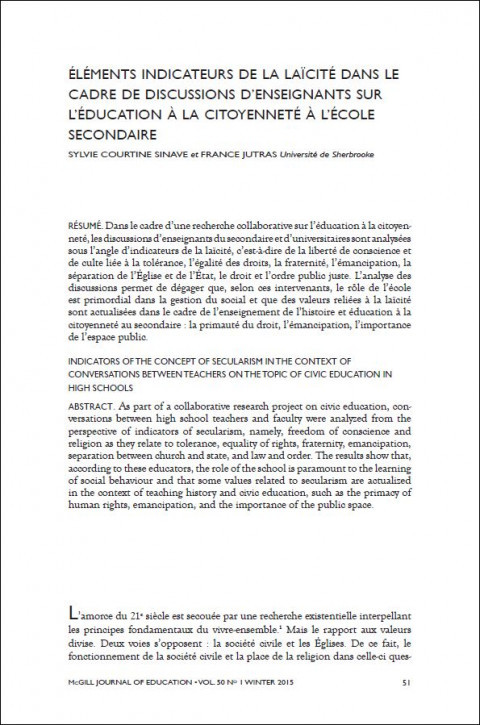 Indicators of the Concept of Secularism in the Context of Conversations Between Teachers on the Topic of Civic Education in High Schools Year of publication: 2015 Author: Sylvie Courtine Sinave | France Jutras Corporate author: McGill University. Faculty of Education As part of a collaborative research project on civic education, conversations between high school teachers and faculty were analyzed from the perspective of indicators of secularism, namely, freedom of conscience and religion as they relate to tolerance, equality of rights, fraternity, emancipation, separation between church and state, and law and order. The results show that, according to these educators, the role of the school is paramount to the learning of social behaviour and that some values related to secularism are actualized in the context of teaching history and civic education, such as the primacy of human rights, emancipation, and the importance of the public space. Éléments indicateurs de la laïcité dans le cadre de discussions d’enseignants sur l’éducation à la citoyenneté à l’école secondaire Year of publication: 2015 Author: Sylvie Courtine Sinave | France Jutras Corporate author: McGill University. Faculty of Education Dans le cadre d’une recherche collaborative sur l’éducation à la citoyenneté, les discussions d’enseignants du secondaire et d’universitaires sont analysées sous l’angle d’indicateurs de la laïcité, c’est-à-dire de la liberté de conscience et de culte liée à la tolérance, l’égalité des droits, la fraternité, l’émancipation, la séparation de l’Église et de l’État, le droit et l’ordre public juste. L’analyse des discussions permet de dégager que, selon ces intervenants, le rôle de l’école est primordial dans la gestion du social et que des valeurs reliées à la laïcité sont actualisées dans le cadre de l’enseignement de l’histoire et éducation à la citoyenneté au secondaire : la primauté du droit, l’émancipation, l’importance de l’espace public. Thinking Today’s Adolescents’ Citizenship through Social Justice Lens: Why and How? Year of publication: 2018 Author: Caroline Caron Corporate author: Lien social et Politiques How do we know what we know about youth citizenship ? This epistemological question has been neglected in the field of youth citizenship and public discourses on youth political apathy. This article draws on the theoretical perspective of social justice studies to unmask the relations of power based on age that have shaped current knowledge about youth citizenship. The analysis draws attention to the epistemic injustices and methodological flaws in the specific field of civic literacy in Canada. It is argued that a difference-centered approach to youth citizenship could help foster a better understanding of youth experiences of civic engagement and political participation. Yet, this potentiel can only be achieved through a self-reflexive inquiry that critically investigates the research process itself in current research trends. Although a dominant approach in the study of civic literacy is limited in its capacity to produce knowledge that is socially just towards adolescents, the concept could be reinvigorated through a critical empirically-grounded examination of youth civic competencies that are evidenced in some of their engagments with new media technologies. Yet, to fulfill this goal also requires that scholars engage in crucial debates about their chosen epistemology and theory of democracy.
 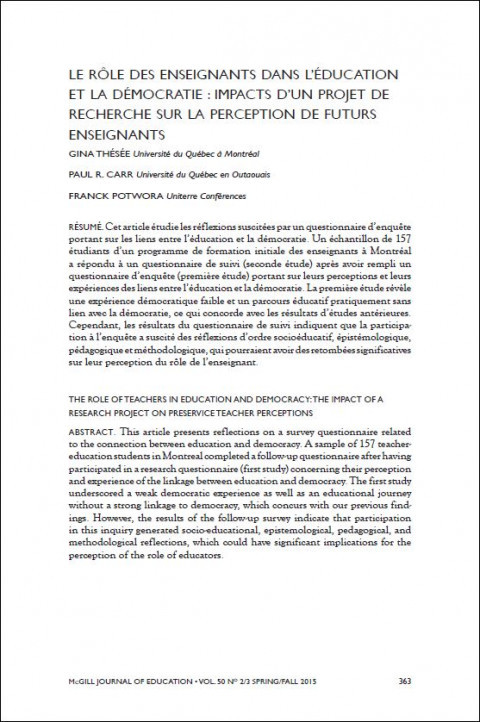 Le rôle des enseignants dans l’éducation et la démocratie : impacts d’un projet de recherche sur la perception de futurs enseignants Year of publication: 2015 Author: Gina Thésée | Paul R. Carr | Franck Potwora Corporate author: McGill University. Faculty of Education Cet article étudie les réflexions suscitées par un questionnaire d’enquête portant sur les liens entre l’éducation et la démocratie. Un échantillon de 157 étudiants d’un programme de formation initiale des enseignants à Montréal a répondu à un questionnaire de suivi (seconde étude) après avoir rempli un questionnaire d’enquête (première étude) portant sur leurs perceptions et leurs expériences des liens entre l’éducation et la démocratie. La première étude révèle une expérience démocratique faible et un parcours éducatif pratiquement sans lien avec la démocratie, ce qui concorde avec les résultats d’études antérieures. Cependant, les résultats du questionnaire de suivi indiquent que la participation à l’enquête a suscité des réflexions d’ordre socioéducatif, épistémologique, pédagogique et méthodologique, qui pourraient avoir des retombées significatives sur leur perception du rôle de l’enseignant.