
Resources
Explore a wide range of valuable resources on GCED to deepen your understanding and enhance your research, advocacy, teaching, and learning.
3,229 Results found
 Ending Learning Poverty : What Will It Take? Year of publication: 2019 Corporate author: World Bank In recent years, it has become clear that many children around the world are not learning to read proficiently. As a major contributor to human capital deficits, the learning crisis undermines sustainable growth and poverty reduction. To spotlight this crisis, we are introducing the concept of Learning Poverty, drawing on new data developed in coordination with the UNESCO Institute for Statistics.
  National Reforms of the Higher Education in Uzbekistan Year of publication: 2019 Author: G. Burkhonova This article addresses the issues of national reform of higher education in Uzbekistan. The author of the article believes that the reforms will lead to the further development of the education system as an important factor in the country's prosperity, sustainable economic growth, and employment. Национальные реформы высшего образования Узбекистана Year of publication: 2019 Author: G. Burkhonova Данная статья рассматривает вопросы национальных реформ высшего образования Узбекистана. Автор статьи считает, что реформы приведут к дальнейшему развитию системы образования как важнейшего фактора процветания страны, устойчивого роста экономики, обеспечения занятости населения.
  Противодействие насильственному экстремизму: Вводное руководство по концепциям, разработке программ и передовой практике Year of publication: 2019 Corporate author: Search for Common Ground Данная учебная программа направлена актуализацию передовых методов и опыта, накопленного в процессе противодействия насильственному экстремизму. Программа по противодействию насильственному экстремизму, адаптированная для Центральной Азии, предназначена для подготовки государственных служащих и работников из организаций гражданского общества. Это контекстуально грамотная и удобная для восприятия учебная программа по противодействию насильственному экстремизму и повышению осведомленности, учитывающая вашу специфику. В ней освещаются преимущества подходов к сотрудничеству, выходящих за рамки применения военных или секьюритизированных мер реагирования на насильственный экстремизм и подкрепленных передовой практикой, а также предлагаются инструменты и рекомендации для простойадаптации к вашим локальным условиям и культуре. Наконец, программа способствует раннему выявлению и смягчению рисков посредством разработки программ, а также использования подхода «Не навреди» (Do No Harm).Данная программа предлагает руководство по разработке, реализации и мониторингу конструктивных мер противодействия насильственному экстремизму, при этом также давая общее представление об управлении проектами. Таким образом, данная учебная программа не направлена на развитие общих навыков управления проектами, мониторинга и оценки или на привлечение средств. Поскольку проблема насильственного экстремизма сложна и в значительной степени зависит от локального контекста, программа также не является руководством по движущим силам радикализации в вашем местном контексте и не предлагает программы и политику, которые могли бы быть наиболее эффективными. Вместо этого программа познакомит вас с наводящими вопросами и инструментами, необходимыми для принятия обоснованных и эффективных решений в вашей работе по противодействию насильственному экстремизму.
  Accountability for Gender Equality Year of publication: 2018 Author: Elaine Unterhulter | Amy North | Orlanda Ward The aim of this paper is to consider approaches to understanding and evaluating accountability in education from the perspective of concerns with gender equality in education. This task has a number of facets and complexities, because ‘gender’ is not one simple set of relationships, and the notion of gender equality in education can be read in a number of different ways. Thus developing adequate conceptualizations for the key terms (accountability, and gender equality and education) needs to take account of gender as a particularly fluid, contextually located and contested idea signaling processes, which link with different formulations of policy and practice to enhance gender equality and accountability in education.In this paper we look at a range of different meanings of accountability, distilled in the main GEM Report (UNESCO, 2017) and consider their implications in relation to debates about gender and gender equality in education. The aim of the paper is to develop a ‘bespoke’ interpretation of accountability and different forms of gender equality in education through which we can assess a number of research studies and country examples of forms of accountability.This paper is also background paper prepared for the 2018 Global education monitoring report gender review: Meeting our commitments to gender equality in education.
  The Lazy Person’s Guide to Saving the World Corporate author: United Nations (UN) End extreme poverty. Fight inequality and injustice. Fix climate change. Whoa. The Sustainable Development Goals are important, world-changing objectives that will require cooperation among governments, international organizations and world leaders. It seems impossible that the average person can make an impact. Should you just give up?No! Change starts with you. Seriously. Every human on earth—even the most indifferent, laziest person among us—is part of the solution. Fortunately, there are some super easy things we can adopt into our routines that, if we all do it, will make a big difference.Have a look at just a few of the many things you can do to make an impact!For more information: https://www.un.org/sustainabledevelopment/takeaction/
 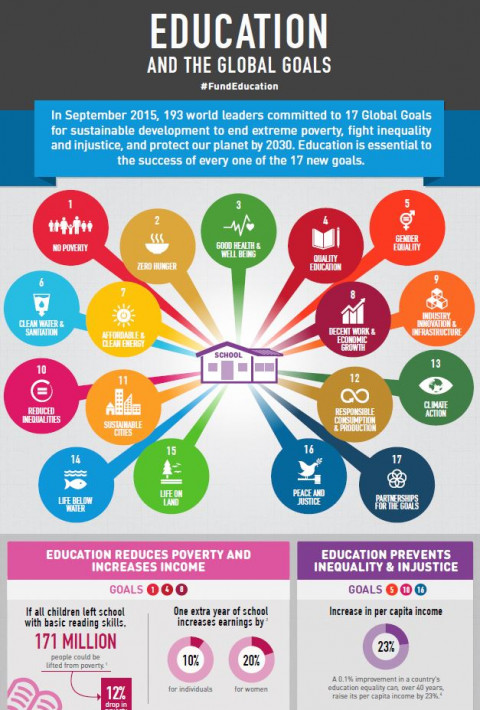 Education and the Global Goals Year of publication: 2015 Corporate author: Global Partnership for Education (GPE) In September 2015, 193 world leaders committed to 17 Global Goals for sustainable development to end extreme poverty, fight inequality and injustice, and protect our planet by 2030. Education is essential to the success of every one of the 17 new goals.To learn more: https://www.globalpartnership.org/blog/17-ways-education-influences-new-17-global-goals
 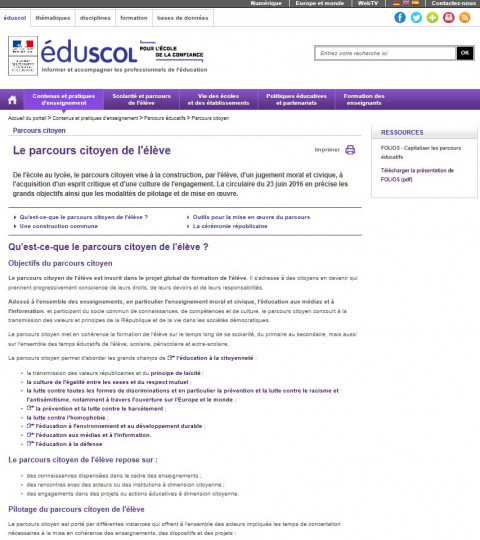 Le parcours citoyen de l'élève Year of publication: 2016 Corporate author: éducscol De l'école au lycée, le parcours citoyen vise à la construction, par l'élève, d'un jugement moral et civique, à l'acquisition d'un esprit critique et d'une culture de l'engagement. La circulaire du 23 juin 2016 en précise les grands objectifs ainsi que les modalités de pilotage et de mise en œuvre. Qu'est-ce-que le parcours citoyen de l'élève ? Une construction commune Outils pour la mise en œuvre du parcours La cérémonie républicaine
  Éducation à la citoyenneté mondiale : Un guide pédagogique Year of publication: 2010 Corporate author: Fondation Éducation et Déveleoppement L’«éducation à la citoyenneté» a pour but d’enseigner les interdépendances mondiales en faisant des liens globaux. Les élèves étudient les différents aspects du même thème à travers les interdé-pendances, les intérêts divergents, les différentes perceptions et valeurs. Ils doivent être capables de se situer dans un monde globalisé et de développer leurs propres valeurs et attitudes. Le Guide d’éducation à la citoyenneté mondiale propose aux enseignant-e-s une méthode d’enseignement qui permettra à leurs élèves de comprendre les interdépendances mondiales.Les bases théoriques vous présentent le concept de l’éducation à la citoyenneté mondiale. Un guide didactique vous aide à préparer votre enseignement.Des exemples vous proposent des idées de mise en œuvre et du matériel pédagogique.
 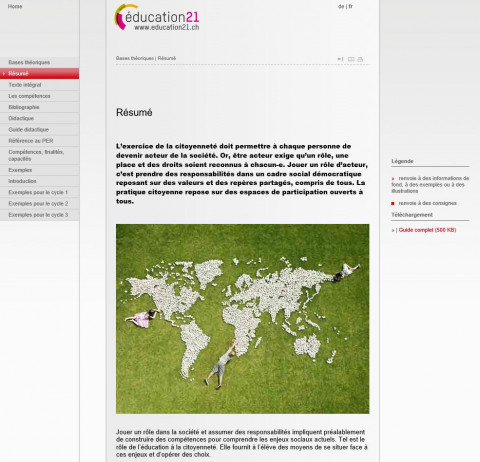 [Résumé] Éducation à la citoyenneté mondiale : Un guide pédagogique Corporate author: Éducation 21 L’exercice de la citoyenneté doit permettre à chaque personne de devenir acteur de la société. Or, être acteur exige qu’un rôle, une place et des droits soient reconnus à chacun-e. Jouer un rôle d’acteur, c’est prendre des responsabilités dans un cadre social démocratique reposant sur des valeurs et des repères partagés, compris de tous. La pratique citoyenne repose sur des espaces de participation ouverts à tous.