
Resources
Explore a wide range of valuable resources on GCED to deepen your understanding and enhance your research, advocacy, teaching, and learning.
1,451 Results found
 School Online Safety - Self review tool Year of publication: 2016 Corporate author: South West Grid for Learning Trust (SWGfL) Le Self Review Tool a pour objectif d'aider les écoles à réviser leurs politiques de sécurité en ligne et leurs pratiques actuelles. Cet outil contient des informations et des conseils de gestion qui peuvent influer sur la production ou la révision des politiques de sécurité en ligne et sur le développement de bonnes pratiques et processus permettant d’identifier les points forts et les faiblesses de ces systèmes. Il étudie également les possibilités d’engagement et d’implication pour l’ensemble de l’école, et la mise en place d’un espace de discussion en vue de passer d’une politique basique à des pratiques ambitieuses et innovantes.
  Initial findings from the IEA international civic and citizenship education study Year of publication: 2010 Author: Wolfram Schulz | John Ainley | Julian Fraillon | David Kerr | Bruno Losito Corporate author: International Association for the Evaluation of Educational Achievement (IEA) The International Civic and Citizenship Education Study (ICCS) studied the ways in which countries prepare their young people to undertake their roles as citizens. It investigated student knowledge and understanding of civics and citizenship as well as student attitudes, perceptions, and activities related to civics and citizenship. It also examined differences among countries in relation to these outcomes of civic and citizenship education, and it explored how differences among countries relate to student characteristics, school and community contexts, and national characteristics. ICCS considered six research questions concerned with the following:1. Variations in civic knowledge;2. Changes in content knowledge since 1999;3. Student interest in engaging in public and political life and their disposition to do so;4. Perceptions of threats to civil society;5. Features of education systems, schools, and classrooms related to civic and citizenship education; and6. Aspects of student background related to the outcomes of civic and citizenship education.ICCS gathered data from more than 140,000 Grade 8 (or equivalent) students in over 5,300 schools from 38 countries. These student data were augmented by data from more than 62,000 teachers in those schools and by contextual data collected from school principals and the study’s national research centers. Different approaches to provision of civic and citizenship education were evident in the ICCS countries. These approaches included having a specific subject, integrating relevant content into other subjects, and including content as a cross-curricular theme. Twenty-one of the 38 countries in ICCS included a specific subject concerned with civic and citizenship education in their curriculum. Civic and citizenship education covered a wide range of topics, including knowledge and understanding of political institutions and concepts, such as human rights, as well as newer topics covering social and community cohesion, diversity, the environment, communications, and global society. Les premiers résultats de l'étude de l'éducation civique et à la citoyenneté internationale AIE Year of publication: 2010 Author: Wolfram Schulz | John Ainley | Julian Fraillon | David Kerr | Bruno Losito Corporate author: International Association for the Evaluation of Educational Achievement (IEA) La Civic Internationale et la Citoyenneté Étude sur l'Éducation (CICÉ) ont étudié les façons dont les pays préparent leurs jeunes à assumer leur rôle en tant que citoyens. Il a étudié les connaissances des élèves et la compréhension de l'éducation civique et la citoyenneté ainsi que les attitudes des élèves, les perceptions et les activités liées à l'éducation civique et la citoyenneté. Il a également examiné les différences entre les pays par rapport à ces résultats de l'éducation civique et à la citoyenneté, et il a exploré comment les différences entre les pays se rapportent aux caractéristiques des élèves, des contextes scolaires et communautaires, et des caractéristiques nationales. CICÉ a examiné six questions de recherche concernés par les suivants: 1. Les variations de connaissances civiques; 2. Modifications de contenu des connaissances depuis 1999; 3. l'intérêt des étudiants dans l'engagement dans la vie publique et politique et leur disposition à le faire; 4. Les perceptions des menaces pour la société civile; 5. Caractéristiques des systèmes d'éducation, les écoles et les salles de classe liées à l'éducation civique et à la citoyenneté; et 6. Les aspects de fond de l'étudiant en rapport avec les résultats de l'éducation civique et à la citoyenneté. CICÉ a recueilli des données provenant de plus de 140.000 8 e année (ou l'équivalent) étudiants dans plus de 5300 écoles de 38 pays. Ces données sur les élèves ont été complétées par des données provenant de plus de 62.000 enseignants dans les écoles et par des données contextuelles recueillies auprès des directeurs d'écoles et de centres de recherche nationaux de l'étude. Différentes approches de l'éducation civique et à la citoyenneté étaient évidentes dans les pays CICÉ. Parmi ces approches ayant un sujet spécifique, intégrant un contenu pertinent dans d'autres matières, et y compris le contenu en tant que thématique transversale. Vingt et un des 38 pays de CICÉ inclus un sujet spécifique concerné par l'éducation civique et à la citoyenneté dans leur curriculum. Éducation civique et à la citoyenneté ont couvert un large éventail de sujets, y compris la connaissance et la compréhension des institutions et des concepts politiques, tels que les droits de l'homme, ainsi que de nouveaux sujets couvrant la cohésion sociale et de la communauté, la diversité, l'environnement, les communications, et de la société mondiale.
  Discrimination, Mobbing and Equality Corporate author: Amnesty International. Swiss Section These 7 education sheets(Stereotypes and Discrimination, Occupational Inequalities, Discrimination in Job Searching, Let’s Talk about Mobbing!, Conflict or Mobbing?, Declaration against Mobbing at School, Freedom from Discrimination) cover the themes of discrimination, equality and mobbing(conflictual relations in the workplace, both between colleagues and between superiors and subordinates), in relation to article 2 of the Universal Declaration of Human Rights. Discrimination, mobbing et égalité Corporate author: Amnesty International. Swiss Section Ces 7 fiches pédagogiques(Stéréotypes et discrimination, Inégalités professionnelles, Discrimination dans la recherche d'emploi, Parlons mobbing!, Conflit ou mobbing? Déclaration contre le mobbing à l'école, Freedom from discrimination) portent sur les thématiques de la discrimination, de l'égalité et du mobbing (relation conflictuelle sur le lieu de travail, aussi bien entre collègues qu'entre supérieurs et subordonnés), en lien avec l'article 2 de la Déclaration universelle des droits de l’homme.
  Moldova SDG Push Framework: Unlocking New Pathways to SDG Acceleration Year of publication: 2024 Corporate author: United Nations Development Programme (UNDP) SDG Push is about realizing development ambition and redefining how we build acceleration pathways. It helps pinpoint policy choices that ‘move the needle’ towards the achievement of the Sustainable Development Goals. A UNDP flagship initiative, SDG Push uses digital and data innovation, systems thinking, and futures approaches to provide a comprehensive and country-specific tool to plan and implement SDG breakthroughs in a variety of development contexts. SDG Acceleration Pathways, specific to context and need, were co-created in collaboration with Indonesia, Moldova, Namibia, Peru and South Africa. These pilots helped to refine the SDG Push approach and the digital SDG Push Diagnostic and formed the foundation of the Integrated SDG Insights Reports, presented at the 2023 SDG Summit. This integrated, modular approach includes the analysis of development trends and priorities with data visualization, integrating generative dialogue, foresight methods and economic modelling to assess the impact of potential accelerators.
 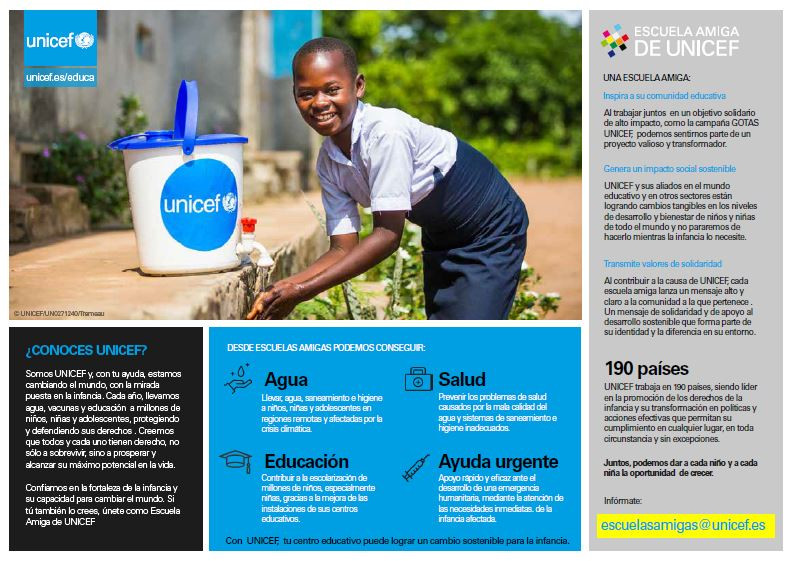 School Friend of UNICEF Year of publication: 2006 Corporate author: UNICEF Spain This infographic presents the program in which each school establishes a personalized commitment to UNICEF in the form of a collaboration agreement by which they undertake, depending on their circumstances, interests and capacity, to carry out different awareness-raising and fundraising activities throughout the school year. The activities can be framed within the GOTAS UNICEF school campaign or directed to an emergency humanitarian action campaign proposed by UNICEF. Escuela amiga de UNICEF Year of publication: 2006 Corporate author: UNICEF Spain Esta infografía presenta el programa en el que cada escuela amiga establece un compromiso personalizado con UNICEF en forma de convenio de colaboración por el que se compromete, en función de sus circunstancias, intereses y capacidad a la realización de diferentes actividades de sensibilización y captación de fondos a lo largo del curso escolar. Las actividades pueden enmarcarse dentro de la campaña escolar GOTAS UNICEF o dirigirse a una campaña de acción humanitaria de emergencias propuesta por UNICEF.
  A Training Manual: Women in Preventing and Countering Violent Extremism Year of publication: 2021 Author: Anne Speckhard Corporate author: United Nations Entity for Gender Equality and the Empowerment of Women (UN Women) This publication serves as guidance for actors involved in the prevention and countering of violent extremism (P/CVE) in Europe and Central Asia including state officials, members of non-governmental organizations, community activists, staff of UN agencies, international and regional organizations to help them understand violent extremism’s gender dimensions. It is designed as a training guide, for staff and trainers who are working with different counterparts engaged in P/CVE, and want to help create more effective and gender-sensitive responses. Participants may for example include civil society activists, women leaders, teachers, journalists, lawyers, social workers, religious authorities, youth, police, local and national governmental officials. The five modules in this guide include learning objectives, explanatory text, warm-up activities, practical exercises, references for further reading and empirical experiences from the region of Europe and Central Asia. Modules may be used all together or one-by-one. The ideal timeframe for delivering the training using all the modules is at least two and a half days (half day per unit). The training is suitable for groups of five to twenty-five people. When organizing the workshop consider gender, age and diversity factors to have the richest learning experience possible. Participants should feel that they are in a safe space where they can openly share their ideas and experiences. Needed materials are indicated for the different exercises. As the guide is aimed at increasing the awareness of persons with different levels of sensitivity and knowledge on violent extremism and gender equality, across Europe and Central Asia, it is an introduction which readers should complement with other resources for deeper and more technical insights. The training should also be tailored to the participants’ interests and needs and to the local context.
  A New Era for Girls: Taking Stock on 25 Years of Progress for Girls Year of publication: 2020 Corporate author: United Nations Children's Fund (UNICEF) | United Nations Entity for Gender Equality and the Empowerment of Women (UN Women) | Plan International The analysis presented in this report demonstrates that while girls' lives are better today than they were 25 years ago, the gains are uneven across all regions. The report calls on global, national and regional stakeholders to expand opportunities for girls and young women to be the changemakers and designers of the solutions to their challenges and opportunities; invest in the skills development of adolescent girls so they can compete in today's labour market; improve girls' health and nutrition; and end violence in all its forms against them.