
Resources
Explore a wide range of valuable resources on GCED to deepen your understanding and enhance your research, advocacy, teaching, and learning.
3,790 Results found
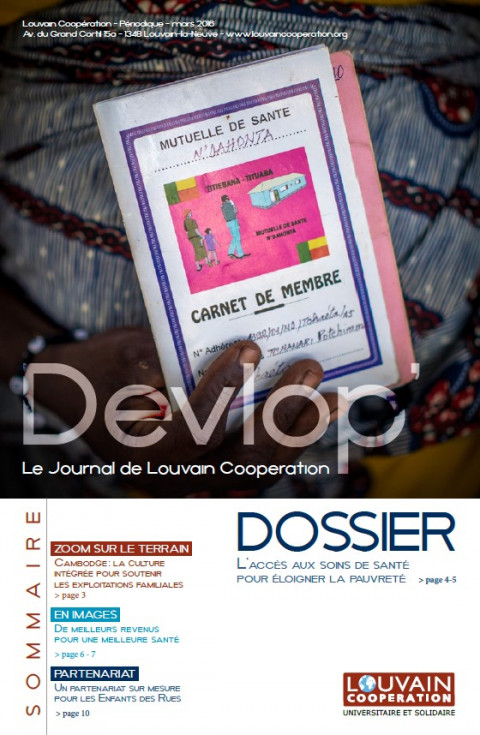 Devlop’ Le journal de Louvain Coopération 2 - Mars 2016 Year of publication: 2016 Corporate author: Louvain Coopération "2016 sera une annee charniere pour Louvain Cooperation" 2016 sera une annee charniere a beaucoup d’egards. Nous fetons les 10 ans d’un partenariat solide avec l’Union Nationale des Mutualites Libres, autour des mutuelles de sante au Benin et au Togo. Chaque annee la collaboration se renforce. Les echanges d’expertise se multiplient. Tout cela dans un contexte ou la protection sociale et la couverture maladie universelle sont en bonne place dans les agendas politiques africains. Au-dela des communes et districts, l’enjeu est national. Le programme MASMUT, alliant les differentes Unions mutualistes belges et leurs ONG partenaires , soutient ce plaidoyer. Differents modeles s’opposent. La mutuelle de sante est le seul qui repartit les responsabilites entre l’Etat, les prestataires de soins et les patients d’une maniere fonctionnelle et democratique. Mais 2016, c’est aussi l’annee de reflexions et decisions en vue de notre prochain plan strategique et notre programme 2017-2021. Une evaluation pointue de nos actions passees nous pousse a encore elargir notre comprehension des mecanismes sociaux ou culturels qui operent partout. Quels codes regissent les choix des micro-entrepreneurs, les reticences a adherer a une cooperative ou a une mutuelle, le type d’alimentation, la conception du bien-etre ? Nos equipes et partenaires, avec l’appui transdisciplinaire de l’UCL vont consacrer leur energie a ces analyses qui nourriront nos projets et actions. Enfin, 2016, ce sont aussi des nouveaux projets, de nouvelles zones d’intervention.
  Devlop’ Le journal de Louvain Coopération 3 - Octobre 2016 Year of publication: 2016 Corporate author: Louvain Coopération “Renforcer la collaboration entre ONG“ Quatre ONG universitaires belges, actives dans les pays du Sud et en Belgique, qui se rejoignent dans leurs domaines et lieux d’intervention, mais aussi dans leur specificite universitaire… Les points qui unissent Louvain Cooperation (ONG de l’UCL), ULB Cooperation (ONG de l’ULB), ADG (ONG de l’ULg-Gembloux) et la FUCID (ONG de l’UNamur) sont nombreux. Ces ONG ont en commun la realisation d’etudes ou de recherches-actions, la capitalisation des acquis, l’appel a des experts academiques universitaires, la diffusion la plus judicieuse possible des savoirs, la sensibilisation des etudiants a travers l’organisation de Campus Plein Sud… Ces collaborations existantes et points communs forment la base de l’idee d’une cooperation plus large, qui correspond a la dynamique du secteur de l’aide au developpement : rechercher des synergies, des apprentissages communs, des reseaux actifs. Les ONG, il faut bien l’admettre, ont souvent eu tendance a travailler de maniere trop isolee. A l’ere de la mondialisation, des nouvelles technologies de l’information et de la communication et des reseaux sociaux, il n’est plus possible, ni souhaitable de travailler dans son coin… Profitons au mieux de chacune des experiences, positive ou negative, des autres ! Juin 2016 fut donc une grande premiere dans l’histoire de ces quatre ONG : celles-ci ont decide de s’associer et de definir ensemble un programme quinquennal (2017-2021) qui vient d’etre soumis a la DGD pour une demande de financement commune. Ce programme comprend des actions au Sud dans les domaines de la Securite alimentaire et economique et de la Sante, et des actions en Belgique, d’Education a la Citoyennete Mondiale et Solidaire.
  Developing Holistic Indicators to Promote the Internationalization of Higher Education in the Asia-Pacific Year of publication: 2018 Author: Da Wan Chang Corporate author: UNESCO Bangkok The internationalization of higher education has been emphasized by the global community to improve access and quality in higher education (SDG4.3), as well as to achieve other global goals by promoting cross-cultural understanding and tolerance. Even though the internationalization of higher education has diverse dimensions, ‘student mobility’ has been a predominant indicator and there are conceptual and methodological challenges in the existing sources of data and statistics. In addition to student mobility, this document proposes a holistic set of indicators to capture other important dimensions of the internationalization of higher education, such as alignment with international normative instruments, international networking, governance and management, as well as the mobility of academics and programmes, etc. The suggested indicators are categorized into domains on two levels: system and institutional. It is hoped that this policy brief will help users better understand and adapt the indicators for use in their local contexts, so as to promote the internationalization of higher education.
  Rethinking post-Soviet Society: Multiculturalism in Central Asia Year of publication: 2014 Author: Nurlan Muminov, Zhasulan Orynbaev The article is devoted to the analysis of the post-Soviet society of Central Asia on the example of Uzbekistan and Kazakhstan with reference to the phenomenon of multiculturalism. In addition, the authors will try to answer the following basic questions: what social problems do multinational and multicultural post-Soviet societies face? and how to solve interethnic and intercultural problems of societies of post-Soviet countries in the process of creating each of them their own unitary national state. Переосмысление постсоветское общество: мультикультурализм в странах Центральной Азии Year of publication: 2014 Author: Nurlan Muminov, Zhasulan Orynbaev Статья посвящена анализу постсоветского общества Центральной Азии на примере Узбекистана и Казахстана со ссылкой на феномен мультикультурности. Кроме того, вавторы постараются ответить на следующие основные вопросы: какими общественными проблемами сталкиваются многонациональные и мультикультурные постсоветские общества; и как решаются межэтнические и межкультурные проблемы обществ постсоветских стран в процессе создания каждым из них собственного унитарного национального государства.
  Культурная идентичность таджиков и мультикультурализм Year of publication: 2014 Author: Khamrokhon Zarifi Статья посвящена вопросам истории, культурной идентичности и наследию таджикского народа. Обсуждаются вопросы сохранения и преемственности культурного разнообразия, а также феномен мультикультурализма.
  Tolerance of Kazakhstani society in the context of ensuring the harmony of values Year of publication: 2013 Author: Alma Sagyngali This article discusses the process of multinational Kazakh society searching for its cultural and civilizational identity in the framework of Kazakhstan's building of a social state and integration into the world community. Particular attention is paid to tolerance as a key cultural value. Толерантность казахстанского общества в контексте обеспечения ценностного согласия Year of publication: 2013 Author: Alma Sagyngali В данной статье рассматривается процесс поиска многонациональным казахстанским обществом своей культурно-цивилизационной идентичности в рамках построения Казахстаном социального государства и интеграции в мировое сообщество. Особое внимание уделяется толерантности, как ключевой культурной ценности.
 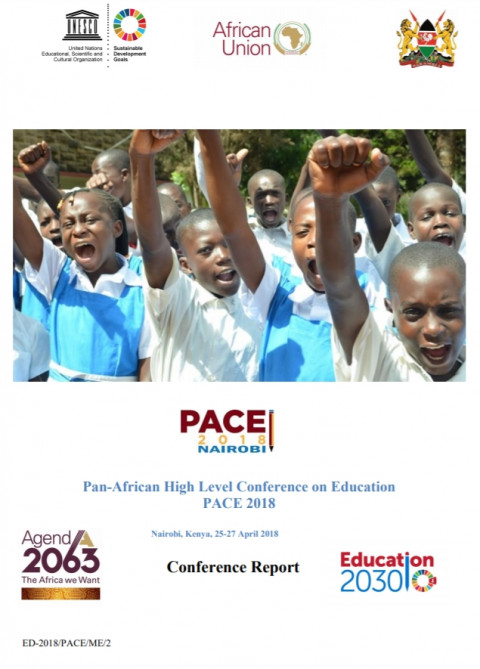 Pan-African High Level Conference on Education, PACE 2018: conference report Year of publication: 2018 Corporate author: African Union | Government of the Republic of Kenya The Pan-African High-level Conference on Education (PACE 2018) was held in Nairobi, Kenya from 25th to 27th April 2018. PACE 2018 was convened by UNESCO, the Government of Kenya and the African Union, with the collaboration of the Association for the Development of Education in Africa (ADEA) and contributions from the Sustainable Development Goal 4 (SDG4) co-conveners. The initiative to organise the PACE 2018 came in the wake of a number of regional consultations organised in Sub Saharan Africa and the Arab states regions to focus attention on the way forward, following the adoption in 2015 of the United Nations’ Sustainable Development Goal 4 on Education (SDG 4) and of the African Union’s Continental Education Strategy for Africa 2016-2025 (CESA 16-25). Conférence panafricaine de haut niveau sur l'éducation, PACE 2018: rapport de la conférence Year of publication: 2018 Corporate author: African Union | Government of the Republic of Kenya La Conférence panafricaine de haut niveau sur l’éducation (PACE 2018) s’est déroulée à Nairobi, au Kenya, du 25 au 27 avril 2018. Elle a été convoquée par l’UNESCO, le Gouvernement du Kenya et l’Union africaine, avec la collaboration de l’Association pour le Développement de l’Éducation en Afrique (ADEA) et des contributions des coorganisateurs de l’Objectif de développement durable 4 (ODD 4). L’initiative d’organiser la conférence PACE 2018 s’inscrit à la suite de plusieurs consultations régionales organisées dans les régions d’Afrique subsaharienne et des États arabes pour appeler l’attention sur la voie à suivre après l’adoption en 2015 de l’Objectif de développement durable 4 (ODD 4) sur l’éducation et de la Stratégie continentale de l’éducation pour l’Afrique de l’Union africaine (CESA 2016-2025) (CESA 16-25).