
Resources
Explore a wide range of valuable resources on GCED to deepen your understanding and enhance your research, advocacy, teaching, and learning.
3,229 Results found
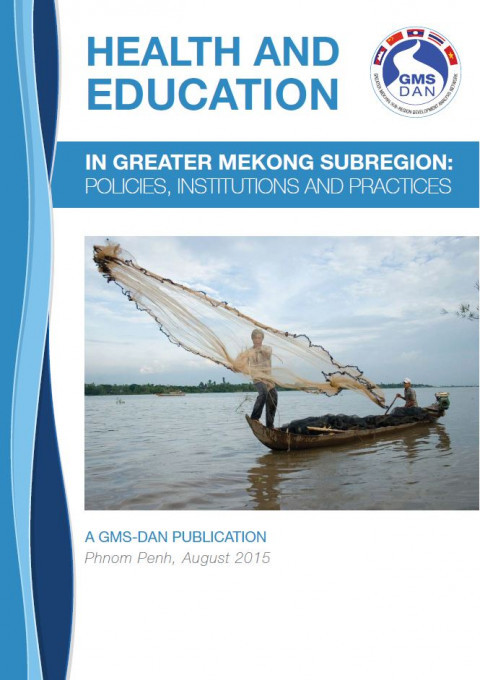 Health and Education in the Greater Mekong Subregion: Policies, Institutions and Practices Year of publication: 2015 Author: Greater Mekong Subregion Development Analysis Network Corporate author: Cambodia Development Resource Institute (CDRI) The focus of the paper is thus on the institutional frameworks and their effectiveness in policy-making and implementation in health and education and not so much on assessing whether these polices themselves are appropriate. In assessing institutional effectiveness, the paper does not purport to be comprehensive but selective in that it looks at only a few key issues: national, especially public, resource commitments; intra-governmental coordination, both vertical and horizontal; the roles of non-state actors, including private sector, civil society organisations and civil society more generally.
 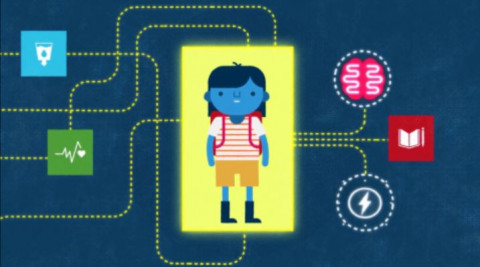 [Video] The Global Goals Food Project: Every Plate Tells a Story Year of publication: 2017 Corporate author: World’s Largest Lesson The World’s Largest Lesson brings the Global Goals to children all over the world, reaching over 130 countries and millions of children since its launch in September 2015.Produced by Project Everyone and delivered in partnership with UNICEF and many NGOs, private sector organisations and foundations, the World’s Largest Lesson reaches students through multiple channels. Ministries of Education are invited annually to take part. NGOs distribute digital content through their networks and education organisations, both for and non-profit, encourage participation through their communities.
  [Video] The World’s Largest Lesson Part 2 - With Thanks to Sir Ken Robinson and Emma Watson Year of publication: 2016 Corporate author: World’s Largest Lesson Sir Ken Robinson, Emma Watson and Aardman Animations invite children to get involved in the Global Goals for Sustainable Development by inventing, innovating and campaigning.To show the version with English subtitles please go to: vimeo.com/181766755
 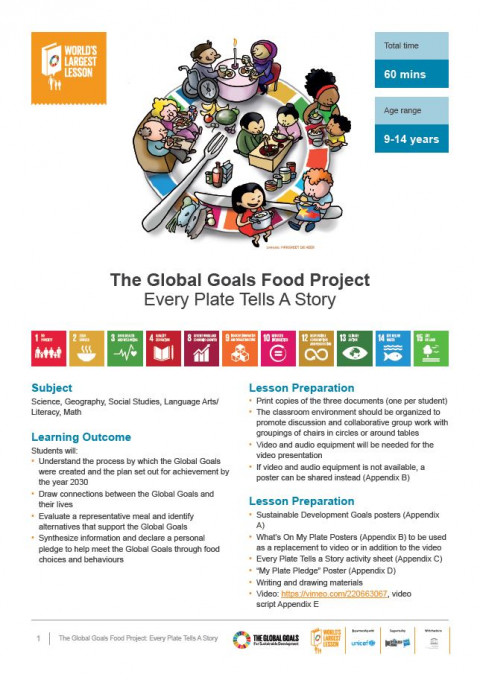 The Global Goals Food Project: Every Plate Tells a Story Year of publication: 2017 Corporate author: World’s Largest Lesson This lesson plan, “Every Plate Tells a Story,” provides a guided activity for teachers and students to work together in efforts to bring the Global Goals to classrooms and learning.The lesson begins by broadly introducing the term “goal” and invites students to make personal connections to people, places, and environments by considering goals in their lives. Learners build knowledge as they integrate understanding of the Global Goals and the processes in which they were designed.During the lesson, students will engage in a process of inquiry through dialogue, collaboration, and research and will establish concrete realizations of the sustainability of the food they eat. Multiple sources of evidence/formative assessments can be used throughout the lesson to document learning, guide conversation, and inform future instruction.
 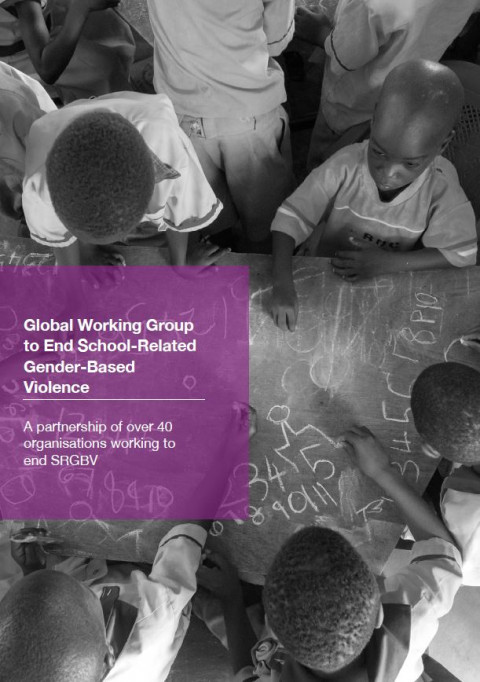 Global Working Group to End School-Related Gender-Based Violence Year of publication: 2017 Corporate author: United Nations Girls' Education Initiative (UNGEI) In August 2014, a coalition of governments, development organizations, civil society activists, UN agencies and research institutions came together to collaborate on ending gender-based violence in and around schools.The Global Working Group to End SRGBV has been a strong advocate to ensure that schools remain safe places for learning and that girls and boys have the opportunity to acquire the knowledge, skills and resources they need to reach their potential.To learn more about the group and its members, please go here:www.ungei.org/srgbv
 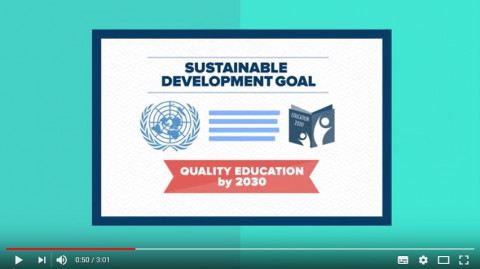 [Video] SDG 4 Data to Get All Children in School and Learning by 2030 Year of publication: 2018 Corporate author: UNESCO Institute for Statistics (UIS) This video speaks in a simple and easy to understand language about the importance of data in achieving SDG 4. It is through data that success and failure can be identified and measure to build upon the successes or tackle the failures can be developed. Go straight to the source for global education data with the UNESCO Institute for Statistics http://on.unesco.org/SDG4web
  [Video] Learning about SDG 4 Year of publication: 2017 Corporate author: United Cities and Local Governments (UCLG) Life is continual learning, we learn to read to understand a constantly changing role, to participate and to live together. We learn in the classroom and beyond its world. Cities are places of opportunity but they can be also be places of exclusion. There are 758 million people over the age 15 in the world who can't read or write. Two out of three of them are women. Local governments because they are close to the people are able to respond to their needs and contribute to create equal educational opportunities. They work to ensure that facilities are ideal for learning and community life. They promote the adoption of sustainable life styles and provide education in values. Local government work with educators and administrations to ensure adequate resources and to improve education. In all these ways local governments contribute to achieve sustainable development goals for ensuring inclusive and quality education for all and promote lifelong learning.
  [Video] Transforming Education for Humanity Year of publication: 2017 Corporate author: Mahatma Gandhi Institute of Education for Peace and Sustainable Development (MGIEP) UNESCO MGIEP focuses on achieving the UN Sustainable Development Goal 4.7 towards education for building peaceful and sustainable societies across the world by developing programmes that promote socio-emotional learning, innovate digital pedagogies and empower the youth.
 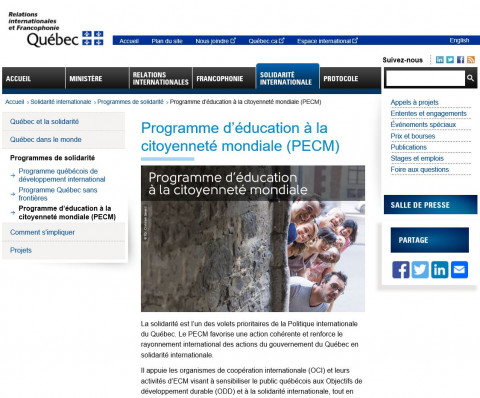 Programme d’éducation à la citoyenneté mondiale (PÉCM) Year of publication: 2018 Corporate author: Ministère des Relations internationales et de la Francophonie La solidarité est l’un des volets prioritaires de la Politique internationale du Québec. Le PECM favorise une action cohérente et renforce le rayonnement international des actions du gouvernement du Québec en solidarité internationale.Il appuie les organismes de coopération internationale (OCI) et leurs activités d’ECM visant à sensibiliser le public québécois aux Objectifs de développement durable (ODD) et à la solidarité internationale, tout en favorisant l’acquisition de connaissances, de valeurs et de comportements qui contribuent à la mise en place d’un monde plus juste, durable et équitable.
 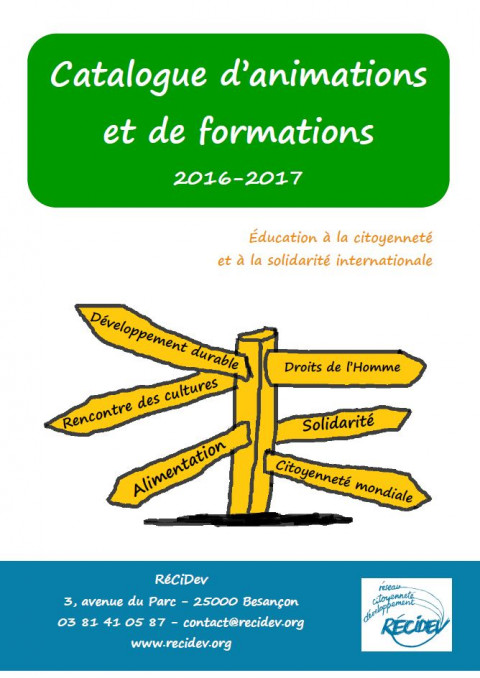 Catalogue d’animations et de formations 2016-2017 : Éducation à la citoyenneté et à la solidarité internationale Year of publication: 2016 Corporate author: Réseau Citoyenneté Développement (RéCiDev) « L’éducation à la citoyenneté et à la solidarité internationale (ECSI) est une démarche sociale et politique dont la finalité est de favoriser la contribution individuelle et collective à la construction d’un monde juste, solidaire et durable. Elle s’appuie sur un processus pédagogique qui se déroule tout au long de la vie.Son objectif est de permettre à chacun de comprendre les mécanismes d’interdépendance et d’exclusion dans le monde ; de prendre conscience de l’importance d’une démarche citoyenne ayant pour but de favoriser une solidarité entre les territoires, les générations, les groupes sociaux… et d’agir pour la construction d’un monde solidaire. L’ECSI contribue à donner à tous des clés pour développer un esprit critique face à un modèle de développement dominant producteur d’inégalités et d’exclusions. Elle vise à une transformation sociale et à la construction collective d’autres modes de développement, respectueux des droits humains et de l’environnement. Elle valorise des alternatives en cours partout dans le monde. Elle favorise le vivre ensemble et l’épanouissement personnel.Parce qu’elle bénéficie au plus grand nombre et qu’elle répond aux enjeux du monde actuel, l’ECSI sert l’intérêt général. À ce titre, la promouvoir et la garantir est un devoir des Etats en cohérence avec l’ensemble des politiques publiques. »