
Resources
Explore a wide range of valuable resources on GCED to deepen your understanding and enhance your research, advocacy, teaching, and learning.
3,229 Results found
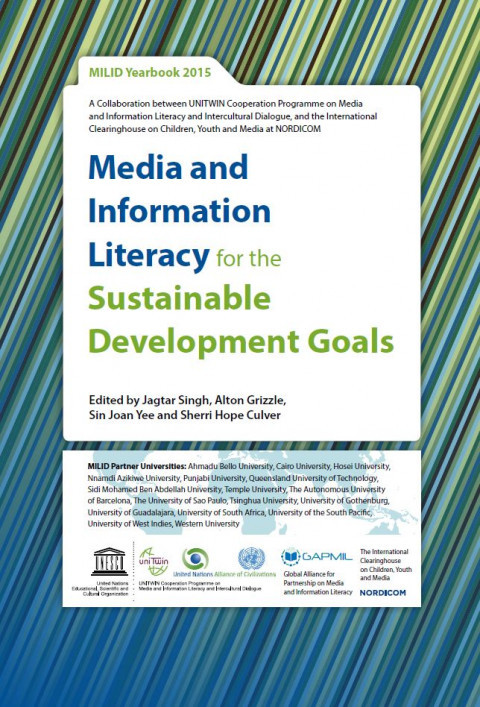 Media and Information Literacy for the Sustainable Development Goals (The MILID Yearbook 2015) Year of publication: 2015 Author: Jagtar Singh | Alton Grizzle | Sin Joan Yee | Sherri Hope Culver Corporate author: International Clearinghouse on Children, Youth and Media (Sweden) In the year 2000, governments and development partners all over the world agreed on eight global development targets called the Millennium Development Goals (MDGs). The year 2015 is a pivotal year as it marks the end of the period during which the MDGs were to be reached and the year in which new global development targets are to be set. These new targets are referred to as the Post-2015 Sustainable Development Goals (SDGs). This process is in its highest gear with ongoing debates and consultative meetings/initiatives globally both online and offline. While much progress has been made, achievement of the MDGs has been mixed across countries. The centrality of information and communication to development is irrefutable. The MILID Yearbook provides a case for media and information literacy (MIL) as a tool for open and inclusive sustainable development.The 2015 edition of the MILID Yearbook displays how media and information literacy can be helpful in facilitating progress and achievement of the sustainable development goals. It is sincerely hoped that the articles in this yearbook will go a long way to sensitize the stakeholders about the role and value of MIL in sustainable development of one and all across frontiers.
 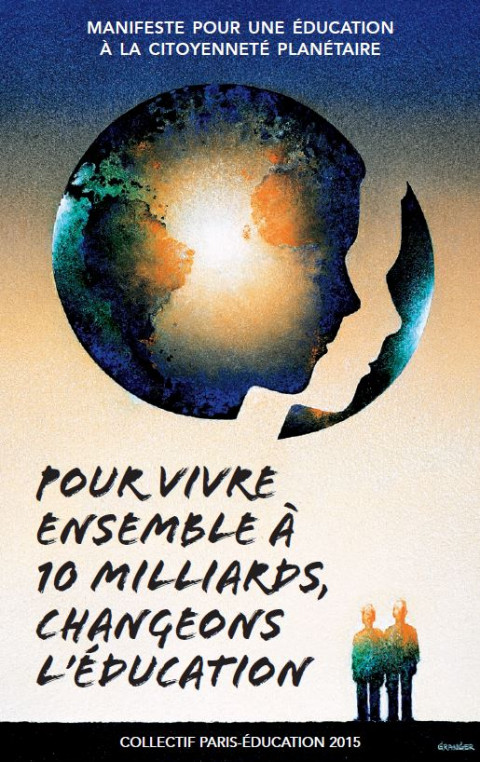 Manifeste pour une éducation à la citoyenneté planétaire: Pour vivre ensemble à 10 milliards, changeons l'éducation Year of publication: 2015 Corporate author: Collectif Paris-Education 2015 Face à l’ampleur, l’urgence, la diversité et la complexité des problématiques engendrées par le modèle de développement de nos sociétés contemporaines, nous sommes donc obligés, dans l’urgence, de nous pencher sur les questions d’éducation et de formation des générations futures qui devront affronter des réalités biophysiques, économiques et politiques inédites, dont nous commençons à peine à entrevoir l’ampleur. Ce qui est dès lors en jeu, avec l’avenir de l’homme et de la Terre, c’est l’humain, ce qu’il deviendra, ce qu’il sera capable de porter comme projet pour l’humanité.Quelles qualités d’humains devons-nous faire advenir pour que ces réalités inédites puissent être rencontrées demain, sans que l’humanité bascule dans la violence et le dépeçage égoïste de la planète? Quels enfants voulons-nous laisser à notre Terre?Cette urgence impose un changement d’échelle dans la transformation des systèmes éducatifs, des contenus et des méthodes d’enseignement. Malgré la volonté et la compétence de nombreux acteurs de l’école, force est de constater que les actions menées pour une éducation plus en cohérence avec les enjeux climatiques et, plus largement, sociétaux restent à la marge. Elles sont réalisées par des individus clairvoyants. Il est temps d’enclencher la vitesse supérieure.
  [Video] GLOBAL CITIZENSHIP EDUCATIONAL PROGRAM Year of publication: 2018 Corporate author: EducacionBA To build a fairer, more equitable and sustainable future, the "Global Citizenship" educational program is created to promote the Sustainable Development Goals through quality education enhanced by digital technologies and by fostering 21st century skills. Through a digital platform, school contents and monitoring, evaluation and planning tools, children learn by playing, carrying out missions, creating strategies and being protagonists of their learning.It has an extensive potential to reach an ambitious scope of 2.000 teachers and 50.000 students. During 2018 a pilot test was carried out with 6 precursory schools. In the platform, teachers are provided with tools to develop and undertake meaningful and innovative educational projects with their students. Students are offered school contents that challenge and empower them as key players. They are encouraged to learn through play, to carry out missions, to devise strategies, and to lead projects which reinforce learning processes and encourage their creativity and commitment. PRESENTACIÓN DE CIUDADANÍA GLOBAL Year of publication: 2018 Corporate author: EducacionBA Para construir un futuro más justo, equitativo y sustentable se crea el programa "Ciudadanía Global", cuyo objetivo es promover los Objetivos de Desarrollo Sostenible a través de una educación de calidad potenciada por las tecnologías digitales y fomentando las habilidades del siglo XXI. A través de una plataforma digital, contenidos de calidad y herramientas de planificación seguimiento y evaluación, niñas y niños aprenden jugando, emprendiendo misiones, creando estrategias y siendo protagonistas de sus aprendizajes.
  Que valent les apprentissages en histoire, géographie et éducation à la citoyenneté ? : Colloque international des didactiques de l'histoire, de la géographie et de l'éducation à la citoyenneté Year of publication: 2014 Author: Caroline Leininger | Angelina Ogier | Sylvain Genevois Corporate author: Institut national de recherche pédagogique L’histoire et la géographie scolaires, de même que l’éducation à la citoyenneté, sont des domaines sensibles, liés au politique et au contexte social et sociétal dans lequel ils s’inscrivent. Si les recherches en didactique ont constaté dans les années 1990 une grande stabilité de l’histoire et la géographie scolaires, elles interrogent aujourd’hui plus spécifiquement les changements curriculaires et les recompositions qu’ils entraînent (thèmes des deux dernières éditions du colloque (Nantes, 2008, Lausanne 2009). Ces changements découlent de choix politiques et de savoirs universitaires, et redéfinissent le projet de ces disciplines et ses finalités. L'élève devient ainsi à l'issue de sa scolarité : un acteur de la société, un citoyen, un acteur économique, membre de communautés culturelles et politiques, un individu épanoui etc.Ce choix de finalités est aussi un choix de valeurs, explicites ou non dans les prescriptions, assumées ou non par les enseignants, par les élèves, les parents. Ce constat amène à questionner les articulations entre les apprentissages disciplinaires d’une part, et les apprentissages sociaux et politiques d’autre part. Les définitions de ces apprentissages, leur légitimité et leurs évaluations posent également question. Enseignants, décideurs, formateurs, didacticiens peuvent ainsi se demander ce que valent les apprentissages en histoire, en géographie et en éducation à la citoyenneté, tant du point de vue de leur reconnaissance disciplinaire et sociale que du point de vue des valeurs qui leur sont associées. Cet ouvrage cherche à questionner les articulations entre les apprentissages disciplinaires et les apprentissages sociaux et politiques.
  The SDGs and Cities INTERNATIONAL HUMAN MOBILITY Year of publication: 2018 Corporate author: International Centre for the Promotion of Human Rights | (ICPHR) The Handbook is to address new situations – and responses to these situations – generated by the global phenomenon of human mobility in urban spaces. Democracies are being threatened by the sustained growth of social gaps and the exclusion of vast sectors of the population from political systems and benefits of development, placing structural limits on the exercise of human rights. In this context, where new tensions and problems have arisen such as massive displacements of the population, the appearance of diverse types of extremism, of wars and conflicts and climate change in turn place these social sectors under conditions of structural inequality, exclusion and discrimination, as the main victims of human rights violations. This Handbook was prepared and published with the support and assistance of the UNESCO Sector for Social and Human Sciences through its Regional Science Bureau in Montevideo and the Latin American and Caribbean Coalition of Cities against Racism, Discrimination and Xenophobia.
  Focus on Global Common Good:The New International Research Trend on World Citizenship Education Year of publication: 2018 Author: Song Qiang | Rao Congman Globalization has posed challenges for national-states to develop traditional citizenship education. To develop the citizenship education in the world needs to regard education and knowledge as global common good, surpass short- term benefit,and promote learners to be world citizens by 2030. Start with the dialectical logic on global benefit and national benefit,the researches of world citizenship education focus on“human rights protection and joint development”,“from national identity to world identity”,“from global governance to world government”, and “western universal mind vs. multi- civilizations intergrowth”. Chinese citizenship education needs to reinforce the national identity in socialism national citizenship education; cultivateing socialism world citizenship and promoteing international discourse power;seek human common good and build community of common destiny for all mankind. 着眼全球共同利益:“世界公民”教育的国际研究新趋势 Year of publication: 2018 Author: Song Qiang | Rao Congman 全球化对民族国家开展的传统公民教育提出了挑战。全球公民教育发展需要将教育和知识视为全球共同利益,超越短期利益,推进学习者成为2030年的“世界公民”。当前“世界公民”教育研究本着全球利益与国家利益的辩证逻辑,聚焦在“人权保护与共同发展”“国家认同到世界认同”“全球治理到世界政府”“西方式普适思想与多元文明共生”四个方面。为此,我国公民教育要加强社会主义“国家公民”教育中的国家认同;培养社会主义“世界公民”,提升国际话语权;寻求人类共同利益,构建“人类命运共同体”。
 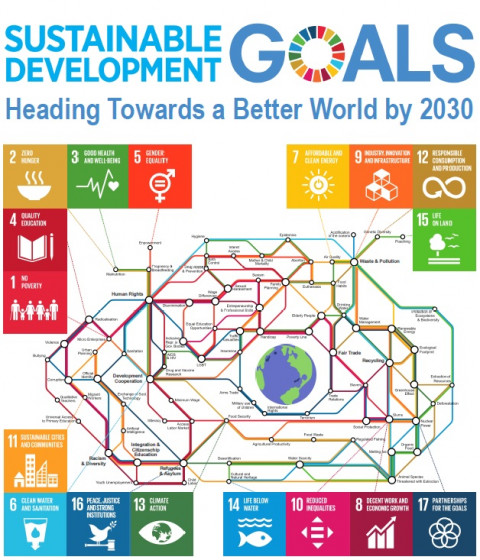 A metro map illustrated in the 17 sustainable development goals Year of publication: 2018 Author: Rembert Jonckheere Corporate author: ASPnet Flanders (Belgium) “Tackling one SDG… is tackling all of them!”This metro map is a complex illustration of the 17 sustainable development goals. With different kinds of topics as service stations and the SDG’s connecting them, it shows how the goals can relate to each other, and thus it emphasises their holistic nature. I do not pretend to be completely exhaustive or correct. Probably one can add more links and topics, but this map could be helpful in education or in other institutions as a source of inspiration to start up projects within the framework of the sustainable development goals.
 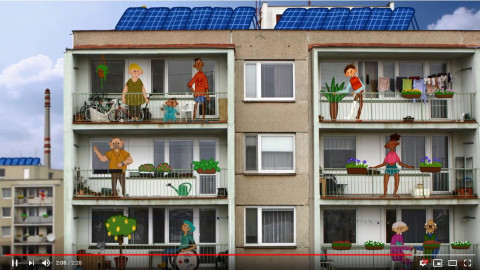 [Video] The future we need – and how we get there Year of publication: 2018 Corporate author: Friends of the Earth Europe Friends of the Earth groups across Europe are working for a socially-just, safe and peaceful future for all – and this is how they do it.