
Resources
Explore a wide range of valuable resources on GCED to deepen your understanding and enhance your research, advocacy, teaching, and learning.
2,165 Results found
 My Migrant Object Corporate author: Museo de la Memoria y los Derechos Humanos Educational material developed by the Museum of Memory and Human Rights from objects associated with stories of exile during the dictatorship of Augusto Pinochet in Chile.
  Action on Global Goals: Community Toolkit Year of publication: 2019 Author: Julia Haimlinger Corporate author: Global Action Plan (GAP) Ireland This toolkit aims to bring Development Education (DevEd) and Education for Sustainable Development (ESD), already established in the formal education sector, to the non-formal adult and community sector. Our toolkit is based on the idea to not have knowledge for knowledge sake, but through critical thinking and reflection we can aim to work towards taking action for positive change. For the goals to be reached, everyone needs to do their part: governments, the private sector, civil society and you! These are universal goals for all countries to be achieved. This resource pack will give you some fun and creative ideas on how to get informed about the Sustainable Development Goals, to create active global citizens and do your bit for the planet.
  Development Education in Theory and Practice: An Educator’s Resource Year of publication: 2016 Author: Michal Cenker | Louiza Hadjivasiliou | Patrick Marren | Niamh Rooney Corporate author: UNIDEV | NGO Support Centre (Cyprus) | Pontis Foundation (Slovakia) | Kimmage Development Studies Centre (Ireland) This publication has been produced to provide a new teaching resource for academics and educators active in the field of Development Education and related disciplines. It covers twelve themes, each chapter includes both a conceptual overview and a teaching methodology section. The conceptual overview introduces the topic, explores the key concepts, theories and current debates. The teaching methodology section gives educators a set of tools that could help them introduce the topic in both formal and non-formal settings.
  Personalized Learning within Teacher Education: A Framework and Guidelines Year of publication: 2020 Corporate author: UNESCO International Bureau of Education (IBE) This paper explores the theoretical and practice elements that together inform the concept of personalised learning. These insights are then used to develop a Framework for Personalized Learning within Teacher Education. In addition, the final chapter outlines pedagogical strategies to support the development of personalised learning that were tested during the project within the participating universities.The Framework and Guidelines are intended for use by to teacher educators and their students, as well as by teachers and students in schools, to support the on‐going shift towards a personalised learning and collaborative paradigm which forefronts learner agency and autonomy and encourages learners of all ages to assume increased responsibility for their own learning and achievements.
 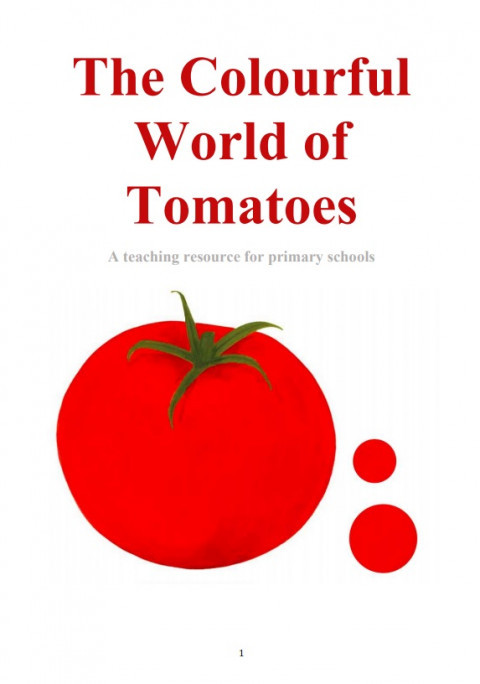 The Colourful World of Tomatoes: A Teaching Resource for Primary Schools Year of publication: 2016 Corporate author: Südwind | Cumbria Development Education Centre(CDEC) This resource allows children from 6 to 10 years to get to know the tomato from different perspectives. All exercises are based on the principle of global learning and are varied, interactive and experience-oriented.Thus it is possible for the children not only to look at this diverse topic from different perspectives, but also to immerse themselves in the tomato world. Activity’ objectives:• The students expand their knowledge about tomatoes and vegetables growing in times of globalisation.• Students learn about unknown types of tomatoes.• They recognise why different varieties are important.
 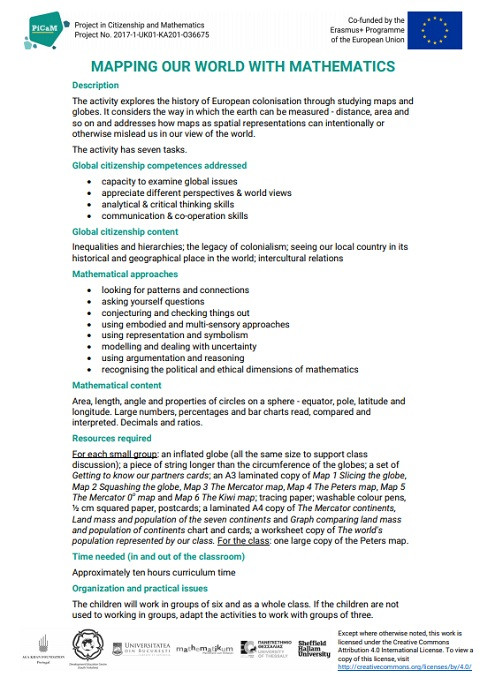 Mapping our World with Mathematics Year of publication: 2019 Corporate author: Project in Citizenship and Mathematics(PiCaM) | Erasmus+ This activity explores the history of European colonisation through studying maps and globes. It considers the way in which the earth can be measured - distance, area and so on and addresses how maps as spatial representations can intentionally or otherwise mislead us in our view of the world. The activity has seven tasks.
 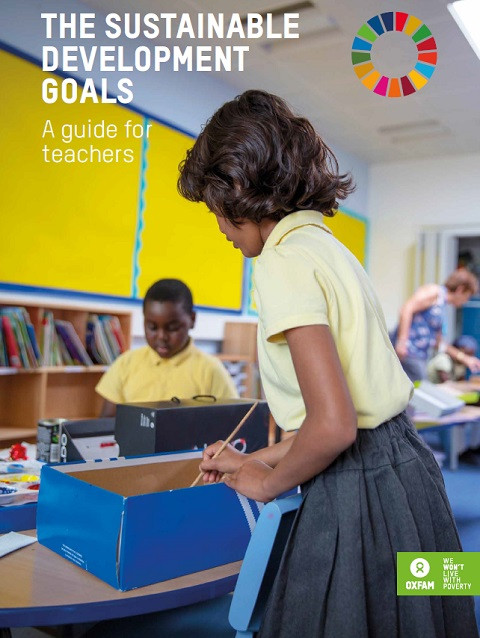 The Sustainable Development Goals: A Guide for Teachers Year of publication: 2019 Corporate author: Oxfam GB This guide supports teachers and educators working with young people to deepen their understanding of education about and for the SDGs and to see how global citizenship education (GCE) approaches and methodologies can underpin good practice. The guide also explores the benefits and challenges of using the SDG framework with learners in schools.
 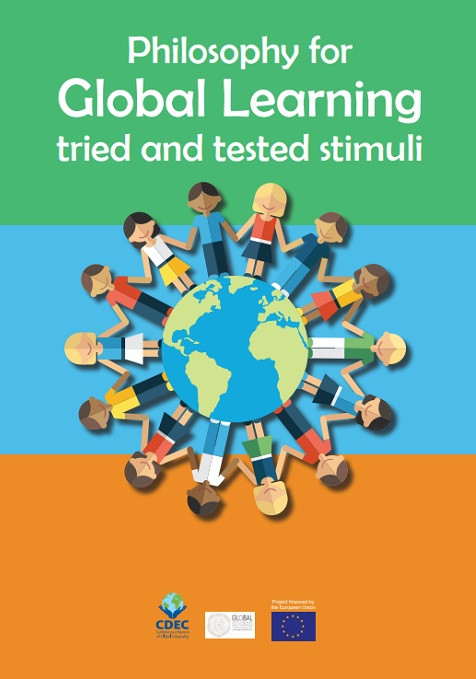 Philosophy for Global Learning: Tried and Tested Stimuli Year of publication: 2018 Corporate author: Cumbria Development Education Centre(CDEC) | European Union (EU) | Global Schools Program Philosophy for Global Learning has been created as a flexible and practical resource for teachers of all levels of experience. It is for those who want to teach global awareness to children through the structure of Philosophy for Children. Philosophy for Global Learning is aimed for use with children in Key Stage 2 but some parts can be used with younger children.
  Programa de formación continua en educación para la sustentabilidad; Informe Edición 2018 Year of publication: 2018 Corporate author: Universidad de San Andrés El programa(Programa de Educación para la Sustentabilidad) se propuso trabajar en la promoción de la Educación para la Susten-tabilidad en las escuelas, a fin de generar en toda la comunidad educativa una cultu-ra sustentable. Este trabajo se basó en un enfoque holístico orientado al desarrollo de una mirada crítica y transformadora, y en la promoción de la participación ciuda-dana.Nuestro planteo fue que cada participante diseñe una propuesta pedagógica innova-dora en Educación para la Sustentabilidad, que responda a las particularidades de su institución de pertenencia, pero que a la vez pueda ser replicada por otras institu-ciones y actores. De esta forma, se deja capacidad instalada para la planificación e implementación de proyectos educativos orientados a la promoción de la Educación para la Sustentabilidad. Mediante las suce-sivas ediciones del programa, buscamos fortalecer una masa crítica de especialistas en Educación para la Sustentabilidad como apoyo a la calidad del sistema educativo en Argentina, conformando una Comunidad Profesional de Aprendizaje que reconozca a nuestro programa como un espacio de encuentro y referencia.
 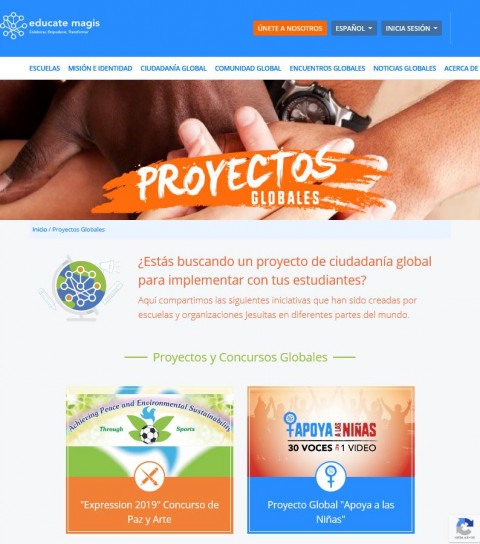 Are You Looking for a Global Citizenship Project to Implement with Your Students?: Global Projects and Contests Year of publication: 2019 Corporate author: Educate Magis In this part of the Educate Magis' webpage from the Society of Jesus one can access a calendar with global activities and events and information about different initiatives that have been organized by different jesuit schools and organizations around the world. One can access different global citizenship educational projects such as "Global red chair", "Walk a mile in my shoes", or "Stand with Girls global project".