
Resources
Explore a wide range of valuable resources on GCED to deepen your understanding and enhance your research, advocacy, teaching, and learning.
1,451 Results found
 Radicalisations Awareness Network (RAN) Edu's Guide on training programmes 'Effective and confident teachers and other school staff' Year of publication: 2016 Corporate author: Radicalisations Awareness Network (RAN) This document will help teachers, principals, schools and (local and national) authorities discuss and design training programmes. Different training modules are identified, like (de)polarisation training, critical thinking, and how to turn a school into a safe and democratic mini society. Radicalisations Awareness Network (RAN) Edu's Guide on training programmes 'Effective and confident teachers and other school staff' Year of publication: 2016 Corporate author: Radicalisations Awareness Network (RAN) Ce document aidera les enseignants, les directeurs d'école, les écoles et les autorités (locales et nationales) à discuter et à concevoir des programmes de formations. Différents modules de formation sont identifiés, comme la formation de dépolarisation, la pensée critique, et comment transformer une école en une mini société sûre et démocratique.
  Manifesto for Education - Empowering Educators and Schools Year of publication: 2015 Corporate author: Radicalisations Awareness Network (RAN) The manifesto is a call to action to help empower the very group of people who have the potential to be some of the most influential in the lives of our young people and to help them truly prevent violent extremism. As it is impossible for schools to solve the problem alone and immediately, on different levels (the educator, the school, the partners and the government) suggestions are made to inspire interventions that could start tomorrow (short term) and help establish a sustainable approach for the future (long term). These insights are mostly based on experiences in secondary education but can easily be translated to primary, vocational and higher education. Manifesto for Education - Empowering Educators and Schools Year of publication: 2015 Corporate author: Radicalisations Awareness Network (RAN) Le manifeste est un appel à l'action pour aider à renforcer ceux qui ont le potentiel d'être parmi les plus influents dans la vie de nos jeunes et pour les aider à prévenir véritablement l'extrémisme violent. Comme il est impossible pour les écoles de résoudre le problème seul et immédiatement, des suggestions sont faites à différents niveaux (au niveau de l'éducateur, de l'école, des partenaires, du gouvernement) pour inspirer des interventions qui pourraient commencer demain (à court terme) et aider à établir une approche durable pour l'avenir (à long terme). Ces idées sont principalement basées sur des expériences dans l'enseignement secondaire, mais peuvent facilement s'appliquer à l'enseignement primaire, professionnel et supérieur.
  Educar para una ciudadanía global: construir un mundo justo desde la escuela Year of publication: 2009 Author: Colette Grech | Roderick Mallia | William Grech Corporate author: Conectando Mundos Consortium (Cidac, inizjamed, Intermon Oxfam, Ucodep) This publication is based on an initiative about the development education, intercultural education, popular education, the education of values, human rights education, education for sustainability, education for peace, education for gender equality, etc. The pedagogical proposal of Global Citizenship Education aspires to integrate in a coherent and challenging vision all these themes, keeping them in a close relationship with one another and taking into consideration the (increasing) interdependence of human beings living in a planet whose sustainability is under threat. This book is the fruit of a process that was triggered off by the joint effort of four European development NGOs, namely Cidac, Inizjamed, Intermón Oxfam and Ucodep within the frame of a project co-financed by the European Commission. These organisations set for themselves the objective to promote the acknowledgment and the inclusion of the contents and the methodology of Global Citizenship Education in the formal educational contexts in their respective countries, in order to kick-start a process of change in attitudes, values, and the beliefs of the pupils. Thanks to the initiative and efforts of the above-mentioned four organisations, and through various meetings and seminars carried out over the last three years in Spain, Italy, Portugal and Malta, groups of educators have been able to come face-to-face with each other, exchange experiences and reflect on the role of formal education with respect to the challenges of our times. Among the other experiences, the publication contains that of a key moment in the process. This took place in July 2008 in Cortona, a small and beautiful Tuscan city close to the border with Umbria, and in which many educators shared the benefit of what was the first international encounter of educators for global citizenship. The Cortona experience, in which around ninety teachers coming from Spain, Portugal, Malta, Italy, the Dominican Republic and Costa Rica have participated, was one of the stages – the starting point, in fact – of a process and a relationship that it is our aim to develop at the regional, national and international levels. In this publication, therefore, one can find theoretical cues put forward at Cortona that encourage educators to share their experiences and to compare the work done by different groups.This publication has two parts. The first part contains contributions of a theoretical type, whereas the second part concentrates on the educational experiences of the participants in the Cortona meeting.
 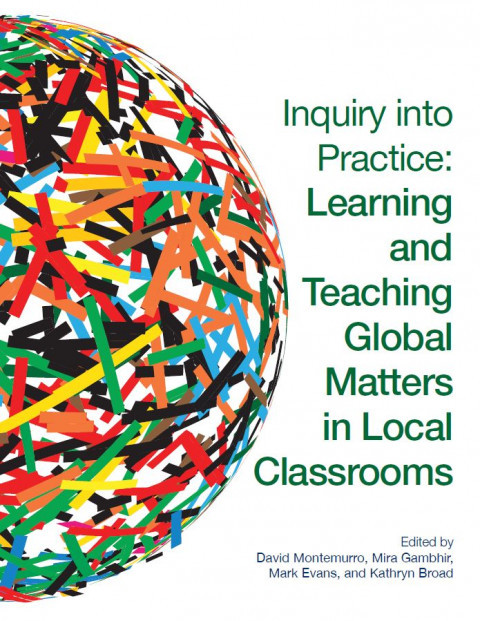 Inquiry into practice: learning and teaching global matters in local classrooms Year of publication: 2014 Author: David Montemurro | Mira Gambhir | Mark Evans | Kathryn Broad Corporate author: University of Toronto. Ontario Institute for Studies in Education This Inquiry into Practice publication, Learning and Teaching Global Matters in Local Classrooms, is the most recent addition to the series. It examines and shares varied perspectives, curricula, instructional practices, and resources intended to enhance student learning related to the infusion of global and international dimensions of education into classroom and schoolwide teaching and learning. It is organized in three sections: Educator Perspectives, Inquiry into Practice, and Resources. In this introduction, we briefly discuss how the text is organized, common themes that emerged across the sections, and concluding reflections.The first section, Educator Perspectives, provides insights from a range of university scholars and fieldbased leaders who, in multiple and distinct ways, have made learning and teaching about global matters in local classrooms a core feature of their work. Each was invited to comment on purposes, opportunities, and challenges related to infusing global and international dimensions into teaching and learning. Therefore, this section offers both contrasting conceptual perspectives and concrete suggestions that can impress the reader with a sense of urgency, critique, hope, and challenge when engaging in the complex and shifting work of teaching and learning about global matters.The second section, Inquiry into Practice, presents the 11 school-based and university-linked professional inquiries undertaken over a two-year period. The inquiries focus on a range of topics including critical global citizenship, the use of children’s literature to develop students’ understanding of sustainability in science education, and the refugee experience in personal and global understanding of “home.” The inquiries were carried out mostly with OISE partner schools and districts located in the city of Toronto and the GTA (regional municipalities including Durham, Halton, Peel, and York). This region of Canada provides a distinctly international, diverse context for this type of study. Local schools and districts linked with OISE’s Initial Teacher Education program have become sites of fascinating explorations into the possibilities of learning and teaching in pluralist contexts. The collection of inquiries in this publication speaks to the process of crossing borders demarcated by tangibles such as regions, nationalities, citizenship, and also by less tangible mindsets, identities, beliefs, and understandings. The voices across the project represent stakeholders in education: including voices of youth, beginning and experienced teachers, administrators, and researchers.The Resources section provides an annotated bibliography of print, media, and web resources to support those interested in teaching with global perspectives in mind. Recommended by project leaders and participants, by the authors, and by experts with various lenses, these resources are offered as a means to extend the exploration of the topics, ideas, and questions posed throughout the publication.
  Установки молодежи современного Казахстана на проявление социальной активности Year of publication: 2018 Author: O.V. Kaldybayeva | F.M. Mussataeva | G.Ye. Okasova В статье поднимается проблема исследования социальной активности среди современной молодежи, от степени которой во многом зависит эффективность реализации многих государственных программ. Выводы основаны на результатах социологического исследования, реализованного Научно-исследовательским центром «Молодежь» во второй половине 2017 г. в Республике Казахстан.
  Key Challenges of Youth in OIC Countries Year of publication: 2015 Corporate author: Organization of Islamic Cooperation (OIC) | Statistical, Economic and Social Research and Training Centre for Islamic Countries (SESRIC) The report contains four main sections, with the exception of the introductory and concluding sections. The first section briefly reviews some of the main educational outcomes in OIC countries. Literacy and participation rates in tertiary schools and international student mobility are the main indicators reviewed in this section. The second section highlights some important labor market indicators related to the young population in order to identify the main challenges and obstacles in the OIC countries. The third section deals with some social problems of young people. The fourth section deals with mental health issues. The last section is devoted to recommendations. التحديات الرئيسية للشباب في دول منظمة التعاون اإلسالمي Year of publication: 2015 Corporate author: Organization of Islamic Cooperation (OIC) | Statistical, Economic and Social Research and Training Centre for Islamic Countries (SESRIC) ويحتوي التقرير على أربعة أقسام رئيسية، باستثناء الأقسام التمهيدية والختامية. يستعرض القسم الأول بإيجاز بعض النتائج التعليمية الرئيسية في دول المنظمة. وتشكل معدلات الإلمام بالقراءة والكتابة والمشاركة في مدارس التعليم العالي والحراك الطلابي الدولي المؤشرات الرئيسية المستعرضة في هذا القسم. يبرز القسم الثاني بعض المؤشرات الهامة لسوق العمل المتعلقة بالسكان الشباب بهدف التعرف على التحديات والعقبات الرئيسية في دول المنظمة. ويتناول القسم الثالث بعض المشاكل الاجتماعية للشباب. أما القسم الرابع فيتناول قضايا الصحة النفسية. والقسم الأخير مخصص للتوصيات. Installations of the Youth of Modern Kazakhstan to Implement Social Activity Year of publication: 2018 Author: O.V. Kaldybayeva | F.M. Mussataeva | G.Ye. Okasova The article discusses the issues related to the study of social activity among modern youth, which largely determines the implementation effeciency of a number of national programs. The conclusions in this article are based on the results of sociological study by Scientific Research Center “Youth”, carried out in the second half of 2017 in the Republic of Kazakhstan.