
Resources
Explore a wide range of valuable resources on GCED to deepen your understanding and enhance your research, advocacy, teaching, and learning.
1,451 Results found
 التعليم متعدد الثقافات بين النمذجة التنظيرية وإشكالية الممارسات : دراسة مقارنة بين مصر وفرنسا واليابان Year of publication: 2006 Author: Ahmed Aidrous | Mohammed Awad Corporate author: Zagazig University تركز هذه الورقة على دراسة التعددية الثقافية كمفهوم والنظريات والأطر والنماذج التطبيقية المرتبطة بها. وتستعرض الدراسة خبرة كلا من فرنسا واليابان ومصر، وتضع مقارنات بينها. تنتهي الدراسة بوضع تصور مقترح للتعليم متعدد الثقافات في ضوء الخبرات المعروضة.
  E-learning Diversité & Inclusion Corporate author: UPANDGO Sur ce site vous trouverez des modules e-learning, micro-learning, jeux de sensibilisation, quiz diversité sur la question de l'inclusion et la diversité. Cette approche parfois décalée et ludique vous permet d’aborder cette thématique sereinement et de mobiliser efficacement vos collaborateurs. On this site you'll find e-learning modules, micro-learning, awareness-raising games and diversity quizzes on the subject of inclusion and diversity. This sometimes offbeat and playful approach enables you to tackle this issue with peace of mind and effectively mobilize your employees.
  Transformer les entreprises par la diversité et l’inclusion Year of publication: 2022 Corporate author: Organisation Internationale du Travail Depuis plus de cent ans, l’Organisation internationale du Travail (OIT) promeut le travail productif et décent des hommes et des femmes dans des conditions de liberté, de dignité, de sécurité économique et d’égalité des chances. L’OIT s’efforce de promouvoir des lieux de travail plus inclusifs et de lutter contre les discriminations pour tous les motifs, notamment le sexe, l’origine ethnique, la race, le statut d’autochtone, le handicap, la séropositivité, l’orientation sexuelle et l’identité de genre, en garantissant l’égalité des chances et de traitement au travail. L’action de l’OIT dans ce domaine participe à la réalisation du Programme de développement durable à l’horizon 2030 et de l’engagement de ne laisser personne de côté. En établissant des normes internationales du travail, en fournissant des conseils techniques et en renforçant les capacités de ses mandants, l’OIT a contribué à l’élaboration et à l’application d’une législation, de politiques et de bonnes pratiques d’entreprise inclusives et à la promotion de l’égalité et de la non-discrimination sur le lieu de travail. For over a hundred years, the International Labour Organization (ILO) has promoted productive and decent work for men and women in conditions of freedom, dignity, economic security and equal opportunity. The ILO strives to promote more inclusive workplaces and to combat discrimination on all grounds, including gender, ethnic origin, race, indigenous status, disability, HIV status, sexual orientation and gender identity, guaranteeing equality of opportunity and treatment at work. The ILO's action in this field contributes to the achievement of the 2030 Agenda for Sustainable Development and the commitment to leave no one behind. By setting international labor standards, providing technical advice and building the capacity of its constituents, the ILO has contributed to the development and application of inclusive legislation, policies and good corporate practices, and to the promotion of equality and non-discrimination in the workplace.
  Guide de la Diversité, de l'Equité et de l'Inclusion Year of publication: 2023 Author: Michelle Norman Corporate author: Suntory Beverage & Food Europe En promouvant la diversité au sein de nos équipes, ainsi qu’en embrassant des valeurs et des idées différentes, nous sommes convaincus de pouvoir créer les meilleures conditions pour que chacun s’épanouisse dans son travail et puisse y déployer tout son potentiel. Ce guide est une ressource pour vous sensibiliser aux thèmes structurants de la Diversité, de l’Equité et de l’Inclusion. Il s’agit d’un outil pédagogique permettant à chacun de comprendre l’essence même du sujet et vous donner les bases pour agir de manière significative au quotidien. Vous y découvrirez nos 5 engagements prioritaires, ainsi qu’un décryptage des différentes notions de DE&I pour mieux comprendre les identités et mieux identifier les comportements discriminatoires. By promoting diversity within our teams, as well as embracing different values and ideas, we are convinced that we can create the best conditions for everyone to flourish in their work and develop their full potential. This guide is a resource to raise your awareness of the structuring themes of Diversity, Equity and Inclusion. It's an educational tool to help you understand the very essence of the subject, and to give you the foundations to take meaningful action on a daily basis. You will discover our 5 priority commitments, as well as a decoding of the different notions of DE&I to better understand identities and better identify discriminatory behavior.
  Global school partnerships programme impact evaluation report Year of publication: 2011 Author: Juliet Sizmur | Bernadetta Brzyska | Louise Cooper | Jo Morrison | Kathryn Wilkinson | David Kerr Corporate author: National Foundation for Educational Research The overarching aim of this evaluation is to assess the impact of DFID‟s Global School Partnerships (GSP) programme on levels of global awareness and attitudes to global issues in pupils attending GSP schools in the UK.This main aim can be broken down into four subsidiary aims, namely:1. to measure levels of global awareness and attitudes to global issues amongst pupils taking part in GSP programme activities2. to compare awareness levels and attitudes among pupils in GSP schools with those of pupils in non-GSP schools3. to evaluate whether the impact of GSP on global awareness and attitudes to global issues differs depending on pupils‟ ages and educational stages (e.g. at primary versus secondary level)4. to assess whether levels of awareness and attitudes amongst participating pupils change as the GSP programme becomes more embedded in schools (i.e. whether, over time, the programme has a positive, neutral or negative impact on pupil levels of development awareness). Programme mondial de partenariats scolaires et Rapport d'évaluation d'impact Year of publication: 2011 Author: Juliet Sizmur | Bernadetta Brzyska | Louise Cooper | Jo Morrison | Kathryn Wilkinson | David Kerr Corporate author: National Foundation for Educational Research L'objectif principal de cette évaluation est d'évaluer l'impact de partenariats scolaires internationaux(PSI) et le programme de DFID sur les niveaux de prise de conscience globale et attitudes aux enjeux mondiaux chez les élèves fréquentant les écoles PSI au Royaume-Uni. Cet objectif principal peut être décomposé en quatre objectifs subsidiaires, à savoir: 1. pour mesurer les niveaux de prise de conscience globale et attitudes à l'égard des enjeux mondiaux entre les élèves qui participent aux activités du programme PSI 2. pour comparer les niveaux de sensibilisation et les attitudes des élèves dans les écoles du PSI avec ceux des élèves des écoles non-PSI 3. afin d'évaluer si l'impact du PSI sur la sensibilisation et les attitudes envers les problèmes mondiaux global diffère selon les élèves «âges et niveaux d'enseignement (par exemple, au primaire ou au secondaire) 4. d'évaluer si les niveaux de sensibilisation et attitudes parmi les élèves participants changent à mesure que le programme PSI devient plus intégré dans les écoles (à savoir si, au fil du temps, le programme a un impact positif, neutre ou négatif sur le niveau des élèves de sensibilisation au développement).
  Learning to live together: an intercultural and interfaith programme for ethics education; Good Practices Series 2; Learning to Play Together Year of publication: 2014 Corporate author: United Nations Children's Fund (UNICEF) | Interfaith Council on Ethics Education for Children | Arigatou Foundation Learning to live together: an intercultural and interfaith programme for ethics education; Good Practices Series 2; Learning to Play Together Aprender a vivir juntos Un programa intercultural e interreligioso para la educación ética: Series de Buenas Prácticas 2; Aprender a jugar juntos Year of publication: 2014 Corporate author: United Nations Children's Fund (UNICEF) | Interfaith Council on Ethics Education for Children | Arigatou Foundation Aprender a vivir juntos Un programa intercultural e interreligioso para la educación ética: Series de Buenas Prácticas 2; Aprender a jugar juntos Multicultural Education between Theoretical Modeling and Problematic Practices: A Comparative Study between Egypt, France, and Japan Year of publication: 2006 Author: Ahmed Aidrous | Mohammed Awad Corporate author: Zagazig University This paper focuses on studying multiculturalism as a concept, theories, frameworks and associated applied models. The study reviews the experience of France, Japan and Egypt, and makes comparisons between them. The study ends with a proposed vision for multicultural education in light of the experiences presented.
 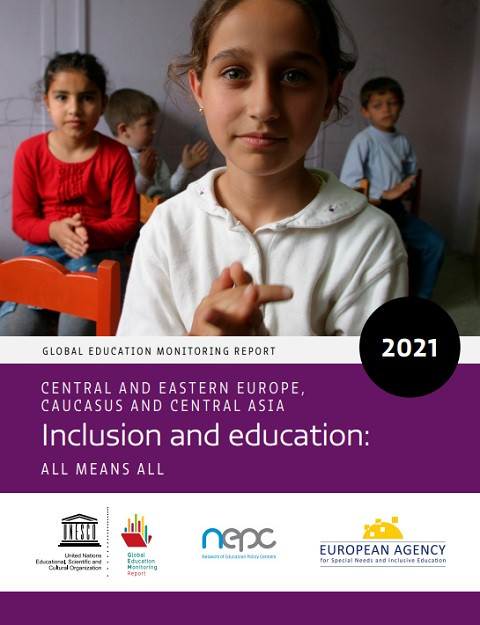 Global Education Monitoring Report, 2021, Central and Eastern Europe, Caucasus and Central Asia: Inclusion and Education; All Means All Year of publication: 2021 Corporate author: Global Education Monitoring Report Team | European Agency for Special Needs and Inclusive Education | Network of Education Policy Centers Prepared by the Global Education Monitoring (GEM) Report, in partnership with the European Agency for Special Needs and Inclusive Education and the Network of Education Policy Centers, the regional report on inclusion and education in Central and Eastern Europe, the Caucasus and Central Asia offers a deep dive into the core challenges and key solutions. The region is working hard to overcome a legacy, whereby children with disabilities attended special schools, once wrongly regarded as an effective solution, segregated by type of disability, if not fully excluded from education.The report draws on in-depth profiles of 30 education systems in the region. It also presents the additional risks to inclusion now posed by the COVID-19 pandemic. Building on the 2020 Global Education Monitoring Report, it documents barriers facing learners, particularly where multiple disadvantages intersect. Its recommendations provide a systematic framework for identifying and dismantling these barriers, according to the principle that ‘every learner matters and matters equally’.