
Resources
Explore a wide range of valuable resources on GCED to deepen your understanding and enhance your research, advocacy, teaching, and learning.
1,322 Results found
 The Impact of the COVID-19 Pandemic on Education: International Evidence From the Responses to Educational Disruption Survey (REDS) Year of publication: 2022 Author: Sabine Meinck | Julian Fraillon | Rolf Strietholt Corporate author: Организация Объединенных Наций по вопросам образования, науки и культуры (UNESCO) | International Association for the Evaluation of Educational Achievement (IEA) The COVID-19 pandemic disrupted education provision at an unprecedented scale, with education systems around the world being impacted by extended school closures and abrupt changes to normal school operations. The Responses to Educational Disruption Survey (REDS) investigated how teaching and learning were affected by the health crisis, and how education stakeholders responded to the educational disruption across and within countries. The study aimed to provide a systemic, multi-perspective, and comparative picture of the situation at the secondary education level (grade eight) in 11 countries spanning Africa, Asia, Arab region, Europe, and Latin America. While many other efforts exist that collect and provide similar information, they are mostly derived from non-representative rapid surveys and lack internationally comparable information from schools, collected in a systematic and scientific manner. The REDS International Report presents unique data, collected from countries, schools, teachers, and students for the first time, in chapters that cover several themes on which data were collected which include student and teacher well-being, students’ academic progress during the school closures, and the measures countries have implemented to keep all children learning. Initial findings provide evidence for better orienting and tailoring policy responses to crisis and provide invaluable information on what may be required to accelerate education, recover from crisis, and to strengthen the resilience of education systems in the future.
  The Journey Towards Comprehensive Sexuality Education: Global Status Report Year of publication: 2021 Corporate author: UNESCO | Joint United Nations Programme on HIV/AIDS (UNAIDS) | United Nations Population Fund (UNFPA) | United Nations Children's Fund (UNICEF) | United Nations Entity for Gender Equality and the Empowerment of Women (UN Women) | World Health Organization (WHO) Comprehensive sexuality education (CSE) is central to children and young people’s well-being, equipping them with the knowledge and skills they need to make healthy and responsible choices in their lives. This report draws on multiple data sources to provide analysis of countries’ progress towards delivering good quality school-based CSE to all learners. 85 per cent of 155 countries surveyed have policies or laws relating to sexuality education, with considerably more countries reporting policies to mandate delivery at secondary education level than at primary level. However, the existence of policy and legal frameworks do not always equate to comprehensive content or strong implementation. Most countries report that they have some curricula in place but more detailed analysis suggests that it often lacks the breadth of topics needed to make sexuality education effective and relevant. Moreover, while efforts to scale-up teacher training are evident in a range of settings, research with teachers shows that many feel they lack confidence to deliver sexuality education. Surveys show that students frequently feel that they received information too late and would have preferred sexuality education to have started earlier in their schooling. There is evidence of opposition to CSE across a range of settings, often reflecting misinformation about the content, purpose or impact of such education. However, in many countries involvement of communities, including parents, school officials, religious leaders, media and young people themselves, has created a favourable environment for CSE. Recommendations to countries in this report include:Clear mandates and budgets to ensure implementation of policies and programmes that support the availability of good quality comprehensive sexuality education for all learners.Invest in quality curriculum reform and teacher training.Strengthen monitoring of the implementation of CSE.
  Global Education Monitoring Report 2021/2: Non-state Actors in Education; Who Chooses? Who Loses? Year of publication: 2021 Corporate author: UNESCO Non-state actors’ role extends beyond provision of schooling to interventions at various education levels and influence spheres. Alongside its review of progress towards SDG 4, including emerging evidence on the COVID-19 pandemic’s impact, the 2021/2 Global Education Monitoring Report urges governments to see all institutions, students and teachers as part of a single system. Standards, information, incentives and accountability should help governments protect, respect and fulfill the right to education of all, without turning their eyes away from privilege or exploitation. Publicly funded education does not have to be publicly provided but disparity in education processes, student outcomes and teacher working conditions must be addressed. Efficiency and innovation, rather than being commercial secrets, should be diffused and practiced by all. To that end, transparency and integrity in the public education policy process need to be maintained to block vested interests. The report’s rallying call – Who chooses? Who loses? – invites policymakers to question relationships with non-state actors in terms of fundamental choices: between equity and freedom of choice; between encouraging initiative and setting standards; between groups of varying means and needs; between immediate commitments under SDG 4 and those to be progressively realized (e.g. post-secondary education); and between education and other social sectors. 全球教育监测报告摘要, 2021/2年: 教育领域的非国家行为体:谁能主动选择?谁将错失机会? Year of publication: 2021 Corporate author: 联合国教科文组织 (UNESCO) 本文件是2021/2022年全球教育检测报告的摘要,主要聚焦教育领域的非国家行为体,包括私人办学、宗教办学等力量,并探讨了与非国家行为体对教育的影响与存在问题。
  L’action de l’UNESCO en faveur de l’égalité des genres dans et par l’éducation: Points majeurs de l’année 2020 Year of publication: 2022 Corporate author: UNESCO Ce rapport présente les points majeurs de l’action menée en 2020 par l’UNESCO pour faire progresser l’égalité des genres dans et par l’éducation.L’action menée par l’UNESCO dans le domaine de l’éducation et du genre est ancrée dans la stratégie de l’UNESCO pour l’égalité des genres dans et par l’éducation 2019-2025. Cette stratégie repose aussi sur l’initiative Son éducation, notre avenir, lancée en parallèle afin de mobiliser les engagements politiques et financiers et de faciliterla coopération et l’action conjointe en faveur de l’éducation des filles et des femmes.
 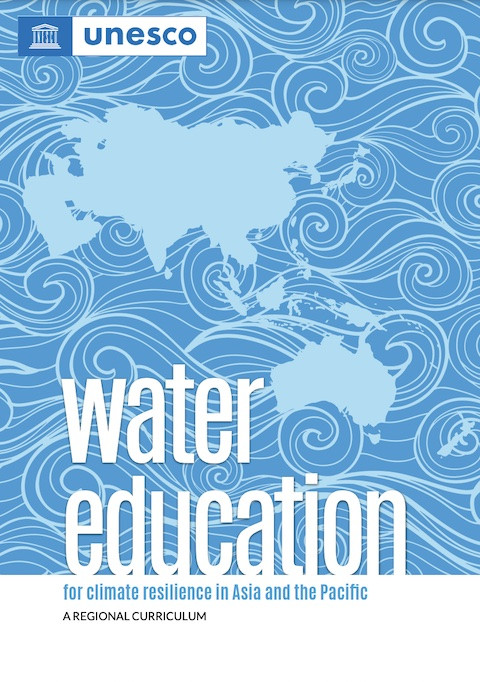 Water Education for Climate Resilience in Asia and the Pacific: A Regional Curriculum Year of publication: 2021 Corporate author: UNESCO A fundamental element towards attaining water security, water education has been at the heart of UNESCO’s Intergovernmental Hydrological Programme since its establishment in 1975.However, in much of Asia and the Pacific, water security remains elusive. Ensuring a water secure future for the region will require the unlocking of broader appreciation, acceptance and internalization of basic water science principles and concepts among experts and communities alike. For this, broader and more effective water education is required.For this potential to be fulfilled, reinforced human, financial and technical resources are required to deliver education, training and capacity development across large segments of society. Not only does this require the mobilization of a much larger contingent of trainers, instructors and conveners—it requires the development of new teaching and learning approaches, methodologies and curricula.This curriculum represents an invitation to tertiary-level educators as well as water managers and decision-makers to redouble efforts towards water security in Asia and the Pacific – and invitation grounded in a process that lies at the heart of UNESCO’s mission: the sharing of knowledge, experience and technologies – in this case among scientific, educational and water management communities across the region.
 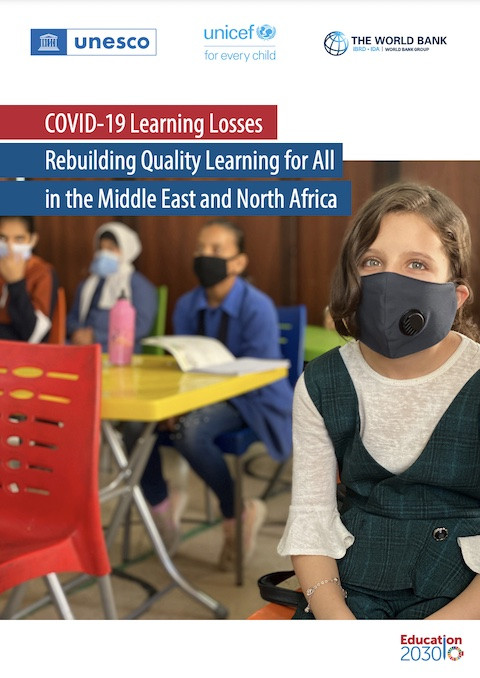 COVID-19 Learning Losses: Rebuilding Quality Learning for All in the Middle East and North Africa Year of publication: 2021 Author: Hana Yoshimoto | Jeannette Vogelaar | Brenda Haiplik Corporate author: UNESCO | United Nations Children's Fund (UNICEF) | World Bank An entire generation of children in the Middle East and North Africa (MENA) is estimated to be affected by the education crisis determined by the COVID-19 pandemic, with potential impacts that are going beyond the immediate/short term and also well beyond the education domain itself, with consequences on children’s socialisation, mental well-being, and future perspective of being active members of their society, including in the labor market. More information on the impact of the crisis would help countries to put in place strategies to mitigate the impacts. Timely investment and action to prevent extreme impacts of this crisis on education are of paramount importance in MENA, which already tackling a learning crisis before the COVID-19 outbreak.This publication delineates the overall education status in MENA after the breakout of COVID-19 pandemic, by presenting the education responses in MENA, and assessing the potential learning loss through a simulation analysis, recommendations are provided on how to build back better and enhance access and quality learning for all.
  Science, Technology and Innovation Policy Instruments for the Sustainable Development Goals: A Global Outlook Year of publication: 2024 Author: Galindo Moreno | Manuel Ricardo Corporate author: UNESCO This publication explores the design, implementation and impact of science, technology and innovation (STI) policy instruments across regions, revealing diverse policy priorities and support strategies. Data from the UNESCO Global Observatory of Science, Technology and Innovation Policy Instruments (GO-SPIN) platform shows that STI policy instruments are closely linked to the SDGs, particularly with SDG 9 (industry, innovation and infrastructure), SDG 8 (decent work and economic growth) and SDG 4 (quality education). Over three-quarters of these policy instruments target these goals. This publication advocates for the use of evidence in designing policies and policy instruments and underscores the importance of continuous monitoring of their implementation. Additionally, it recommends diversifying funding sources, enhancing program management, fostering communication with stakeholders, and applying policy instruments to promote transformative learning.
 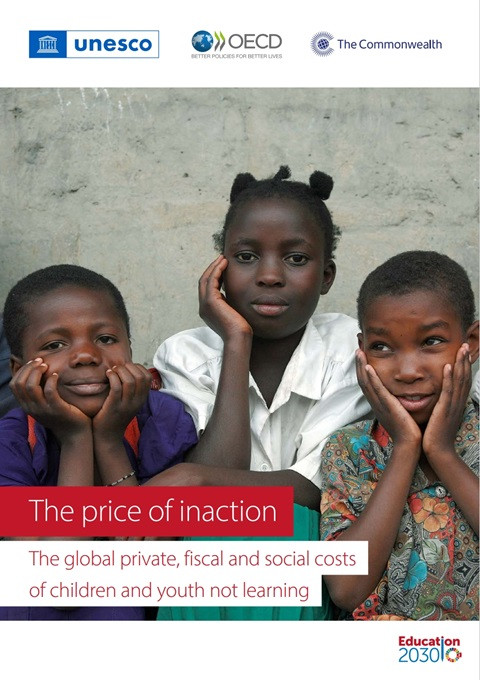 The Price of Inaction: The Global Private, Fiscal and Social Costs of Children and Youth Not Learning Year of publication: 2024 Author: Giorgio Brunello | Lorenzo Rocco | Matthias Eck Corporate author: UNESCO | Organisation for Economic Co-operation and Development (OECD) | Commonwealth Secretariat Despite efforts by countries, the number of out-of-school children remains significant, with 128 million boys and 122 million girls excluded from schooling. Educational skills deficits are also immense – 57 per cent of the world’s children have not gained basic skill levels. UNESCO, OECD and the Commonwealth Secretariat have developed the first global report to illustrate the monetary costs to economies around the world of leaving children and youth behind in education. Using available evidence, the report calculates the costs, globally and by region, of children and youth that are not in school or gaining basic skills. Calculations are also provided for twenty selected countries in which there are gender disparities in education at either girls’ or boys’ expense. If governments were to increase efforts so that every child was in school and achieving basic skills, the future world GDP would raise by more than US$6.5 trillion annually, not to mention eliminating the social costs of failure. This publication offers the evidence and insights that show that for economic development to accelerate, so must prioritizations and investments in education and gender-transformative action.
 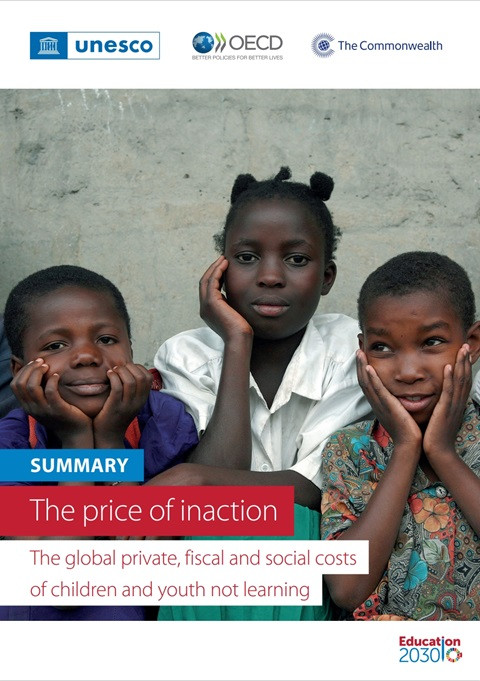 [Summary] The Price of Inaction: The Global Private, Fiscal and Social Costs of Children and Youth Not Learning Year of publication: 2024 Corporate author: UNESCO | Organisation for Economic Co-operation and Development (OECD) | Commonwealth Secretariat Education is a fundamental human right for all. The United Nations Sustainable Development Goal (SDG) 4 on education has received considerable attention since its adoption in 2015. But more than halfway through the implementation period, achieving the ambitious agenda of inclusive and equitable quality education for all by 2030 remains a significant challenge for countries around the globe. As this report shows, the US$10 trillion social cost of failing to educate all the world’s children is just too high. This is the summary of The Price of Inaction: The Global Private, Fiscal and Social Costs of Children and Youth Not Learning.