
Resources
Explore a wide range of valuable resources on GCED to deepen your understanding and enhance your research, advocacy, teaching, and learning.
3,790 Results found
 Le grenier de Sarah Sarah’s attic is a website introducing Shoah History that addresses specifically children from age 8 to 12 with full respect of their sensitivity. This website invites them to watch and hear tales and expressions testifying of the diversity of Jewish cultures transmitted before, during and after the Second World War. In addition, nine personal itineraries bear witness to the daily life of Jews during the war, based on archive documents kept at the Mémorial de la Shoah in Paris. Mémoire et Histoire de la Shoah à l'école This publication is organized according three themes: "History of the Holocaust", "citizenship" and "arts and transmission". It is an valuable guide for primary education teachers, where they can find workshop suggestions and materials for a first approach to the Holocaust topic.
 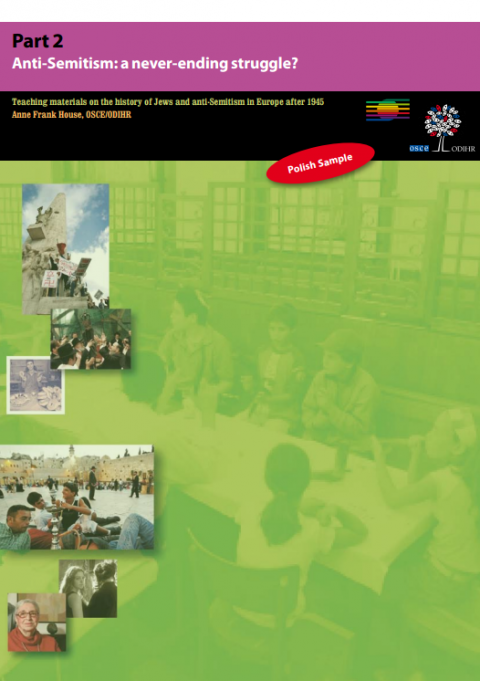 Anti-Semitism: A Never-ending Struggle? (Vol 2) These teaching materials were developed by ODIHR and the Anne Frank House in Amsterdam, in co-operation with experts from several OSCE participating States. Part 2 covers contemporary forms of anti-Semitism. The version available here is an English translation of the Polish version.
 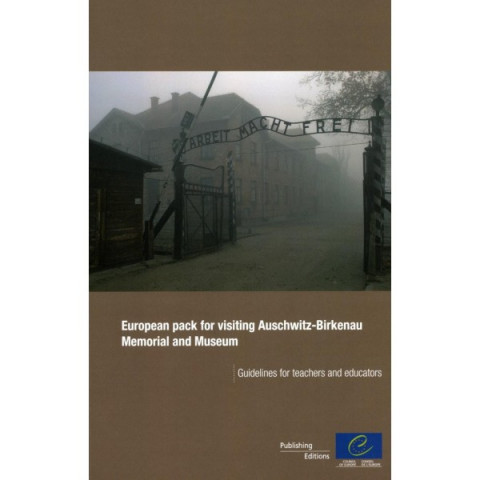 European pack for visiting Auschwitz-Birkenau Memorial and Museum - Guidelines for teachers and educators Taking groups of students to the Auschwitz-Birkenau Memorial and Museum is a heavy responsibility, but it is a major contribution to citizenship if it fosters understanding of what Auschwitz stands for, particularly when the last survivors are at the end of their lives. This pack is designed for teachers wishing to organize student visits to authentic places of remembrance, and for the guides, academics and others who work every day with young people at Auschwitz. To avoid the risk of inappropriate reactions or the failure to benefit from a large investment in travel and accommodation, considerable preparation and discussion is necessary before the visit and serious reflection afterwards. This pack offers insights into the complexities of human behaviour so that students can have a better understanding of what it means to be a citizen. The young people who visit Auschwitz in the next few years will be witnesses of the last witnesses. Their generation will be the last to hear the survivors speaking on the spot. The Council of Europe, the Polish Ministry of Education and the Auschwitz-Birkenau Memorial and Museum are jointly sponsoring this project aimed at preventing crimes against humanity through Holocaust remembrance teaching. (By the Council of Europe) Addressing Anti-Semitism: Why and How? A Guide for Educators These guidelines provide suggestions for teachers and other educators who feel the need to address issues pertaining to contemporary anti-Semitism. Recognizing that the context may vary in every country, or even in individual classrooms, this document provides educators with a general overview of common manifestations of contemporary anti-Semitism, as well as with some key educational principles and strategies for addressing this complex and challenging subject.
  Le parcours citoyen de l'élève Year of publication: 2016 Corporate author: éducscol De l'école au lycée, le parcours citoyen vise à la construction, par l'élève, d'un jugement moral et civique, à l'acquisition d'un esprit critique et d'une culture de l'engagement. La circulaire du 23 juin 2016 en précise les grands objectifs ainsi que les modalités de pilotage et de mise en œuvre. Qu'est-ce-que le parcours citoyen de l'élève ? Une construction commune Outils pour la mise en œuvre du parcours La cérémonie républicaine
  Éducation à la citoyenneté mondiale : Un guide pédagogique Year of publication: 2010 Corporate author: Fondation Éducation et Déveleoppement L’«éducation à la citoyenneté» a pour but d’enseigner les interdépendances mondiales en faisant des liens globaux. Les élèves étudient les différents aspects du même thème à travers les interdé-pendances, les intérêts divergents, les différentes perceptions et valeurs. Ils doivent être capables de se situer dans un monde globalisé et de développer leurs propres valeurs et attitudes. Le Guide d’éducation à la citoyenneté mondiale propose aux enseignant-e-s une méthode d’enseignement qui permettra à leurs élèves de comprendre les interdépendances mondiales.Les bases théoriques vous présentent le concept de l’éducation à la citoyenneté mondiale. Un guide didactique vous aide à préparer votre enseignement.Des exemples vous proposent des idées de mise en œuvre et du matériel pédagogique.
 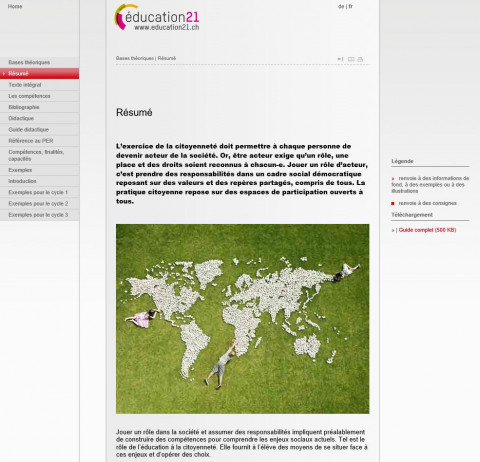 [Résumé] Éducation à la citoyenneté mondiale : Un guide pédagogique Corporate author: Éducation 21 L’exercice de la citoyenneté doit permettre à chaque personne de devenir acteur de la société. Or, être acteur exige qu’un rôle, une place et des droits soient reconnus à chacun-e. Jouer un rôle d’acteur, c’est prendre des responsabilités dans un cadre social démocratique reposant sur des valeurs et des repères partagés, compris de tous. La pratique citoyenne repose sur des espaces de participation ouverts à tous.
  La fondation Zentrum fir politesch Bildung : Un centre pour l’éducation à la citoyenneté Year of publication: 2016 Corporate author: Fondation Zentrum fir politesch Bildung | Le Gouvernement du Grand-Duché de Luxembourg L’éducation à la citoyenneté fait partie des priorités du gouvernement dans le cadre de la politique éducative. Il s’agit de préparer le citoyen, durant son enfance et sa jeunesse, à la transition vers sa vie d’adulte responsable, capable de participer activement à une société en constante évolution, en faisant preuve de tolérance, de respect et d’esprit critique.Le gouvernement a opté pour la création d’une structure indépendante, chargée d’élaborer les concepts pour une éducation à la citoyenneté, tant à l’école que dans les structures d’accueil, de centraliser les efforts, de développer des offres pédagogiques, de mettre en place des campagnes d’information et de promouvoir la compréhension de la démocratie et la participation politique des enfants et des jeunes, …Ce Centre pour l’éducation à la citoyenneté - Zentrum fir politesch Bildung – prend la forme d’une fondation de droit privé afin de garantir son autonomie.
 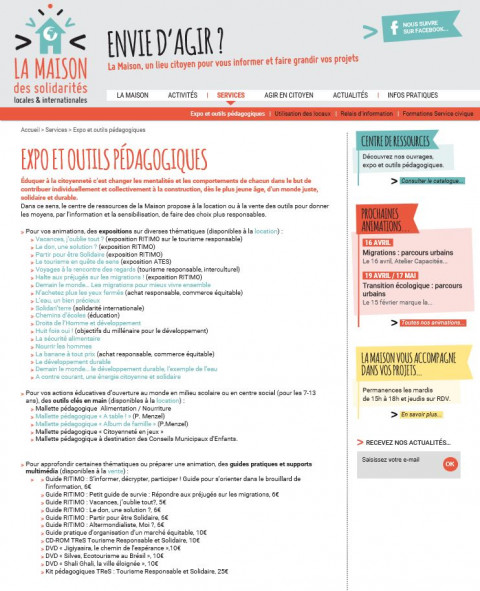 Expo et outils pédagogiques Year of publication: 2015 Corporate author: La maison des solidarités locales et internationales Éduquer à la citoyenneté c’est changer les mentalités et les comportements de chacun dans le but de contribuer individuellement et collectivement à la construction, dès le plus jeune âge, d’un monde juste, solidaire et durable.Dans ce sens, le centre de ressources de la Maison propose à la location ou à la vente des outils pour donner les moyens, par l’information et la sensibilisation, de faire des choix plus responsables.