
Resources
Explore a wide range of valuable resources on GCED to deepen your understanding and enhance your research, advocacy, teaching, and learning.
3,790 Results found
 Seeing, Hearing and Feeling: How Can a Visit to Auschwitz Encourage Young People to Practise Citizenship? In 2005 the first national educational visit to Auschwitz took place for Scottish pupils aged between 16 and 17 years. This study examines the impact this had on pupils in Fife Region, the third largest local authority in Scotland. Soon after this visit, pupils formed ‘The Auschwitz Experience Group’, and over a year organized the ‘Anne Frank and You Festival’, a large-scale community initiative that focused on citizenship issues. The research sought pupil feedback on the educational visit and identified key issues of importance for teachers and cultural managers who work alongside education services. (By the author)
 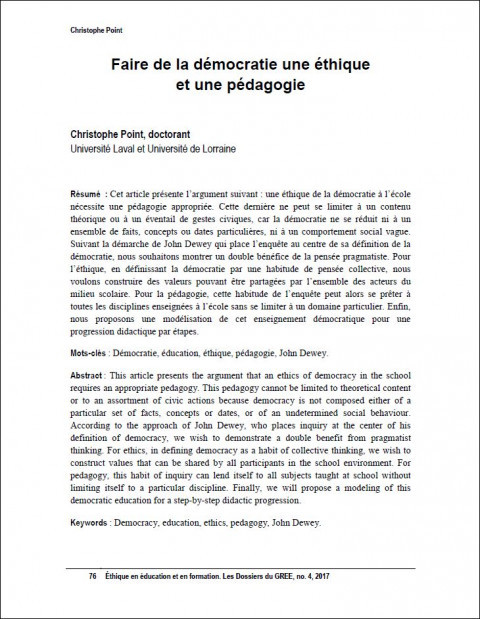 Making Democracy an Ethic and a Pedagogy Year of publication: 2017 Author: Christophe Point Corporate author: Éthique en éducation et en formation This article presents the argument that an ethics of democracy in the school requires an appropriate pedagogy. This pedagogy cannot be limited to theoretical content or to an assortment of civic actions because democracy is not composed either of a particular set of facts, concepts or dates, or of an undetermined social behaviour. According to the approach of John Dewey, who places inquiry at the center of his definition of democracy, we wish to demonstrate a double benefit from pragmatist thinking. For ethics, in defining democracy as a habit of collective thinking, we wish to construct values that can be shared by all participants in the school environment. For pedagogy, this habit of inquiry can lend itself to all subjects taught at school without limiting itself to a particular discipline. Finally, we will propose a modeling of this democratic education for a step-by-step didactic progression. Faire de la démocratie une éthique et une pédagogie Year of publication: 2017 Author: Christophe Point Corporate author: Éthique en éducation et en formation Cet article présente l’argument suivant : une éthique de la démocratie à l’école nécessite une pédagogie appropriée. Cette dernière ne peut se limiter à un contenu théorique ou à un éventail de gestes civiques, car la démocratie ne se réduit ni à un ensemble de faits, concepts ou dates particulières, ni à un comportement social vague. Suivant la démarche de John Dewey qui place l’enquête au centre de sa définition de la démocratie, nous souhaitons montrer un double bénéfice de la pensée pragmatiste. Pour l’éthique, en définissant la démocratie par une habitude de pensée collective, nous voulons construire des valeurs pouvant être partagées par l’ensemble des acteurs du milieu scolaire. Pour la pédagogie, cette habitude de l’enquête peut alors se prêter à toutes les disciplines enseignées à l’école sans se limiter à un domaine particulier. Enfin, nous proposons une modélisation de cet enseignement démocratique pour une progression didactique par étapes. Gathering the voices: Disseminating the message of the Holocaust for the digital generation by applying an interdisciplinary approach The aim of the Gathering the Voices project is to gather testimonies from Holocaust survivors who have made their home in Scotland and to make these testimonies available on the World Wide Web. The project commenced in 2012, and a key outcome of the project is to educate current and future generations about the resilience of these survivors. Volunteers from the Jewish community are collaborating with staff and undergraduate students in Glasgow Caledonian University in developing innovative approaches to engage with school children. These multimedia approaches are essential, as future generations will be unable to interact in person with Holocaust survivors. By students being active participants in the project, they will learn more about the Holocaust and recognize the relevance of these testimonies in today’s society. Although some of the survivors have been interviewed about their journeys in fleeing from the Nazi atrocities, for all of the interviewees, this is the first time that they have been asked about their lives once they arrived in the United Kingdom. The interviews have also focused on citizenship and integration into society. The project is not yet completed, and an evaluation will be taking place to measure the effectiveness of the project in communicating its message to the public. (By the author) "Why are we learning this ?" : Does studying Holocaust Encourage better citizenship values ? Year of publication: 2008 Author: Henry Maitles The relationship between learning about the Holocaust and the development of positive values may seem common sense, but in reality there is a complex level of development and understanding. The research reported here, which was sponsored by the Scottish government, was designed to ascertain whether learning about the Holocaust has an impact on young people’s general citizenship values and attitudes; does learning about the Holocaust allow them to extrapolate from the events of the Holocaust to present-day issues, such as racism and discrimination? The study followed a cohort of approximately 100 pupils (aged 11–12) who had studied the Holocaust and compared their values one year later both to their earlier attitudes and to those of their peers who had not studied the Holocaust. As we might expect, the results were not always as predicted, particularly when it came to the pupils’ understanding of anti-Semitism or genocide; in general, however, the study’s core group maintained more positive values than they had before their lessons on the Holocaust and showed more positive values than their peers who had not studied the Holocaust. (By the author) Intercultural Education : Special Issue : Holocaust Education : Promise, Practice, Power and Potential (Vol 24) Issue 1 & 2 Year of publication: 2013 Corporate author: International Association for Intercultural Education | Routledge "Intercultural Education is a global forum for the analysis of issues dealing with education in plural societies. It provides educational professionals with the knowledge and information that can assist them in contributing to the critical analysis and the implementation of intercultural education." This issue is about the promise, practice, power and potential of Holocaust Education. The Coverage of the Holocaust in High School History textbooks Year of publication: 2009 Author: David H. Lindquist The Holocaust is now a regular part of high school history curricula throughout the United States and, as a result, coverage of the Holocaust has become a standard feature of high school textbooks. As with any major event, it is important for textbooks to provide a rigorously accurate and valid historical account. In dealing with the Holocaust, however, textbook authors face particular challenges. The Holocaust had complex causes, both immediate and long-term; different groups played roles in perpetrating or assisting it; and the meticulous accuracy required in detailing its occurrence imposes many demands on authors. Unlike many other events listed in history textbooks, students have often heard of the Holocaust and may bring considerable prior conceptions of it to the classroom but many of these impressions may come from sources for whom historical accuracy is of little concern. Textbooks are often the first recourse for teachers and students interested in dispelling inaccurate notions and seeking to acquire valid knowledge. In addition, the existence of Holocaust denial makes it crucial that textbook narratives should be completely accurate because deniers often contend that the presence of any error calls into question the actual occurrence of the Holocaust. This article presents the results of a study the author conducted of the treatment of the Holocaust in major history textbooks. While the textbooks provide substantial coverage of the Holocaust, there are also problems in the coverage that can foster inaccurate perspectives about the event. The author recommends that substantive changes be made in future editions of these textbooks to ensure that accurate, comprehensive Holocaust units are presented to students. (By the author) Does addressing prejudice and discrimination through Holocaust education produce better citizens? Year of publication: 2007 Author: Paula Cowan | Henry Maitles Previous research on teaching the Holocaust, primarily case studies in either the primary or the secondary sectors, suggests that Holocaust education can contribute to pupils' citizenship values in a positive way. Yet, in common with other initiatives, this evidence focuses exclusively on the short term impact of Holocaust education. Our ongoing longitudinal research is concerned with both the immediate and longer term effects of Holocaust education on pupils' values and attitudes. Initially focused on primary pupils aged 11–12 years, it has followed them into the first year of secondary to examine whether the general improvements in attitudes found in the first stage of the research has been maintained. Further, we are able to compare their attitudes with pupils in their year who did not study the Holocaust in their primary schools. This article draws conclusions from this study. (By the author)
 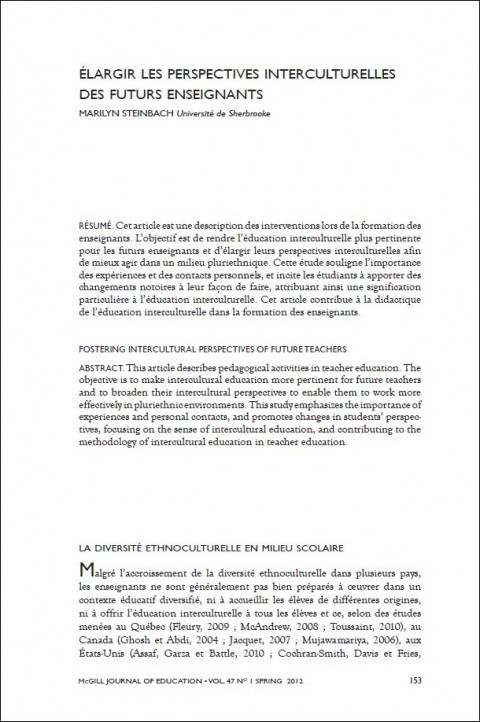 Fostering Intercultural Perspectives of Future Teachers Year of publication: 2012 Author: Marilyn Steinbach Corporate author: McGill University. Faculty of Education This article describes pedagogical activities in teacher education. The objective is to make intercultural education more pertinent for future teachers and to broaden their intercultural perspectives to enable them to work more effectively in pluriethnic environments. This study emphasizes the importance of experiences and personal contacts, and promotes changes in students’ perspectives, focusing on the sense of intercultural education, and contributing to the methodology of intercultural education in teacher education. Élargir les perspectives interculturelles des futurs enseignants Year of publication: 2012 Author: Marilyn Steinbach Corporate author: McGill University. Faculty of Education Cet article est une description des interventions lors de la formation des enseignants. L’objectif est de rendre l’éducation interculturelle plus pertinente pour les futurs enseignants et d’élargir leurs perspectives interculturelles afin de mieux agir dans un milieu pluriethnique. Cette étude souligne l’importance des expériences et des contacts personnels, et incite les étudiants à apporter des changements notoires à leur façon de faire, attribuant ainsi une signification particulière à l’éducation interculturelle. Cet article contribue à la didactique de l’éducation interculturelle dans la formation des enseignants.