
Resources
Explore a wide range of valuable resources on GCED to deepen your understanding and enhance your research, advocacy, teaching, and learning.
130 Results found
 Citizenship and Digital Literacy Plan 2024 Year of publication: 2024 Corporate author: Chile. Ministerio Secretaría General de Gobierno | Chile. Ministerio de Educación The Ministry of the General Secretariat of the Government together with the Ministry of Education have launched the “Citizenship and Digital Literacy” Plan with the aim of addressing the growing challenges, opportunities and risks involved in the use of digital technologies in everyday life. The actions presented in the plan seek to strengthen the skills of citizens in general and also with a focus on educational communities, supported by the frameworks of digital citizenship and media, information and digital literacy. This plan includes three axes: 1.) Training for citizenship and digital literacy; 2.) Incorporation of media literacy and digital citizenship in the national school curriculum; and 3.) Resources and guidelines for strengthening citizenship and digital literacy. Plan ciudadanía y alfabetización digital 2024 Year of publication: 2024 Corporate author: Chile. Ministerio Secretaría General de Gobierno | Chile. Ministerio de Educación El Ministerio Secretaria General de Gobierno junto al Ministerio de Educación han lanzado el Plan “Ciudadanía y Alfabetización Digital” con el objetivo de abordar los crecientes desafíos, oportunidades y riesgos que implica el uso de tecnologías digitales en la vida cotidiana. Las acciones presentadas en el plan buscan fortalecer las competencias de la ciudadanía en general y también con foco en las comunidades educativas, amparados en los marcos de ciudadanía digital y de alfabetización mediática, informacional y digital. Este plan contempla tres ejes: 1.) Formación para la ciudadanía y alfabetización digital; 2.) Incorporación de la alfabetización mediática y la ciudadanía digital en el currículum escolar nacional; y 3.) Recursos y orientaciones para el fortalecimiento de la ciudadanía y la alfabetización digital.
 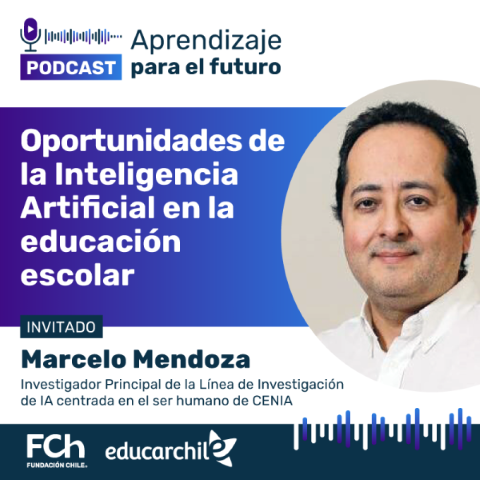 Podcast: Learning for the Future; Opportunities of Artificial Intelligence in School Education Year of publication: 2024 Author: Marcelo Mendoza Corporate author: Chile Foundation | Educarchile In this edition of the podcast: Learning for the Future, we spoke with Marcelo Mendoza, Principal Investigator of the Human-Centered AI Research Line at CENIA, with whom we developed the topic: Opportunities for Artificial Intelligence in school education. We also learned about the experience of the Bicentennial People Help People High School in Pilmaiquén using AI in various processes, together with teacher Cristóbal Morales. Podcast: Aprendizaje para el futuro; Oportunidades de la Inteligencia Artificial en la educación escolar Year of publication: 2024 Author: Marcelo Mendoza Corporate author: Chile Foundation | Educarchile En esta edición del podcast: Aprendizaje para el Futuro, conversamos con Marcelo Mendoza, Investigador Principal de la Línea de Investigación de IA centrada en el ser humano de CENIA, con quien desarrollamos el tema: Oportunidades de la Inteligencia Artificial en la educación escolar. También, conocimos la experiencia del Liceo Bicentenario People Help People de Pilmaiquén usando la IA en diversos procesos, junto al docente Cristóbal Morales.
  Resource Kit for Working With Families in Digital Citizenship Year of publication: 2024 Corporate author: Chile. Ministry of Education The role of families and guardians is essential to help children and adolescents learn to navigate the digital environment, taking advantage of its opportunities and minimizing its risks. For this reason, it is important that schools work with families and guardians to provide support in the digital environment, safeguarding the rights of children and adolescents and promoting their autonomy in a progressive way, through the development of digital citizenship. This kit is composed of: Capsules for parents/guardians that deal with issues related to the digital environment, Booklets “Recommendations for working with families on their mediating role in the use of mobile devices” and a training module “Digital Citizenship”. Kit de recursos para el trabajo con familias en ciudadanía digital Year of publication: 2024 Corporate author: Chile. Ministerio de Educación El rol de las familias y tutores es fundamental para ayudar a los niños, niñas y adolescentes a aprender a desenvolverse en el entorno digital aprovechando sus oportunidades y minimizando sus riesgos. Por esta razón, resulta importante que desde el espacio escolar se trabaje con las familias y tutores para realizar un acompañamiento en el entorno digital, resguardando la protección de los derechos de niños, niñas y adolescentes y favoreciendo su autonomía de forma progresiva, a través del desarrollo de la ciudadanía digital. Este kit está compuesto por: Cápsulas para apoderados/as que tratan temas relacionados con el entorno digital, Cartillas “Recomendaciones para trabajar con familias su rol mediador en el uso de dispositivos móviles” y un módulo de formación “Ciudadanía Digital”.
  Respuestas del sector de educación frente al bullying homofóbico Year of publication: 2013 Corporate author: UNESCO This publication is part of a Good Policy and Practice series that addresses key themes of UNESCO’s work with the education sector including HIV and AIDS and safe, healthy educational environments for all learners. This volume, on the theme of homophobic bullying in educational institutions, builds on UNESCO’s work on gender, discrimination and violence in schools.
  Educación y diversidad cultural: Lecciones desde la práctica innovadora en América Latina Year of publication: 2008 Author: Carolina Hirmas R. Corporate author: UNESCO Esta publicación, que constituye el segundo volumen de la colección, es el resultado del análisis y la reflexión acerca de un conjunto experiencias educati- vas innovadoras de varios países de Latinoamérica, que responden con pertinen- cia pedagógica al contexto cultural de los estudiantes y ofrecen una educación orientada al conocimiento, comprensión y diálogo entre personas de diferentes culturas. El aporte significativo de las experiencias referidas, reside en el reco- nocimiento y valoración de la diversidad étnica y cultural de sus estudiantes y comunidades, como punto de partida para el desarrollo de nuevos aprendizajes y afirmación de su identidad. A su vez, la vida en los centros educativos promueve relaciones interculturales de respeto y fraternidad en un contexto sociogeográfico local y subregional, caracterizado por la multiculturalidad.
  National Education Responses to COVID-19: The Situation of Latin America and the Caribbean Year of publication: 2021 Corporate author: UNESCO The COVID-19 pandemic caused the greatest global, simultaneous interruption of education services in recent history. It has impacted over 90% of the worldwide student population from preschool to higher education.Latin American and Caribbean countries have engaged in enormous efforts to promote continuity of teaching and learning in this context. In spite of this, profound inequities persist in school systems that limit the capacity to reach the entire population.It is imperative to have information that contributes to guiding the actions that may mitigate or reverse the pandemic’s negative impacts on learning and educational inequities.This report presents a regional overview based on the results of the “Survey on National Education Responses to COVID-19,” which was implemented by UNESCO, UNICEF and the World Bank between May and October 2020. Las respuestas educativas nacionales frente a la COVID-19: El panorama de América Latina y el Caribe Year of publication: 2021 Corporate author: UNESCO La pandemia de la COVID-19 provocó la mayor interrupción de servicios educativos, de forma global y simultánea, de la historia reciente y ha afectado a más del 90% de la población mundial de estudiantes, desde la educación preprimaria hasta la educación superior.Los países de América Latina y el Caribe han llevado adelante enormes esfuerzos para promover la continuidad de la enseñanza y el aprendizaje en este contexto. A pesar de ello, persisten en los sistemas escolares profundas inequidades que limitan la capacidad de alcanzar a toda la población.Es imperativo contar con información que contribuya a orientar las acciones que permitan atenuar o revertir los impactos negativos que ha provocado la pandemia en los aprendizajes y en las desigualdades educativas.Para ello este reporte presenta un panorama regional a partir de los resultados de la “Encuesta sobre las respuestas nacionales en materia de educación frente a la COVID-19", implementada por la UNESCO, UNICEF y el Banco Mundial entre mayo y octubre de 2020.