
Resources
Explore a wide range of valuable resources on GCED to deepen your understanding and enhance your research, advocacy, teaching, and learning.
518 Results found
 Estrategias para poner fin a la violencia de género en el ámbito escolar: La experiencia de los sindicatos de la educación en África Year of publication: 2019 Author: Rex Fyles Corporate author: Education International (EI) | United Nations Girls' Education Initiative (UNGEI) | Gender at Work Este documento se basa en la experiencia de nueve organizaciones afiliadas de la IE en siete países africanos comprometidos a combatir la VGAE en sus contextos. Presenta una amplia gama de acciones y estrategias que los sindicatos pueden iniciar para afrontar los desafíos que plantea la VGAE a sus estudiantes, miembros, organizaciones y sociedades. El propósito de esta colección de experiencias sindicales es informar e inspirar a los sindicatos de la educación y sus miembros para que pongan a prueba sus propias iniciativas para eliminar la VGAE. El documento también informará a otros grupos, del sector educación, interesados en aprender más sobre las fortalezas únicas y el papel específico que los sindicatos de la educación pueden desempeñar como socios en los esfuerzos colectivos para acabar con la VGAE.El documento está dividido en dos partes. La primera sección se enfoca en acciones que estos sindicatos han emprendido internamente para adaptar las estructuras de toma de decisiones, actualizar las políticas y desplegar recursos para empoderar a los y las miembros para actuar. La segunda sección da una mirada a cómo los sindicatos de la educación han llegado a otros grupos de interés – legisladores, ministerios, organizaciones de la sociedad civil, líderes tradicionales, padres, medios de comunicación y estudiantes – para desarrollar estrategias coordinadas hacia el cambio. Stratégies pour éradiquer la violence fondée sur le genre en milieu scolaire : L’éxperience des syndicats de l’éducation en afrique Year of publication: 2019 Author: Rex Fyles Corporate author: Education International (EI) | United Nations Girls' Education Initiative (UNGEI) | Gender at Work Le présent document puise dans l’expérience de neuf organisations membres de l’IE dans sept pays africains engagés dans la lutte contre la VGMS dans leur contexte particulier. Il présente la large gamme d’actions et de stratégies que peuvent mettre en œuvre les syndicats de l’enseignement pour relever le défi que la VGMS pose à leurs membres et à leurs élèves, à leurs organisations et à leurs sociétés. Ce recueil d’expériences syndicales est destiné à informer et à encourager les syndicats de l’enseignement et leurs membres à tester leurs propres démarches pour éliminer la VGMS. Il éclairera également les autres acteurs de l’enseignement qui souhaitent en savoir davantage sur les forces uniques et les rôles spécifiques que peuvent jouer les syndicats de l’enseignement dans les efforts collectifs pour mettre fin à la VGMS.Ce document est organisé en deux parties. La première section examine les mesures prises par ces syndicats à l’interne pour adapter leurs structures décisionnelles, mettre à jour leurs politiques et déployer les ressources nécessaires pour permettre à leurs membres d’agir. La seconde section étudie la façon dont les syndicats de l’enseignement ont amorcé le dialogue avec d’autres parties prenantes (législateurs, ministères, organisations de la société civile, responsables traditionnels, parents, médias et élèves) pour mettre en œuvre des stratégies de changement coordonnées.
 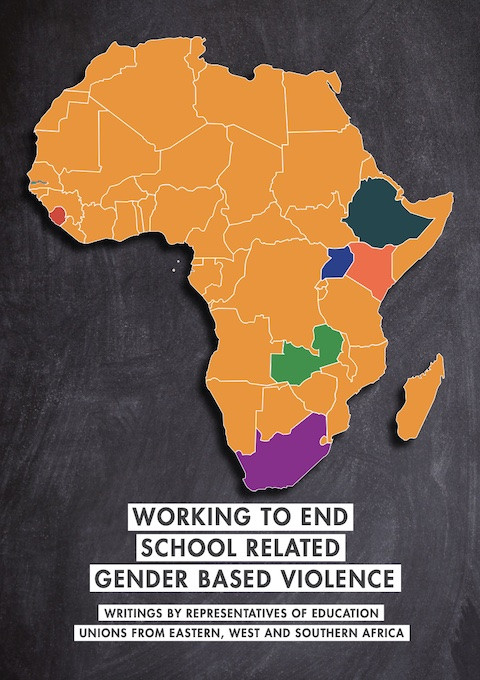 Working to End School Related Gender Based Violence: Writings by Representatives of Education Unions From Eastern, West and Southern Africa Year of publication: 2019 Author: Shamim Meer Corporate author: Gender at Work | Labour Research Service (LRS) | Global Affairs Canada (GAC) | United Nations Girls' Education Initiative (UNGEI) | Education International (EI) School Related Gender Based Violence (SRGBV) is violence that undermines the bodily integrity, human rights, and gender equality of all those involved in the school but primarily that of the school child.In 2016, 7 teacher unions i.e. SADTU and NAPTOSA from South Africa, BETUZ and ZNUT from Zambia, UNATU from Uganda, ETA from Ethiopia and KNUT from Kenya and in 2018, SLTU from Sierra Leone, GTU from the Gambia and the staff from the Ghana-based Education International Regional Africa Office - actively engaged in a Gender at Work - Gender Action Learning Process (GAL).The main aim of this specific GAL process was to create a participatory EI pilot program in Southern, East and West Africa focusing on individual teachers’ and teacher unions’ capacity to address SRGBV. With the support of Gender at Work facilitators, participants strengthened their understanding of gender inequality and gender based violence in the context of the school. Throughout the GAL Process participants spoke from their hearts, sharing inspirational stories of change.
  Global Message of Peace 2017 by Forest Whitaker, UNESCO Special Envoy for Peace and Reconciliation Year of publication: 2017 Corporate author: UNESCO International Institute for Capacity-Building in Africa (IICBA) Global Message of Peace 2017 by Forest Whitaker, UNESCO Special Envoy for Peace and Reconciliation Global Message of Peace 2017 by Forest Whitaker, UNESCO Special Envoy for Peace and Reconciliation Year of publication: 2017 Corporate author: UNESCO International Institute for Capacity-Building in Africa (IICBA) Global Message of Peace 2017 by Forest Whitaker, UNESCO Special Envoy for Peace and Reconciliation Global Message of Peace 2017 by Forest Whitaker, UNESCO Special Envoy for Peace and Reconciliation Year of publication: 2017 Corporate author: UNESCO International Institute for Capacity-Building in Africa (IICBA) Global Message of Peace 2017 by Forest Whitaker, UNESCO Special Envoy for Peace and Reconciliation
 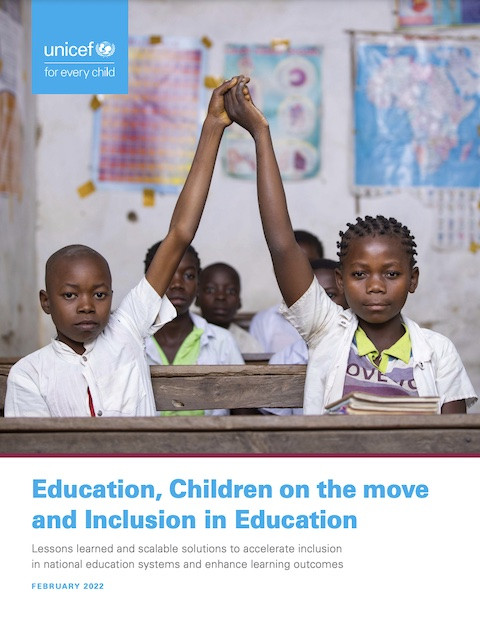 Education, Children on the Move and Inclusion in Education: Lessons Learned and Scalable Solutions to Accelerate Inclusion in National Education Systems and Enhance Learning Outcomes Year of publication: 2022 Author: Neven Knezevic | Katherine Curtiss | Eric Gero Corporate author: United Nations Children's Fund (UNICEF) This report summarizes how UNICEF and its partners have contributed to the creation of education solutions that support the skills development and educational attainment of children on the move in countries and regions across the world. Country case studies highlighting best practices from 19 countries and the East African and Sahel regions showcase UNICEF’s work with country governments on issues such as the inclusion of refugees in national education systems and improving relations between refugee children, their families, and their host communities.
  Connect With Respect: Preventing Gender-Based Violence in Schools; Classroom Programme for Learners in Upper Primary and Early Secondary School (Ages 12-15) Year of publication: 2021 Author: Helen Cahill | Sally Beadle | Michelle Davis | Anne Farrelly | Katherine Romei Corporate author: UNESCO Harare This toolkit for schools in the region addresses the growing issue of school violence, including bullying and gender-based violence. The tool from the programme Connect with Respect (CwR) guides teachers in lower secondary schools to deliver a range of activities with their students. The activities can be integrated within a range of subjects, including literacy, social studies, civics/citizenship education, health, life skills and sexuality education.
  Citizenship and Civics: Learn From These Young Senegalese Leaders Year of publication: 2020 Corporate author: Vibe Radio Senegal This is a video of young Senegalese leaders presenting on Citizenship and civics. La citoyenneté et le civisme: Apprenez de ces jeunes leaders sénégalais Year of publication: 2020 Corporate author: Vibe Radio Senegal C'est une vidéo de jeunes leaders sénégalais présentant sur Citoyenneté et civisme.