
Resources
Explore a wide range of valuable resources on GCED to deepen your understanding and enhance your research, advocacy, teaching, and learning.
3,777 Results found
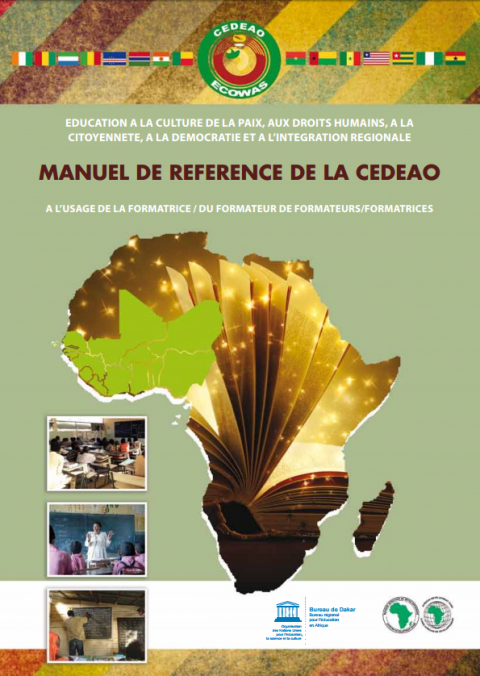 EDUCATION A LA CULTURE DE LA PAIX, AUX DROITS HUMAINS, A LA CITOYENNETE, A LA DEMOCRATIE ET A L’INTEGRATION REGIONALE MANUEL DE REFERENCE DE LA CEDEAO A L’USAGE DE LA FORMATRICE / DU FORMATEUR DE FORMATEURS/FORMATRICES Year of publication: 2013 Corporate author: UNESCO Dakar | Economic Community of West African States (ECOWAS) The manual comprises seven modules dealing with the Culture of Peace and Conflict Management; Human Rights; Civism and Citizenship; Democracy and Good Governance; Gender and Development; Public Health, Environment and Sustainable Development; and Regional Integration. Each module has sub-themes with introductions, reference materials, general objectives to guide the trainer and generic pedagogical tables that are flexible enough to be adapted to available teaching resources in the different ECOWAS countries. It is also suitable and adaptable to the training of teachers involved in both formal and non-formal education delivery at different levels of teaching and learning. The ultimate goal of the Manual is to build a critical mass of ECOWAS citizens equipped with competent skills, not only for cognitive and psycho-motor domains of education, but also affective skills for positive values, attitudes and behaviors that promote peace, tolerance and peaceful co-existence of community citizens.
  Guide d'utilisation du manuel d'apprentissage de la démocratie pour les jeunes en Tunisie, à l'attention des formateurs et adultes-relais Year of publication: 2013 Corporate author: UNESCO Rabat The main aim of these manual and guide is to raise awareness among Tunisian youth about the values of democracy, human rights and responsible citizenship, and empower youth to make their voice heard during this critical period in the Tunisian democratic transition.
  Guide on Human Rights Education Curriculum Development Year of publication: 2021 Author: Cecilia Decara | Carol Rask | Felisa Tibbitts Corporate author: Danish Institute for Human Rights This document aims to bring conceptual clarity on human rights education and curriculum development and provide concrete suggestions on how to build human rights curricula ft for 21st century human rights challenges, while contributing to the realisation of the SDG goals and targets set by the international community.
  2023 Asia-Pacific Regional Global Citizenship Education (GCED): Network Activities Summary Report Year of publication: 2023 Author: Seek Ling Tan Corporate author: UNESCO Bangkok This is a summary report from the Global Citizenship Education (GCED) network activities in Asia-Pacific in 2023. The Asia-Pacific Regional Global Citizenship Education Network, spearheaded by UNESCO Bangkok and the Asia-Pacific Centre of Education for International Understanding (APCEIU), has illuminated the path to empower learners to become global citizens since its inception in 2018. In 2023, their journey was punctuated by significant milestones and a revitalized commitment to propel GCED across the region. This commitment is particularly evident in the key priority areas of advocacy, capacity building, learning/teaching materials, policy and research and the synergizing of regional collaboration towards Education 2030.
  School Convivencia : Reviewing the Concept (Psicoperspectivas; No. 18, Vol. 1) Year of publication: 2019 Author: Cecilia Fierro-Evans | Patricia Carbajal-Padilla Corporate author: Catholic University of Valparaíso. School of Psychology This article reports an effort to review the concept of school convivencia (peaceful coexistence, living together) in the Spanish context with the purpose of advancing into its clarification, and thus contributing to developing a common language in the Latin American region. The authors conduct a basic literature review oriented to identify the main theoretical approaches in the convivencia field. Subsequently, they analyze four studies focused in systematizing the prevailing approaches in the study of school convivencia. As a result, they propose a concept of convivencia from a social justice perspective adapted to education, and they operationalize it in three areas of school life: pedagogical-curricular, organizationaladministrative, and the socio-communitarian. This comprehensive notion of school convivencia may guide future research, educational initiatives, and school assessments in the convivencia field that may respond to the violence and pervasive social exclusion that exist in the Latin American region. Convivencia escolar: Una revisión del concepto (Psicoperspectivas; No. 18, Vol. 1) Year of publication: 2019 Author: Cecilia Fierro-Evans | Patricia Carbajal-Padilla Corporate author: Catholic University of Valparaíso. School of Psychology El presente trabajo reporta un ejercicio de revisión del concepto de convivencia escolar con vistas a apoyar su clarificación y, por tanto, contribuir al desarrollo de un lenguaje común en la región latinoamericana. Para ello las autoras conducen un trabajo documental orientado a identificar los principales enfoques teóricos en la literatura de convivencia. Posteriormente analizan cuatro estudios enfocados a sistematizar los enfoques prevalecientes en el estudio de la convivencia escolar. Como resultado, proponen un concepto de convivencia desde la perspectiva de la justicia social adaptada a la educación y lo operacionalizan en tres ámbitos de la vida escolar: pedagógico-curricular, organizativo-administrativo y socio-comunitario. Esta noción comprehensiva de la convivencia escolar podría apoyar la realización de investigaciones futuras, propuestas educativas y evaluaciones de convivencia escolar que ofrezcan una respuesta a la violencia y a la persistente exclusión social que existe en la región latinoamericana.
 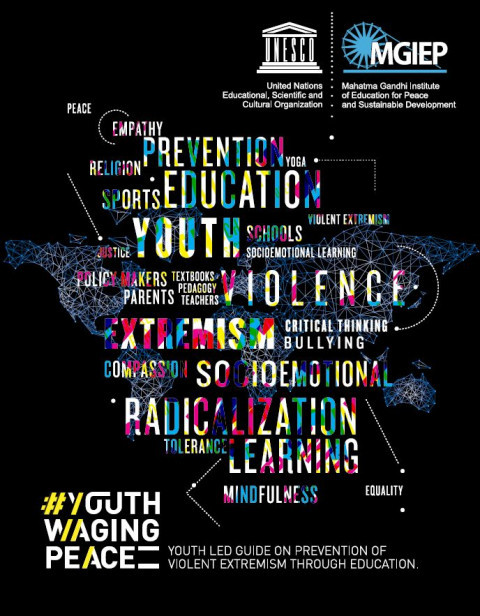 Youth Led Guide on Prevention of Violent Extremism through Education Year of publication: 2017 Author: Carolyn Nash | Yulia Nesterova | Kenneth Primrose | Wing Yu Alice Chan | Rios, Paul A. Chan | María José Velásquez Flores | Aniqah Zowmi Corporate author: Mahatma Gandhi Institute of Education for Peace and Sustainable Development (MGIEP) In September 2016, the education sector from the UNESCO headquarters and the UNESCO category 1 research Institute, the UNESCO Mahatma Gandhi Institute of Education for Peace and Sustainable Development(MGIEP) organised the first International Conference on Prevention of Violent Extremism through Education: Taking Action, in New Delhi, India. The usual plethora of reports and guides produced by experts on the subject, roundtables and expert panels were organised.But something different also happened. UNESCO MGIEP brought 50 youth from across the world rigorously selected through six week online discussion on the subject to participate in a first of its kind, “Talking Across Generations on Education (TAGe)” event. This event organised as a plenary session—not a side or lunch event—brought together these youth in a non-hierarchical “flat” dialogue with about 12 senior policymakers on the challenges and opportunities the youth see in preventing violent extremism through education.The conference culminated with the presentation of a “Youth Action Plan” containing three clear tangible action points. One action point was the development of a youth-led guide on Prevention of Violent Extremism through Education. This Guide is the result of that call to action.The Institute circulated a global call to youth who were willing to take up the challenge of producing the Guide. After a rigorous search based on a well-defined set of criteria, two coordinating lead authors were identified. These authors were then tasked to find the remaining authors who they saw fit to contribute to the Guide and this team then reached out to the wider group of youth to solicit their experiences and guidance in producing the Guide. The youth have done their part. They have reached out to more than 2,000 young people from more than 50 countries, collated their ideas and experiences and finally featured more than 150 unique voices into this document.
 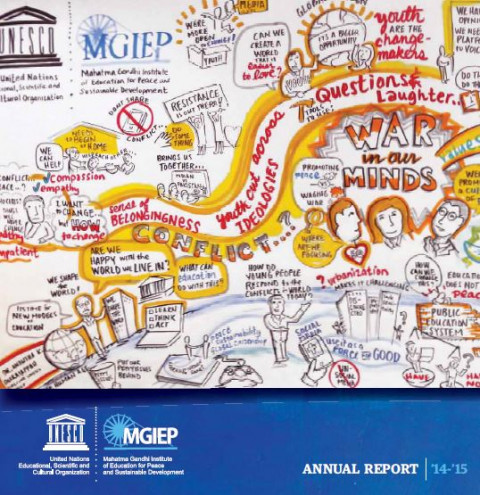 MGIEP Annual Report '14-'15 Year of publication: 2016 Corporate author: Mahatma Gandhi Institute of Education for Peace and Sustainable Development (MGIEP) The Mahatma Gandhi Institute of Education for Peace and Sustainable Development (MGIEP) is UNESCO’s first Category I institute in the Asia-Pacific region, established with the generous support of the Government of India. UNESCO MGIEP focuses on transforming current education policies and practices by developing innovative teaching and learning methods.Their objective is to build generations of young people equipped to create peaceful and sustainable societies. This annual report describes MGIEP’s main works and various educational programmes for peace and sustainable development.
  Empathy, Perspective and Complicity: How Digital Games can Support Peace Education and Conflict Resolution Year of publication: 2016 Author: Paul Darvasi Corporate author: Mahatma Gandhi Institute of Education for Peace and Sustainable Development (MGIEP) This paper will address how digital games may be uniquely suited to further the work of peace education and conflict resolution. There is a scarcity of research that specifically studies how digital games, as dynamic and interreactive learning tools, can be leveraged to support and enhance the closely related fields of peace education or conflict resolution; however, research in a number relevant sectors will be recruited to better understand the topic and expose gaps for further work. After defining basic terms, the first section will briefly discuss the aims of peace education and interactive conflict resolution and how digital games can assist in facilitating intergroup contact and collaboration. The heart of the paper will examine several serious games for their potential to cultivate perspective-taking and empathy, explore ethical dilemmas, promote intercultural understanding and encourage a sense of complicity, all crucial components in the work of peace education and conflict resolution. The final section will discuss the importance of context and reflection when implementing digital games and consider whether they can produce long-term, sustainable changes to behaviors and attitudes.
 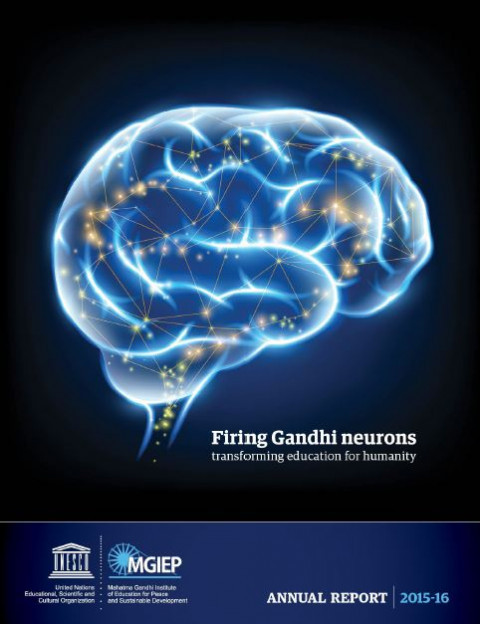 MGIEP Annual Report 2015-2016 Year of publication: 2017 Corporate author: Mahatma Gandhi Institute of Education for Peace and Sustainable Development (MGIEP) The Mahatma Gandhi Institute of Education for Peace and Sustainable Development (MGIEP) is UNESCO’s first Category I institute in the Asia-Pacific region, established with the generous support of the Government of India.UNESCO MGIEP focuses on transforming current education policies and practices by developing innovative teaching and learning methods. Their objective is to build generations of young people equipped to create peaceful and sustainable societies.This annual report describes MGIEP’s main works and various educational programmes for peace and sustainable development.