
Resources
Explore a wide range of valuable resources on GCED to deepen your understanding and enhance your research, advocacy, teaching, and learning.
685 Results found
 United Nations Global Principles for Information Integrity : Recommendations for Multi-stakeholder Action Year of publication: 2024 Corporate author: United Nations (UN) Technological advances have revolutionized communications, connecting people on a previously unthinkable scale. They have supported communities in times of crisis, elevated marginalized voices and helped mobilize global movements for racial justice and gender equality. Yet these same advances have enabled the spread of misinformation, disinformation and hate speech at an unprecedented volume, velocity and virality, risking the integrity of the information ecosystem. New and escalating risks stemming from leaps in AI technologies have made strengthening information integrity one of the urgent tasks of our time. This clear and present global threat demands coordinated international action. The United Nations Global Principles for Information Integrity show us another future is possible. Principes mondiaux des Nations Unies pour l’intégrité de l’information: Recommandations pour une action multipartite Year of publication: 2024 Corporate author: United Nations (UN) Les avancées technologiques ont révolutionné les communications, connectant les personnes à une échelle autrefois inimaginable. Elles ont soutenu les communautés en temps de crise, amplifié les voix marginalisées et contribué à la mobilisation mondiale pour la justice raciale et l’égalité des genres. Pourtant, ces mêmes avancées ont également favorisé la propagation de la désinformation, des informations fallacieuses (ou « fake news ») et des discours de haine à une vitesse, une ampleur et une viralité sans précédent, menaçant ainsi l’intégrité de l’écosystème informationnel. Les risques émergents et croissants liés aux progrès rapides de l’intelligence artificielle font du renforcement de l’intégrité de l’information l’un des défis les plus urgents de notre époque. Cette menace mondiale, claire et actuelle, exige une action internationale coordonnée. La publication Principes mondiaux des Nations Unies pour l’intégrité de l’information nous montrent qu’un autre avenir est possible.
  Podcast: Learning for the Future; Digital Citizenship; Tools to Prevent and Eradicate Cyberbullying Year of publication: 2022 Author: Alheli Arona | Patricio Romero Corporate author: Chile Foundation | Educarchile One of the dimensions of digital citizenship is protection and security. This includes digital harassment or cyberbullying, a problem that affected more than 22% of students in Chile during the months of October and December 2021, according to the Citizen Participation Survey “Together against cyberbullying and digital violence” applied by the Superintendency of Education. What can we, as teachers, management teams and education professionals, do to prevent and eradicate this type of violence and help our students? Podcast: Aprendizaje para el futuro; Ciudadanía digital; Herramientas para prevenir e irradicar el ciberacoso Year of publication: 2022 Author: Alheli Arona | Patricio Romero Corporate author: Chile Foundation | Educarchile Una de las dimensiones de la ciudadanía digital es la protección y la seguridad. Dentro de esta se encuentra el acoso digital o ciberacoso, un problema que durante los meses de octubre y diciembre de 2021 afectó a más de un 22% de estudiantes en Chile según la Encuesta de Participación Ciudadana “Juntos frente al ciberacoso y la violencia digital” aplicada por la Superintendencia de Educación. ¿Qué podemos hacer las y los docentes, equipos directivos y profesionales de la educación para prevenir y erradicar este tipo de violencia y ayudar a nuestros estudiantes?
  The Impact of AI on Curriculum Systems: Towards an Orbit-Shifting Dialogue (In-Progress Reflection; no. 32, 2019) Year of publication: 2019 Corporate author: UNESCO International Bureau of Education (IBE) ‘Artificial Intelligence’ (AI) refers to the theory and development of computer systems able to perform tasks normally requiring human intelligence. In order to achieve transformational change in contemporary curriculum systems and learning environments, we need to engender an orbitshifting dialogue about the potential relationship between AI and education, in terms of both independent variables (threats), and dependent variables (opportunities). Through such a dialogue, we need to create foresight indicators that can predict the process of this relationship. It is, however, crucial that the relationship between AI and education is strong and directly proportionate. If the potential of the relationship is not exploited sufficiently, then underdeveloped education systems will lag behind and fail to achieve their potential for transformation, whether radical or incremental. Indeed, some may even become obsolete. The paper contends that in order to effectively contribute to the knowledge economy and to sustainable development in the age of the 4th Industrial Revolution (characterized by a fusion of cyber-physical technologies) modern educational systems need to overcome obstacles to innovation in order to maximize the potential for transformative change. To achieve this will require an ‘orbital shift’ in educational planning, practice and resourcing, to enable schools to respond more effectively to the rapidly changing needs of young people, society, the economy and environment in the third decade of the 21st century. Schools, educational institutions and environments, need to transform from being primarily spaces for teaching and taking exams, into spaces for innovation and personal learning, based on a culture of actively listening to the voices, choices, needs and goals of learners. Teachers need to become facilitators, coaches and mentors for learners. Schools need to create AI-enabled, flexible, collaborative working spaces. Visionary, energetic educational leaders need to communicate effectively with all stakeholders, including employers and parents, to inspire and manage change and smart decision-making to develop schools of the future. The aim of this reflection is to initiate an ‘orbit-shifting’ dialogue about the potential of AI applications to transform all components of the curriculum system to meet emergent 21st century educational goals. The conceptualization aims to explore the variable roles and impact of curriculum learning and assessment on these emerging educational goals. Theme 1 of the paper outlines the concepts and characteristics of a range of existing AI systems and their potential to enhance teaching learning and assessment. Theme 2 reflects on the potential to embrace AI systems across the curriculum system. Theme 3 proposes an action model to enable AI to have an ‘orbit shifting impact’ on all the components of the curriculum system (i.e. learners, teachers, learning environments, leadership and management, content, pedagogy and assessment) by enhancing opportunities for individualization, creativity and uniqueness.
 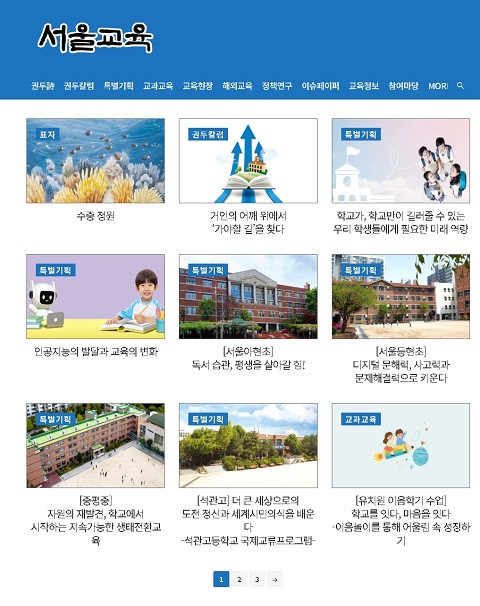 서울교육 2024년 여름호 (제66권 통권 255호) Year of publication: 2024 Corporate author: 서울특별시교육청 교육연구정보원 권두칼럼: 거인의 어깨 위에서 ‘가야할 길’을 찾다 특별기획:- 학교가, 학교만이 길러줄 수 있는 우리 학생들에게 필요한 미래 역량- 인공지능의 발달과 교육의 변화- [서울아현초] 독서 습관, 평생을 살아갈 힘!- [서울등현초] 디지털 문해력, 사고력과 문제해결력으로 키운다- [중평중] 자원의 재발견, 학교에서 시작하는 지속가능한 생태전환교육- [석관고] 더 큰 세상으로의 도전 정신과 세계시민의식을 배운다: 석관고등학교 국제교류프로그램 교과교육:- [유치원 이음학기 수업] 학교를 잇다, 마음을 잇다: 이음놀이를 통해 어울림 속 성장하기- [특수학급 국제 공동 수업] 바다를 넘고 장애를 넘는 특별한 우정 프로젝트- [초등학교 생태전환교육 수업] 기후 위기? 예술로 공존!- [중학교 역지사지 공존형 토론 수업] 경쟁이 아닌 공존을 위한 토론!교과교육- [고등학교 인공지능 활용 수업] 인공지능과 함께 성장하는 수학수업- [학급운영 현장보기] 육개장 사발면반 제자들과의 시간- [체험·문화·예술활동 Ⅰ] 예술의 언어로 소통하며 공동체를 이루다: 중학교 맞춤형 예술 교육- [체험·문화·예술활동 Ⅱ] 나를 발견하게 하고, 나를 표현하게 하는 “예술교육”: 고등학교 협력종합예술활동- [학교현장 미리보기] AI 디지털교과서를 통한 미래교육 엿보기 정책연구: 학교수업 내 에듀테크 활용 정도가 중학생의 교육적 성장에 미치는 영향 분석 정책연구 교육정보:- 2024년 강화된 교육활동 보호 정책, 이것만큼은 꼭 알아두세요- 돌봄과 배움이 공존하는 서울형 늘봄학교- 수업-평가의 연계성 강화를 위한 초 · 중등학교 정보공시(교수학습 및 평가계획 관련) 개정 안내- 메타버스는 정말 끝났을까? 참여마당:- [웹툰] 알찬 여름방학 보내기- [수기] 뮤지컬 배우가 꿈이었던 교사, 학교에서 뮤지컬을 꿈꾸다- [서평] 쉬운 공공의 언어는 인권이다: 이건범 『언어는 인권이다』를 읽고- [후기] 모니터단 2024 ‘봄호’ 후기 갤러리: “어린이·청소년의 미래역량 신장을 위해 노력합니다!”
  Generative AI and the Future of Education Year of publication: 2023 Corporate author: UNESCO. Assistant Director-General for Education, 2018- (Giannini, Stefania) The digital revolution has brought about significant changes in how we live, learn, and interact, with multiple waves of technological advancements. The current AI revolution represents a new and profound shift, particularly through AI's ability to simulate human language and conversation. This development challenges our understanding of language, intelligence, and the role of technology in education and society.As AI begins to generate human-like responses and knowledge, it raises fundamental questions about its impact on education, societal values, and our concept of humanity. Education systems are now grappling with how to integrate and regulate AI, which has been rapidly introduced into classrooms without sufficient oversight. The author emphasizes the importance of carefully considering the risks and ethical implications of AI, particularly in its potential to manipulate and shape knowledge systems. There is a need for balanced development, where AI technology is aligned with human values, and education remains a deeply human-centered process.UNESCO is working with countries to develop strategies for the safe use of AI in education, emphasizing the need for a cautious approach and robust regulatory frameworks. The overarching message is that while AI offers immense possibilities, it must be integrated thoughtfully to ensure it enhances education and society without undermining human agency, equity, or the foundational values of learning. La IA generativa y el futuro de la educació Year of publication: 2023 Corporate author: UNESCO. Assistant Director-General for Education, 2018- (Giannini, Stefania) La revolución digital ha traído cambios significativos en cómo vivimos, aprendemos e interactuamos, con múltiples olas de avances tecnológicos. La actual revolución de la inteligencia artificial representa un cambio nuevo y profundo, particularmente a través de la capacidad de la IA para simular el lenguaje humano y la conversación. Este desarrollo desafía nuestra comprensión del lenguaje, la inteligencia y el papel de la tecnología en la educación y la sociedad. A medida que la IA comienza a generar respuestas y conocimientos similares a los humanos, surgen preguntas fundamentales sobre su impacto en la educación, los valores sociales y nuestro concepto de humanidad. Los sistemas educativos ahora están lidiando con la forma de integrar y regular la IA, que ha sido introducida rápidamente en las aulas sin una supervisión adecuada. El autor enfatiza la importancia de considerar cuidadosamente los riesgos y las implicaciones éticas de la IA, particularmente en su potencial para manipular y moldear los sistemas de conocimiento. Existe una necesidad de un desarrollo equilibrado, donde la tecnología de la IA esté alineada con los valores humanos y la educación siga siendo un proceso profundamente centrado en el ser humano. UNESCO está trabajando con los países para desarrollar estrategias para el uso seguro de la IA en la educación, enfatizando la necesidad de un enfoque cauteloso y marcos regulatorios robustos. El mensaje general es que, si bien la IA ofrece inmensas posibilidades, debe integrarse de manera reflexiva para asegurar que mejore la educación y la sociedad sin socavar la agencia humana, la equidad o los valores fundamentales del aprendizaje. L’IA générative et le futur de l’éducation Year of publication: 2023 Corporate author: UNESCO. Assistant Director-General for Education, 2018- (Giannini, Stefania) La révolution numérique a apporté des changements significatifs dans nos modes de vie, d'apprentissage et d'interaction, avec plusieurs vagues de progrès technologiques. La révolution actuelle de l'IA représente un nouveau tournant profond, notamment grâce à la capacité de l'IA à simuler le langage et la conversation humaine. Ce développement remet en question notre compréhension du langage, de l'intelligence et du rôle de la technologie dans l'éducation et la société.Alors que l'IA commence à générer des réponses et des connaissances semblables à celles des humains, cela soulève des questions fondamentales quant à son impact sur l'éducation, les valeurs sociétales et notre conception de l'humanité. Les systèmes éducatifs se retrouvent désormais face au défi d'intégrer et de réguler l'IA, qui a été introduite rapidement dans les salles de classe sans une supervision suffisante. L'auteur insiste sur l'importance de prendre en compte les risques et les implications éthiques de l'IA, en particulier son potentiel à manipuler et à influencer les systèmes de connaissance. Il est nécessaire d'adopter un développement équilibré, où la technologie de l'IA est en phase avec les valeurs humaines, et où l'éducation reste un processus profondément centré sur l'humain.L'UNESCO travaille avec les pays pour élaborer des stratégies visant à utiliser l'IA en toute sécurité dans l'éducation, en insistant sur la nécessité d'une approche prudente et de cadres réglementaires solides. Le message principal est que, bien que l'IA offre d'immenses possibilités, elle doit être intégrée de manière réfléchie afin de garantir qu'elle améliore l'éducation et la société sans compromettre l'autonomie humaine, l'équité ou les valeurs fondamentales de l'apprentissage.
  The Butterfly Effect on Social Networks Year of publication: 2021 Corporate author: Canada Learning Code This video shows the dangers of the internet and social networks through the story of 12-year-old Amira in the form of a comic strip.