
Resources
Explore a wide range of valuable resources on GCED to deepen your understanding and enhance your research, advocacy, teaching, and learning.
2,161 Results found
 Ouvrez de nouvelles fenêtres pour semer la paix: la construction de la citoyenneté ... Year of publication: 2015 Author: Tatiana Zuluaga Zapata | Carlos Humberto Vélez Ocampo | Laura Juliana Pachón Rodríguez | María Julieta Ortiz Fernández Corporate author: Bogotá. Secretaría de Educación del Distrito (SED) Ce document vise à aider les élèves à venir avec des idées novatrices pour générer des transformations pour la paix et la citoyenneté en Colombie. Il est destiné à créer une mobilisation consciente le 9 Avril, lors de la commémoration des victimes et des disparus en Colombie, et a l'intention des citoyens de motivation pour remplir les rues avec joie, faire entendre leur voix et engager à la paix. Abrir nuevas ventanas para sembrar la paz: una ciudadanía que construye… Year of publication: 2015 Author: Tatiana Zuluaga Zapata | Carlos Humberto Vélez Ocampo | Laura Juliana Pachón Rodríguez | María Julieta Ortiz Fernández Corporate author: Bogotá. Secretaría de Educación del Distrito (SED) This document aims to help students come with innovative ideas to generate transformations for peace and citizenship in Colombia. It is aimed at creating a conscious mobilization every April 9, during the commemoration of the victims and the missing in Colombia, and has the intention of motivating citizens to fill the streets with joy, raise their voices and commit to peace.
  EDUCATION A LA CULTURE DE LA PAIX, AUX DROITS HUMAINS, A LA CITOYENNETE, A LA DEMOCRATIE ET A L’INTEGRATION REGIONALE MANUEL DE REFERENCE DE LA CEDEAO A L’USAGE DE LA FORMATRICE / DU FORMATEUR DE FORMATEURS/FORMATRICES Year of publication: 2013 Corporate author: UNESCO Dakar | Economic Community of West African States (ECOWAS) The manual comprises seven modules dealing with the Culture of Peace and Conflict Management; Human Rights; Civism and Citizenship; Democracy and Good Governance; Gender and Development; Public Health, Environment and Sustainable Development; and Regional Integration. Each module has sub-themes with introductions, reference materials, general objectives to guide the trainer and generic pedagogical tables that are flexible enough to be adapted to available teaching resources in the different ECOWAS countries. It is also suitable and adaptable to the training of teachers involved in both formal and non-formal education delivery at different levels of teaching and learning. The ultimate goal of the Manual is to build a critical mass of ECOWAS citizens equipped with competent skills, not only for cognitive and psycho-motor domains of education, but also affective skills for positive values, attitudes and behaviors that promote peace, tolerance and peaceful co-existence of community citizens.
  Guide d'utilisation du manuel d'apprentissage de la démocratie pour les jeunes en Tunisie, à l'attention des formateurs et adultes-relais Year of publication: 2013 Corporate author: UNESCO Rabat The main aim of these manual and guide is to raise awareness among Tunisian youth about the values of democracy, human rights and responsible citizenship, and empower youth to make their voice heard during this critical period in the Tunisian democratic transition.
  Guide on Human Rights Education Curriculum Development Year of publication: 2021 Author: Cecilia Decara | Carol Rask | Felisa Tibbitts Corporate author: Danish Institute for Human Rights This document aims to bring conceptual clarity on human rights education and curriculum development and provide concrete suggestions on how to build human rights curricula ft for 21st century human rights challenges, while contributing to the realisation of the SDG goals and targets set by the international community.
  Citizenship Education: Human Rights, History and Memory 50 Years After the 1973 Coup Year of publication: 2023 Corporate author: Chile. Ministry of Education Educational material that proposes a series of activities regarding the commemoration of the 50 years of the coup d'état, a topic that brings together the country through various channels and constitutes a great opportunity to contextualize the learning objectives linked to memory, democracy and human rights. Educación en ciudadanía derechos humanos historia y memoria: A 50 años del golpe de estado de 1973 Year of publication: 2023 Corporate author: Chile. Ministry of Education Material educativo que propone una serie de actividades a propósito de la conmemoración de los 50 años del golpe de Estado, tema que convoca al país a través de diversos canales y se constituye como una gran oportunidad para contextualizar los objetivos de aprendizaje vinculados a memoria, democracia y derechos humanos.
 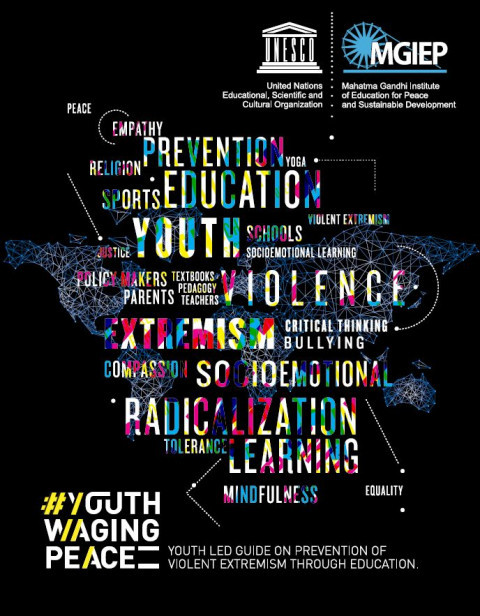 Youth Led Guide on Prevention of Violent Extremism through Education Year of publication: 2017 Author: Carolyn Nash | Yulia Nesterova | Kenneth Primrose | Wing Yu Alice Chan | Rios, Paul A. Chan | María José Velásquez Flores | Aniqah Zowmi Corporate author: Mahatma Gandhi Institute of Education for Peace and Sustainable Development (MGIEP) In September 2016, the education sector from the UNESCO headquarters and the UNESCO category 1 research Institute, the UNESCO Mahatma Gandhi Institute of Education for Peace and Sustainable Development(MGIEP) organised the first International Conference on Prevention of Violent Extremism through Education: Taking Action, in New Delhi, India. The usual plethora of reports and guides produced by experts on the subject, roundtables and expert panels were organised.But something different also happened. UNESCO MGIEP brought 50 youth from across the world rigorously selected through six week online discussion on the subject to participate in a first of its kind, “Talking Across Generations on Education (TAGe)” event. This event organised as a plenary session—not a side or lunch event—brought together these youth in a non-hierarchical “flat” dialogue with about 12 senior policymakers on the challenges and opportunities the youth see in preventing violent extremism through education.The conference culminated with the presentation of a “Youth Action Plan” containing three clear tangible action points. One action point was the development of a youth-led guide on Prevention of Violent Extremism through Education. This Guide is the result of that call to action.The Institute circulated a global call to youth who were willing to take up the challenge of producing the Guide. After a rigorous search based on a well-defined set of criteria, two coordinating lead authors were identified. These authors were then tasked to find the remaining authors who they saw fit to contribute to the Guide and this team then reached out to the wider group of youth to solicit their experiences and guidance in producing the Guide. The youth have done their part. They have reached out to more than 2,000 young people from more than 50 countries, collated their ideas and experiences and finally featured more than 150 unique voices into this document.
 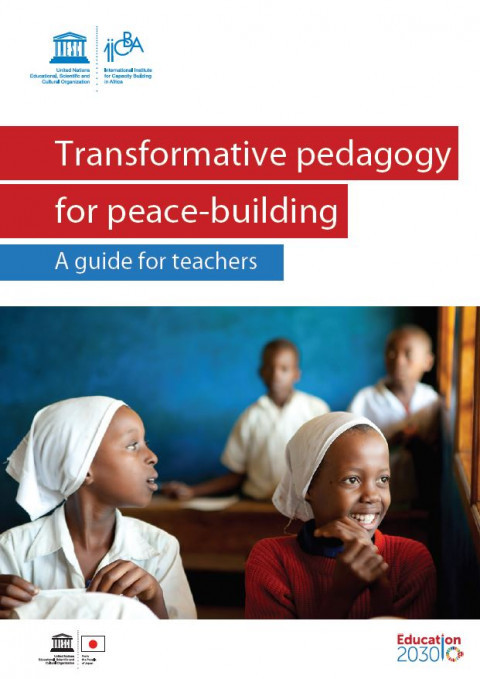 Transformative Pedagogy for Peace-building: A Guide for Teachers Year of publication: 2017 Corporate author: UNESCO International Institute for Capacity-Building in Africa (IICBA) This publication is a guide for teachers and teacher trainers on transformative pedagogy so that they are able to empower youth with peace-building knowledge, skills and competencies necessary to develop into advocates and actors of peace.The guide particularly aims to introduce teachers to the foundation of conflict analysis and peace-building and to equip them with a learner-centered approach to peace education and community engagement.This guide is a resource for educators to engage and support youth in their journey to becoming active peace-builders and fostering transformation in the Horn of Africa and Surrounding Countries.
 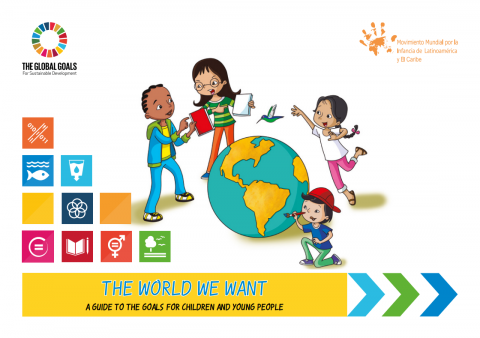 The World We Want: A Guide to the Goals for Children and Young People Year of publication: 2015 Author: Dora Bardales | Paola Arenas Corporate author: Global Movement for Children of Latin America and Caribbean | United Nations Children's Fund (UNICEF) The purpose of this guide is to help children and young people understand the Sustainable Development Goals, how they impact their life and what they can do every day to help their government achieve the Goals.