
Resources
Explore a wide range of valuable resources on GCED to deepen your understanding and enhance your research, advocacy, teaching, and learning.
3,790 Results found
 Using archival documents, memoir, and testimony to teach about Jewish families during and after the Holocaust Carson Phillips suggests the use of archival documents, memoir and recorded testimony to engage students in learning. Use the three survivor testimonies below, from Czechoslovakia, Hungary and Croatia, in conjunction with those in the Gurewitsch essay (pp. 48–55) for a rich and varied look at the fraught experiences of Jewish families struggling to survive and, ultimately, rebuild their lives. (By the publisher)
 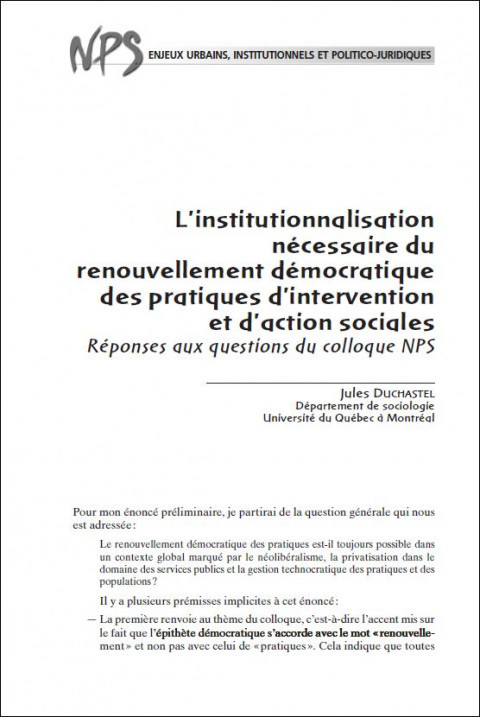 L’institutionnalisation nécessaire du renouvèlement démocratique des pratiques d’intervention et d’action sociales Year of publication: 2009 Author: Jules Duchastel Corporate author: Nouvelles pratiques sociales Pour mon énoncé préliminaire, je partirai de la question générale qui nous est adressée :Le renouvellement démocratique des pratiques est-il toujours possible dans un contexte global marqué par le néolibéralisme, la privatisation dans le domaine des services publics et la gestion technocratique des pratiques et des populations ?Il y a plusieurs prémisses implicites à cet énoncé :La première renvoie au thème du colloque, c’est-à-dire l’accent mis sur le fait que l’épithète démocratique s’accorde avec le mot « renouvellement » et non pas avec celui de « pratiques ». Cela indique que toutes les pratiques, pas seulement celles qui sont généralement associées aux institutions démocratiques, devraient être envisagées sous l’angle de la démocratie. Il s’agirait donc d’élargir la portée de l’idéal démocratique.La deuxième prémisse est qu’il y a des obstacles à cet élargissement. Ces obstacles seraient au nombre de trois :la prédominance du néolibéralisme, la privatisation des services publics, la gestion technocratique.Je vais tenter d’éclairer chacune de ces prémisses, dans un premier temps, de manière générale pour y revenir de manière plus spécifique à l’occasion des sous-questions posées par les organisateurs.
 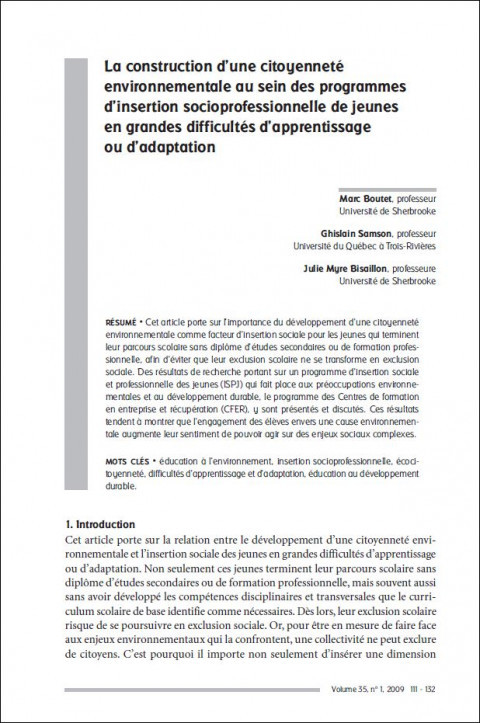 Constructing Environmental Citizenship through Socio-professional Insertion Programs for Youth with Severe Learning and Adaptation Difficulties Year of publication: 2009 Author: Marc Boutet | Ghislain Samson | Julie Myre Bisaillon Corporate author: Revue des sciences de l’éducation This article is about the importance of environmental citizenship as a factor of socio-professional insertion for students who terminate their schooling without a secondary or professional training diploma, in order to prevent that their school exclusion leads to a social exclusion. Results of a research on a socio-professional insertion program for youth that integrates environmental and sustainable development issues and the Corporate Training and Recuperation Centres Network (CFER) are presented and discussed. Those results tend to demonstrate that the students’ involvement in an environmental cause increases their empowerment towards complex social issues. La construcción de una ciudadanía medioambiental en los programas de inserción socioprofesional de los jóvenes con grandes dificultades de aprendizaje o de adaptación Year of publication: 2009 Author: Marc Boutet | Ghislain Samson | Julie Myre Bisaillon Corporate author: Revue des sciences de l’éducation Se trata en este artículo de la importancia del desarrollo de una ciudadanía medioambiental como factor de inserción social para los jóvenes que terminan su recorrido escolar sin diploma de escuela secundaria o de formación profesional, con la finalidad de evitar que su exclusión escolar se transforme en exclusión social. Se presentan y analizan algunos resultados de investigación acerca de un programa de inserción social y profesional de los jóvenes (ISPJ) que toma en cuenta las preocupaciones medioambientales y el desarrollo duradero, el programa de los Centros de formación en empresa y recuperación (CFER). Estos resultados tienden a demostrar que el compromiso de los alumnos hacia una causa medioambiental aumenta su sentimiento de poder actuar en asuntos sociales complejos. La construction d’une citoyenneté environnementale au sein des programmes d’insertion socioprofessionnelle de jeunes en grandes difficultés d’apprentissage ou d’adaptation Year of publication: 2009 Author: Marc Boutet | Ghislain Samson | Julie Myre Bisaillon Corporate author: Revue des sciences de l’éducation Cet article porte sur l’importance du développement d’une citoyenneté environnementale comme facteur d’insertion sociale pour les jeunes qui terminent leur parcours scolaire sans diplôme d’études secondaires ou de formation professionnelle, afin d’éviter que leur exclusion scolaire ne se transforme en exclusion sociale. Des résultats de recherche portant sur un programme d’insertion sociale et professionnelle des jeunes (ISPJ) qui fait place aux préoccupations environnementales et au développement durable, le programme des Centres de formation en entreprise et récupération (CFER), y sont présentés et discutés. Ces résultats tendent à montrer que l’engagement des élèves envers une cause environnementale augmente leur sentiment de pouvoir agir sur des enjeux sociaux complexes. Holocaust Education in Post-Communist Romania As Israeli historian Leon Volovici noted in a recent article, Romania today is marked by the concurrent presence of a prolific nationalistic media with strong anti-Semitic accents and a swell of events dedicated to the history of its Jews. This remarkable paradox is perhaps just one more example of the originality of Romania’s post-communist transition, the more so since the object of both trends is becoming less and less numerous every day: there are only about 9,000, mostly elderly Jews living in contemporary Romania. After 45 years of “relative silence” imposed by the communists and eight more years of “relevant silence” imposed by the neo-communists, as of 1998 the Holocaust is finally mentioned and discussed, but “in the third person”, as it were: it’s true, it happened, but not in Romania! (By the author) Entering the World of a Holocaust Victim: Schoolchildren Discuss a Ghetto Memoir – a Case Study Despite Adorno's famous dictum, the memory of the Shoah features prominently in the cultural legacy of the 20th century and beyond. It has led to a proliferation of works of representation and re-memorialization which have brought in their wake concerns about a 'holocaust industry' and banalization. This volume sheds fresh light on some of the issues, such as the question of silence and denial, of the formation of contemporary identities — German, East European, Jewish or Israeli, the consequences of the legacy of the Shoah for survivors and for the 'second generation,' and the political, ideological, and professional implications of Shoah historiography. One of the conclusions to be drawn from this volume is that the 'Auschwitz code’, invoked in relation to all 'unspeakable' catastrophes, has impoverished our vocabulary; it does not help us remember the Shoah and its victims, but rather erases that memory. (By the author)
 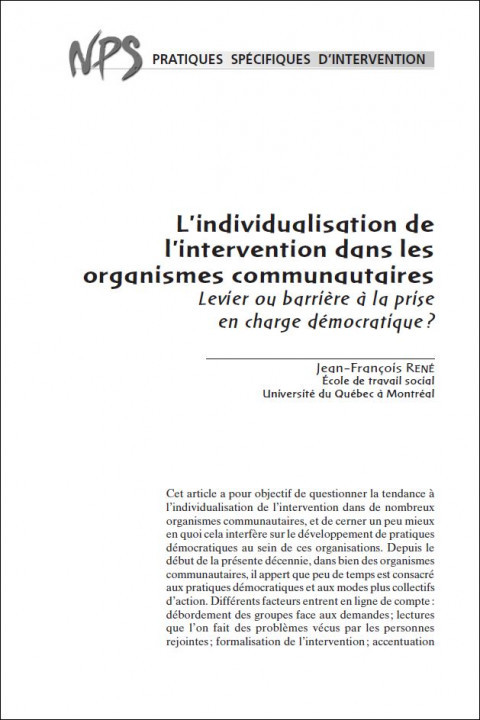 The Individualization of Intervention in Community Organizations: Openings or Barriers in Relation to Democracy? Year of publication: 2009 Author: Jean-François René Corporate author: Nouvelles pratiques sociales This paper questions the fact that in some community-based organisations the level of intervention is often the individual rather than the community. This trend interferes with the internal participatory democratic practices within these organisations. To explain this relatively recent situation (beginning of the present decade) in many community-based organisations, various factors are taken into account : the large number of requests received by these groups ; the way we solve problems that people face ; the institutionalization of community intervention ; the pressure on organisations to integrate state services agendas. In this context, what actions are needed to stimulate the internal democratic practices within these groups ? L’individualisation de l’intervention dans les organismes communautaires : Levier ou barrière à la prise en charge démocratique ? Year of publication: 2009 Author: Jean-François René Corporate author: Nouvelles pratiques sociales Cet article a pour objectif de questionner la tendance à l’individualisation de l’intervention dans de nombreux organismes communautaires, et de cerner un peu mieux en quoi cela interfère sur le développement de pratiques démocratiques au sein de ces organisations. Depuis le début de la présente décennie, dans bien des organismes communautaires, il appert que peu de temps est consacré aux pratiques démocratiques et aux modes plus collectifs d’action. Différents facteurs entrent en ligne de compte : débordement des groupes face aux demandes ; lectures que l’on fait des problèmes vécus par les personnes rejointes ; formalisation de l’intervention ; accentuation de la pression étatique quant à l’intégration des services. Dans ce contexte, quelles pistes d’action faut-il explorer ? C’est à cette question que s’attarde cet article, en se centrant sur la place et le pouvoir que pourraient prendre les personnes rejointes au sein de ces organismes.
  2018 유네스코 평화누리 활동보고서 Year of publication: 2018 Corporate author: 유네스코한국위원회 ‘유네스코 평화누리 사업’은 2013년 ‘유네스코 볼론티어 프로젝트’라는 이름으로, 대학생들의 사회 참여를 높이고 역량을 강화하기 위해 시작되었다. 2018년 에는 유엔 지속가능발전목표의 17개 목표를 주제로, 청년들 스스로 자신들이 살아가는 지역사회 현장의 지속가능성을 위협하는 문제에 대한 개선방안을 기획하고 실행함으로써 청년들이 사회변화의 주체(agents of social innovation)로 성장할 수 있도록 지원하고 있다.유네스코한국위원회는 평화누리 사업을 통해 전국 대학(원)생 및 청년으로 구성된 동아리(5-20명)를 선발하여 소정의 활동지원금을 지원한다. 또한 유네스코 본부·한국위원회 관련 정보 및 공지 안내, 워크숍 및 활동보고회 개최, 각종 네트워크 활용 지원, 프로젝트 현장 지원 등 청년들의 성공적인 활동을 위해 함께 노력하고 있다.목표하는 활동 분야의 전문가나 대학 교수를 자문위원으로 위촉할 수 있고, 전체 인원 중 대표 및 부대표를 포함한 80%가 대학생이라면 기존·신설·연합·프로젝트 성 팀 모두 관계없이 지원 가능하다. 유네스코는 우리의 현재이자 미래인 청년들을 세계의 다양한 이슈에 대해 해결방안을 찾아내고 창의력을 이용해 변화를 만드는 필수적인 존재라고 보고 있으며 이에 유네스코한국위원회는 청년들이 사회문제에 보다 관심을 가지고 그들의 활동과 노력이 더 나은 사회를 만들 수 있도록 지지하고 지원하며 청년의 사회참여를 독려합니다. 많은 대학(원)생·청년들이 유네스코 평화누리 사업을 포함한 유네스코한국위원회의 청년 활동에 참여하여 유네스코의 이념에 함께 동참해주기를 바란다.