
Resources
Explore a wide range of valuable resources on GCED to deepen your understanding and enhance your research, advocacy, teaching, and learning.
1,443 Results found
 UNESCO in Action for Gender Equality: 2020-2021 Year of publication: 2022 Corporate author: 유네스코 UNESCO’s global priority gender equality took on new meaning over the past biennium. The years 2020 and 2021 have been marked by dramatic social, political, environmental, and economic changes across countries resulting from an unprecedented pandemic: COVID-19. The COVID-19 pandemic magnified deep rooted structural gender inequalities across societies and forced the world to question the degree to which advances towards achieving gender equality had been made since the first UN World Conference on Women held in Beijing. This publication shows how a collective work by all structures of UNESCO has mobilized an extraordinary effort to go beyond a necessary adaptation to a multi-faceted crisis and counter backlashes and strengthen the resilience of women and girls and the systems which protect and empower them around the world through education, sciences, culture, communication, and information.
  Transforming Education Summit 2022: Futures of Education Briefing Notes Year of publication: 2022 Corporate author: UNESCO National consultations that aim at developing a shared vision, commitment, and alignment of action across constituencies are one of the key TES workstreams. The Reimagining our futures together report is proposed as a framework for examining how education systems need to change to better serve learners and societies into the future.A series of briefing notes have been prepared in alignment with the summit's five action tracks:o Inclusive, equitable, safe and healthy schoolso Learning and skills for life, work and sustainable developmento Teachers, teaching and the teaching professiono Digital learning and transformationo Financing of education Cumbre 2022 sobre la Transformación de la Educación: Notas sinópticas sobre los Futuros de la Educación Year of publication: 2022 Corporate author: UNESCO Las consultas nacionales que apuntan a desarrollar una visión compartida, un compromiso y una alineación de la acción entre los grupos constituyen uno de los flujos de trabajo clave de TES. El informe Reimaginando juntos nuestro futuro se propone como un marco para examinar cómo deben cambiar los sistemas educativos para servir mejor a los estudiantes y las sociedades en el futuro. Se ha preparado una serie de notas informativas en consonancia con las cinco vías de acción de la cumbre: o Escuelas inclusivas, equitativas, seguras y saludableso Aprendizaje y habilidades para la vida, el trabajo y el desarrollo sostenibleo Docentes, docencia y profesión docenteo Aprendizaje y transformación digitalo Financiamiento de la educación Sommet 2022 sur la Transformation de l’Education: Notes de synthèse sur Les futurs de l’éducation Year of publication: 2022 Corporate author: Organisation des Nations Unies pour l'éducation, la science et la culture (UNESCO) Les consultations nationales qui visent à développer une vision, un engagement et un alignement des actions partagés entre les groupes constitutifs sont l'un des principaux axes de travail de la TES. Le rapport Reimagining our futures together est proposé comme un cadre pour examiner comment les systèmes éducatifs doivent changer pour mieux servir les apprenants et les sociétés à l'avenir. Une série de notes d'information a été préparée conformément aux cinq pistes d'action du sommet : o Des écoles inclusives, équitables, sûres et saineso Apprentissage et compétences pour la vie, le travail et le développement durableo Enseignants, enseignement et profession enseignanteo Apprentissage et transformation numériqueso Financement de l'éducation
  [Summary] First Meeting of UNESCO Chairs Relating to Global Citizenship Education Year of publication: 2022 Corporate author: 联合国教科文组织 (UNESCO) | 亚太地区促进国际理解教育中心 (APCEIU) This report shares the overview of the First Meeting of UNESCO Chairs Relating to Global Citizenship Education held on Friday, 30 September 2022. The event was co-organized by UNESCO and APCEIU with the main objective of gathering UNESCO Chairs from GCED-related fields to discuss the need for a platform for information sharing and knowledge exchanges and share ideas of how UNESCO Chairs could collaborate through joint projects.As UNESCO is in the process of revising the 1974 UNESCO Recommendation concerning Education for International Understanding, Co-operation and Peace and Education relating to Human Rights and Fundamental Freedoms, the report also shared the summary of the discussion over the meeting regarding the current status of the revision process and UNESCO Chairs' thoughts and suggestions on the revised Recommendation.
  Berlin Declaration on Education for Sustainable Development; Learn for Our Planet: Act for Sustainability Year of publication: 2022 Corporate author: UNESCO From 17 May to 19 May 2021 around 2800 people – politicians, business people, youth leaders, scientists, Non-governmental organizations, and many more - from 160 countries came together virtually at the UNESCO World Conference on Education for Sustainable Development (ESD) 2021. During the conference, they expressed their commitment to use the transformative power of education in order to address the global challenges we face. The Berlin Declaration was the main result of the conference.The Berlin Declaration on Education for Sustainable Development is an important document that emphasizes the significance of ESD for each and every one of us. It identifies concrete challenges the global community is facing and calls for changes that are urgently needed in order to fully integrate and strengthen ESD in all educational contexts.
  Technical Note on the Implementation of the Convention on the Rights of Persons with Disabilities in Uzbekistan Year of publication: 2023 Corporate author: World Bank This compilation of technical briefs lays out the key problems faced by persons with disabilities in Uzbekistan under all areas of life and formulates detailed recommendations, providing the evidence base for a Strategic Note that aims to guide Uzbekistan's next five-year National Action Plan (NAP) for implementing the United Nations Convention on the Rights of Persons with Disabilities (CRPD). Технические справки по имплементации Конвенции о правах инвалидов Year of publication: 2023 Corporate author: World Bank В этом сборнике девяти отраслевых технических справок очень подробно анализируются проблемы, с которыми сталкиваются лица с инвалидностью в Узбекистане во всех сферах жизни, и формулируются подробные рекомендации, обеспечивающие доказательную базу для Стратегической записки, которая призвана служить ориентиром для следующего пятилетнего Национального плана действий Узбекистана (НПД) по имплементации Конвенции Организации Объединенных Наций о правах инвалидов (КПИ) в стране.
 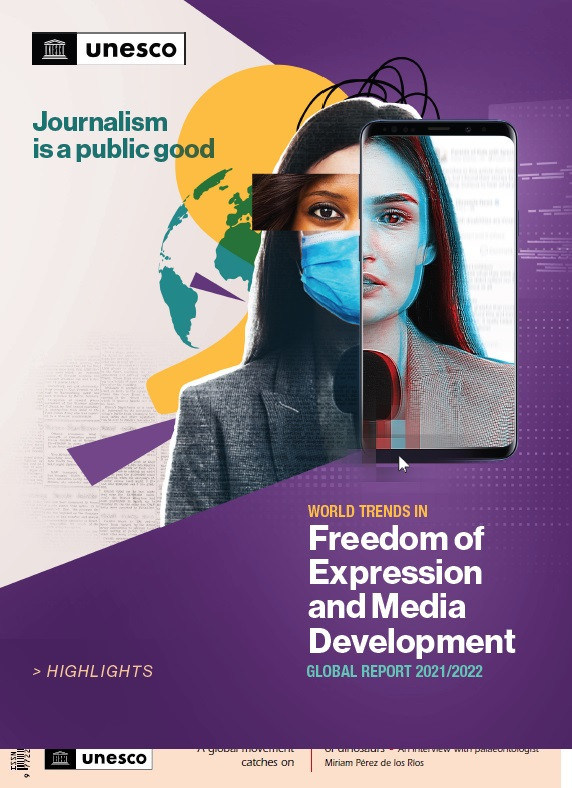 Journalism is a Public Good: World Trends in Freedom of Expression and Media Development: Global Report 2021/2022; Highlights Year of publication: 2021 Corporate author: UNESCO This document is a report on world trends in freedom of expression and media development published by UNESCO in 2021/22 and focuses on the many challenges facing access to information since 2016, in terms of analysis of trends in media freedom, pluralism, independence and safety of journalists. 新闻是一种公共产品: 世界趋势、言论自由和媒体发展; 全球报告 2021/2022 Year of publication: 2021 Corporate author: 联合国教科文组织 (UNESCO) 本文件是2021/22年联合国教科文组织所发布的关于言论自由和媒体发展的世界趋势报告,主要从媒体自由、多元化、独立性和记者安全等趋势分析,探讨2016年以来信息获取所面临的众多挑战。