
Resources
Explore a wide range of valuable resources on GCED to deepen your understanding and enhance your research, advocacy, teaching, and learning.
2,781 Results found
 Desempeños de educación para la paz Year of publication: 2016 Author: Enrique Chaux | José Fernando Mejía | Juanita Lleras | David Guáqueta | Andrea Bustamante | Gloria Inés Rodríguez | Paula Andrea Pineda | Alexander Ruiz-Silva | Carolina Valencia | Charlotte Greniez | Daniel García | Sara Victoria Alvarado | Ana María Velásquez Corporate author: Colombia. Ministerio de Educación Nacional Este documento presenta una propuesta de desempeños de Educación para la Paz para los grados transición a 11º. Esta propuesta busca servir de ilustración de cómo podría ser un diseño curricular consistente con las Orientaciones para la Implementación de la Cátedra de la Paz.
  Didactic Sequences of Education for Peace Year of publication: 2016 Author: Enrique Chaux | José Fernando Mejía | Juanita Lleras | David Guáqueta | Andrea Bustamante | Gloria Inés Rodríguez | Paula Andrea Pineda | Alexander Ruiz-Silva | Carolina Valencia | Charlotte Greniez | Daniel García | Sara Victoria Alvarado | Ana María Velásquez Corporate author: Colombia. Ministerio de Educación Nacional This document proposes examples of didactic sequences of Peace Education for all grades from 1st to 11th. A didactic sequence can be understood as the detailed description of a series of articulated lesson organized in a coherent way. The proposed sequences include between 4 and 7 class sessions of approximately 50 minutes each. They seek to be consistent with the General Guidelines for the Implementation of the Peace Law and with the Proposed Performances. Secuencias didácticas de educación para la paz Year of publication: 2016 Author: Enrique Chaux | José Fernando Mejía | Juanita Lleras | David Guáqueta | Andrea Bustamante | Gloria Inés Rodríguez | Paula Andrea Pineda | Alexander Ruiz-Silva | Carolina Valencia | Charlotte Greniez | Daniel García | Sara Victoria Alvarado | Ana María Velásquez Corporate author: Colombia. Ministerio de Educación Nacional En este documento se proponen ejemplos de secuencias didácticas de Educación para la Paz para cada uno de los grados desde 1º hasta 11º. Una secuencia didáctica puede comprenderse como la descripción detallada de una serie de planeaciones de clases articuladas de una manera coherente. Las secuencias propuestas incluyen entre 4 y 7 sesiones de clase de aproximadamente 50 minutos cada una. Buscan ser consistentes con las Orientaciones Generales para la Implementación de la Cátedra de la Paz y con la Propuesta de Desempeños de Educación para la Paz.
 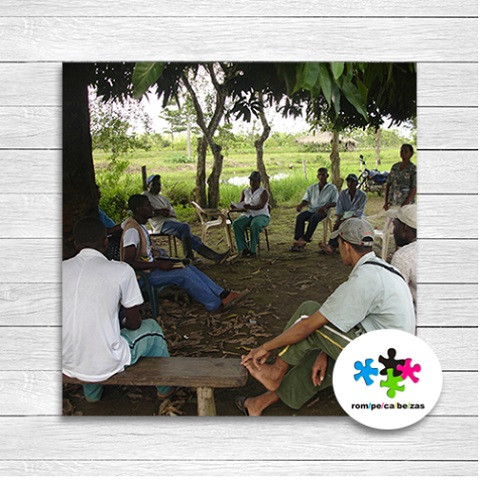 What Does Peace Sound Like? Education for Coexistence Year of publication: 2015 Author: María Del Carmen Muñoz | Marco Fidel Vargas Corporate author: Center for Research and Popular Education / Program for Peace (CINEP/PPP) This podcast discusses education for peace in Colombia and how it contributes to overcoming violence and promoting coexistence. ¿A qué suena la paz? Educación para la convivencia Year of publication: 2015 Author: María Del Carmen Muñoz | Marco Fidel Vargas Corporate author: Center for Research and Popular Education / Program for Peace (CINEP/PPP) En este podcast se discute acerca de la educación para la paz en Colombia y cómo contribuye a la superación de la violencia y a a promoción de la convivencia.
  Assurer à tous une éducation équitable, inclusive et de qualité: Objectif de développement durable 4 au Canada Year of publication: 2020 Corporate author: Council of Ministers of Education, Canada (CMEC) Ce rapport fournit un cadre pour communiquer l’information aux échelons pancanadien et international au sujet du travail en cours au Canada sur la réalisation de l’ODD 4. Il tire parti des données et des indicateurs liés à l’ODD 4 et inclut, dans la mesure du possible, les données provinciales et territoriales.
 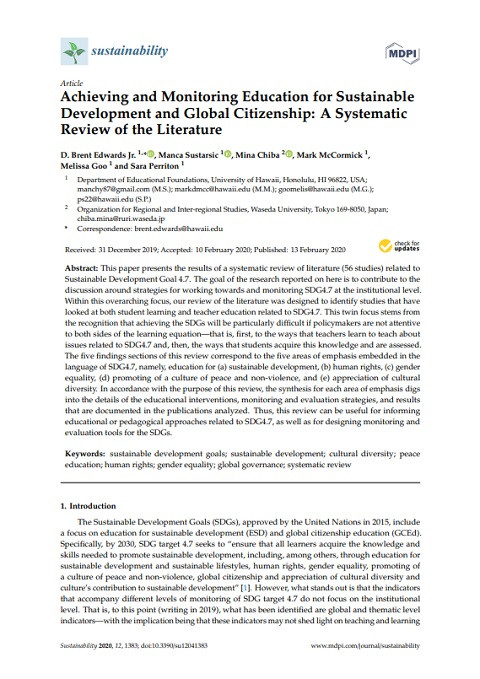 Achieving and Monitoring Education for Sustainable Development and Global Citizenship: A Systematic Review of the Literature (Sustainability 2020; Vol. 12, No. 4) Year of publication: 2020 Author: Brent Edwards | Manca Sustarsic | Mina Chiba | Mark McCormick | Melissa Goo | Sara Perriton Corporate author: Multidisciplinary Digital Publishing Institute (MDPI) This paper presents the results of a systematic review of literature (56 studies) related to Sustainable Development Goal 4.7. The goal of the research reported on here is to contribute to the discussion around strategies for working towards and monitoring SDG4.7 at the institutional level. Within this overarching focus, our review of the literature was designed to identify studies that have looked at both student learning and teacher education related to SDG4.7. This twin focus stems from the recognition that achieving the SDGs will be particularly difficult if policymakers are not attentive to both sides of the learning equation—that is, first, to the ways that teachers learn to teach about issues related to SDG4.7 and, then, the ways that students acquire this knowledge and are assessed. The five findings sections of this review correspond to the five areas of emphasis embedded in the language of SDG4.7, namely, education for (a) sustainable development, (b) human rights, (c) gender equality, (d) promoting of a culture of peace and non-violence, and (e) appreciation of cultural diversity. In accordance with the purpose of this review, the synthesis for each area of emphasis digs into the details of the educational interventions, monitoring and evaluation strategies, and results that are documented in the publications analyzed. Thus, this review can be useful for informing educational or pedagogical approaches related to SDG4.7, as well as for designing monitoring and evaluation tools for the SDGs.
 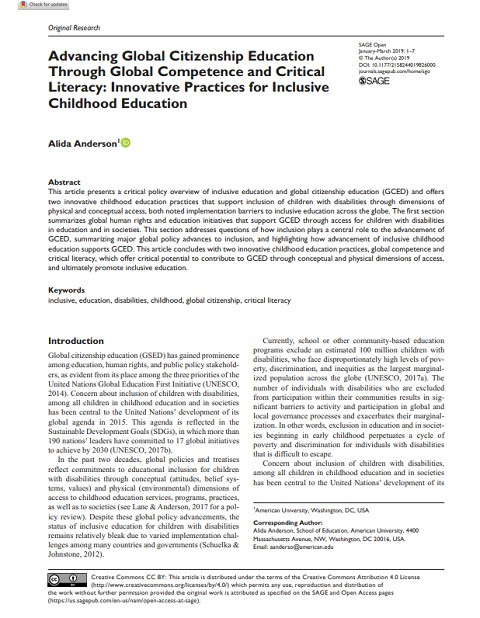 Advancing Global Citizenship Education Through Global Competence and Critical Literacy: Innovative Practices for Inclusive Childhood Education (SAGE Open; Vol. 9, No. 1) Year of publication: 2019 Author: Alida Anderson Corporate author: SAGE Publications This article presents a critical policy overview of inclusive education and global citizenship education (GCED) and offers two innovative childhood education practices that support inclusion of children with disabilities through dimensions of physical and conceptual access, both noted implementation barriers to inclusive education across the globe. The first section summarizes global human rights and education initiatives that support GCED through access for children with disabilities in education and in societies. This section addresses questions of how inclusion plays a central role to the advancement of GCED, summarizing major global policy advances to inclusion, and highlighting how advancement of inclusive childhood education supports GCED. This article concludes with two innovative childhood education practices, global competence and critical literacy, which offer critical potential to contribute to GCED through conceptual and physical dimensions of access, and ultimately promote inclusive education. Ensuring Inclusive and Equitable Quality Education: Sustainable Development Goal 4 in Canada Year of publication: 2020 Corporate author: Council of Ministers of Education, Canada (CMEC) This report provides a framework to share information at the pan-Canadian and international levels on work underway in Canada to achieve SDG 4. The report builds on SDG 4 data and indicators and includes, where possible, provincial and territorial data.
 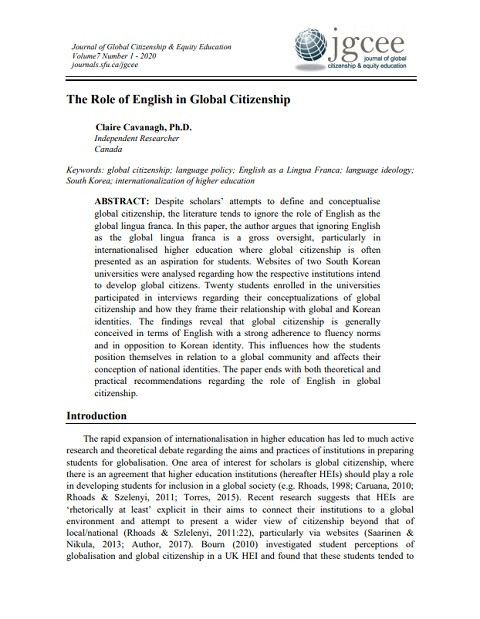 The Role of English in Global Citizenship (Journal of Global Citizenship & Equity Education; Vol. 7, No. 1) Year of publication: 2020 Author: Claire Cavanagh Corporate author: Centennial College Despite scholars’ attempts to define and conceptualise global citizenship, the literature tends to ignore the role of English as the global lingua franca. In this paper, the author argues that ignoring English as the global lingua franca is a gross oversight, particularly in internationalised higher education where global citizenship is often presented as an aspiration for students. Websites of two South Korean universities were analysed regarding how the respective institutions intend to develop global citizens. Twenty students enrolled in the universities participated in interviews regarding their conceptualizations of global citizenship and how they frame their relationship with global and Korean identities. The findings reveal that global citizenship is generally conceived in terms of English with a strong adherence to fluency norms and in opposition to Korean identity. This influences how the students position themselves in relation to a global community and affects their conception of national identities. The paper ends with both theoretical and practical recommendations regarding the role of English in global citizenship.