
Resources
Explore a wide range of valuable resources on GCED to deepen your understanding and enhance your research, advocacy, teaching, and learning.
3,790 Results found
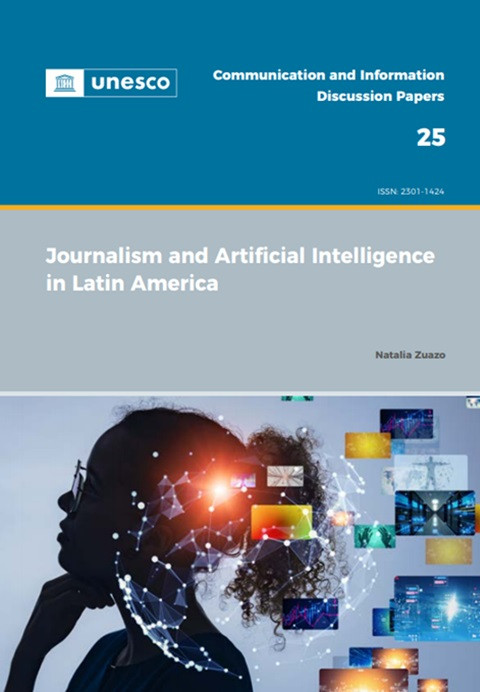 Journalism and Artificial Intelligence in Latin America Year of publication: 2023 Author: Natalia Zuazo Corporate author: UNESCO Montevideo In a context of exponential growth of artificial intelligence (AI) and technological dominance in all spheres of life — economic, social, cultural, environmental, and political —, this Paper explores the impact of AI on journalism from a critical and ethical perspective, with special attention to Latin America. It addresses inequalities and challenges inherent in the implementation of AI in the region. The aim is to offer an useful tool in the continuous training of students and media professionals.
  워크북: 교실에서 듣는 환경 이야기 Year of publication: 2022 Author: 김진영 | 박영식 | 유미리 | 이전기 | 이현지 | 정준영 | 홍성택 Corporate author: 강원도교육청 강원도에서 초등학교를 다니는 5, 6학년 학생을 위한 교재입니다. 쓰레기, 물 부족, 탄소중립, 기후변화, 신재생에너지 등 최근 이슈가 되고 있는 환경문제를 우리 지역 사례를 통해 쉽게 이해할 수 있도록 했습니다. 특히 과도한 위기의식이나 좌절감을 느끼지 않도록 부정적인 요소를 강조하지 않았습니다. 나의 삶과 환경이 어떤 관계가 있는지 생각해 볼 수 있는 기회가 될 것입니다.
  Before the Fire is Extinguished: The Commemoration Work at Nazi Memorial Sites as a Project of Political Learning Year of publication: 2003 Author: Peter Gstettner The original title: Bevor die Glut verlöscht: Die Erinnerungsarbeit an NS-Tatorten als ein Politisches Lernprojekt(In Jahrbuch für Pädagogik 2003)The author reflects upon his experience of reconstructing Nazi history in Germany. All efforts to spread light upon the dark sides of this history end up in the attempt to break the collective silence and to retune the song from “the good old times.” Memorial sites pedagogy and educational policies must decide the relevance of the past for the present, expose local Nazi history, and set the gaze, across the wall of silence, on the future. Tangible memory work and personal experiences of pain are steps towards makingxsubmerged memories, obliterated traces and forgotten places useful again for an education for democracy and tolerance. (Written by publisher) The above abstract is taken from the International Holocaust Remembrance Alliance Education Research Project. Please also consult the full list of abstracts in 15 languages and the accompanying publication Research in Teaching and Learning about the Holocaust: A Dialogue Beyond Borders. Ed: IHRA, Monique Eckmann, Doyle Stevick, Jolanta Ambrosewicz-Jacobs, 2017, Metropol Verlag at www.holocaustremembrance.com/resources/publications.
 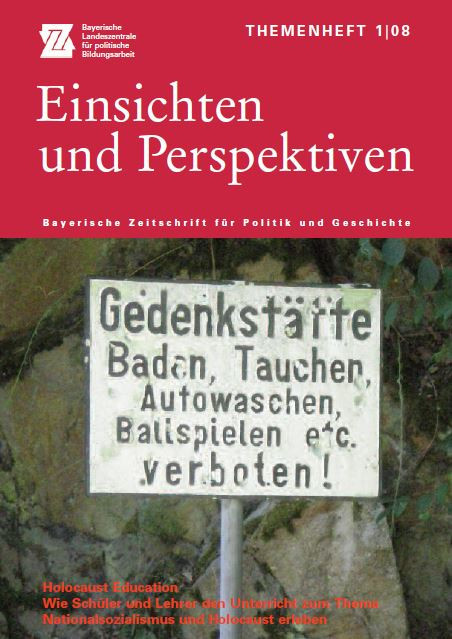 Holocaust Education: How Students and Teachers Experience Teaching and Learning about National Socialism and the Holocaust Year of publication: 2008 Corporate author: Bayerische Landeszentrale fürpolitische Bildungsarbeit The original title: Holocaust Education: Wie Schüler und Lehrer den Unterricht zum Thema Nationalsozialismus und Holocaust Erleben(Bayerische Zeitschrift für Politik und Geschichte, 1(8) [Themenheft Einsichten und Perspektiven]) Special issue of a Journal presenting several articles of a pilot study carried out in Bayern, focusing on the subjective experiences and representations of teachers and students when dealing with the Holocaust and with National Socialism. The above abstract is taken from the International Holocaust Remembrance Alliance Education Research Project. Please also consult the full list of abstracts in 15 languages and the accompanying publication Research in Teaching and Learning about the Holocaust: A Dialogue Beyond Borders. Ed: IHRA, Monique Eckmann, Doyle Stevick, Jolanta Ambrosewicz-Jacobs, 2017, Metropol Verlag at www.holocaustremembrance.com/resources/publications.
  Early Historical Learning about National Socialism and the Persecution of Jews: Family Conditions, Interests and Acquisition of Knowledge among Fourth Graders Year of publication: 2012 Author: Christina Klätte The original title: Frühes Historisches Lernen über Nationalsozialismus und Judenverfolgung: Familiäre Bedingungen, Interessen und Wissenserwerb bei Viertklässlern(Kinder und Zeitgeschichte: Jüdische Geschichte und Gegenwart, Nationalsozialismus und Antisemitismus Supplement 8, pp. 85–99) This is a quantitative study of German primary school children’s knowledge about the Holocaust. It demonstrates the importance of family background, family discussion and a general interest in history. It also displays how teachers’ willingness to bring up the Nazi period at a comparatively early age, among other things, depends upon the socio-economic status of the school children’s parents. The above abstract is taken from the International Holocaust Remembrance Alliance Education Research Project. Please also consult the full list of abstracts in 15 languages and the accompanying publication Research in Teaching and Learning about the Holocaust: A Dialogue Beyond Borders. Ed: IHRA, Monique Eckmann, Doyle Stevick, Jolanta Ambrosewicz-Jacobs, 2017, Metropol Verlag at www.holocaustremembrance.com/resources/publications.
  The Memory of Nazism and the Migration Society: Fears, Experiences and Attributions. Intergenerational Historical Consciousness Year of publication: 2008 Author: Angela Kühner The original title: NS-Erinnerung und Migrationsgesellschaft: Befüchtungen, Erfahrungen und Zuschreibungen(Einsichten und Perspektiven, Bayerische Zeitschrift für Politik und Geschichte, 1(8), pp. 52-65) The articles deals with a specific part of the pilot-study (see Kühner et al. 2008) on teachers’ and students’ experiences and representations, i.e. with the dimension of a migration-society. The author suggests to use the idea of “a society of migration as a context,” instead of the “migrants as target group.” This approach allows the author to work out several ways in which the students and teachers position themselves towards the national-socialist past of German society, and how the attribution of guilt, shame or esponsibility to several groups of “Others” serves as an interactive pattern in a migration society. Migration can therefore offer on one hand a tool to project their own fears or feelings, but on the other hand, it can also offer an opportunity for dialog and a higher degree of reflexivity on the past and the present. The above abstract is taken from the International Holocaust Remembrance Alliance Education Research Project. Please also consult the full list of abstracts in 15 languages and the accompanying publication Research in Teaching and Learning about the Holocaust: A Dialogue Beyond Borders. Ed: IHRA, Monique Eckmann, Doyle Stevick, Jolanta Ambrosewicz-Jacobs, 2017, Metropol Verlag at www.holocaustremembrance.com/resources/publications.
  Constructions of Generational Relations: Childhood and the Theme of National Socialism in Primary-School Education Year of publication: 2012 Author: Alexandra Flügel The original title: Konstruktionen des Generationalen Verhältnisses: Kindheit und das Thema Nationalsozialismus im Grundschulunterricht(Kinder und Zeitgeschichte: Jüdische Geschichte und Gegenwart, Nationalsozialismus und Antisemitismus, Supplement 8, pp. 75–84) This is a qualitative study, based on the results in Fügel 2009, of German primary school children’s communication about Nazism and the Holocaust. It demonstrates how interwoven these exchanges are with general German memory discourses about these topics, but also how the children already at the age of 9–10 reflect upon their need to learn about this dark side of German history.The above abstract is taken from the International Holocaust Remembrance Alliance Education Research Project. Please also consult the full list of abstracts in 15 languages and the accompanying publication Research in Teaching and Learning about the Holocaust: A Dialogue Beyond Borders. Ed: IHRA, Monique Eckmann, Doyle Stevick, Jolanta Ambrosewicz-Jacobs, 2017, Metropol Verlag at www.holocaustremembrance.com/resources/publications.
  Citizenship and Collective Action in Latin America. Recent Trends Year of publication: 2005 Author: Marisa Revilla Blanco The following text intends to analyze those forms of collective action through which citizens have been present in the streets of the region during the last thirty years. It seeks to understand the actors and the conditions of their appearance and continuity; In this way, it is also intended to make a small contribution to the theoretical development of the analysis of social movements in Latin America. Ciudadanía y Acción Colectiva en América Latina. Tendencias Recientes Year of publication: 2005 Author: Marisa Revilla Blanco En el siguiente texto se pretende analizar esas formas de acción colectiva mediante las cuales la ciudadanía se ha estado haciendo presente en las calles de la región durante los treinta años más recientes. Se busca comprender los actores y las condiciones de su aparición y continuidad; de este modo, también se pretende hacer un pequeño aporte al desarrollo teórico del análisis de los movimientos sociales en América Latina.Este artículo está publicado en Estudios Políticos. [en linea] 2005, (Julio-Diciembre)
  Gender Justice, Citizenship and Difference in Latin America Year of publication: 2010 Author: Maxine Molyneux This article surveys feminist citizenship practices and scholarship on gender, justice, citizenship and rights in Latin America. Feminism’s critique of patriarchal privilege expressed a modern desire for greater individual freedom and collective recognition, a combination that produced tensions and some inconsistencies in regard to the «difference» question, notably in its encounter with indigenous populations. However, central to feminism’s project was the pursuit of both recognition and redistribution, which achieved greater success in the realm of law and politics than in the distribution of public and private goods. A review of Latin American feminism’s achievements reveals a history of substantial advances but a striking persistence of gender inequality, which provides a rich agenda for further investigation.