
Resources
Explore a wide range of valuable resources on GCED to deepen your understanding and enhance your research, advocacy, teaching, and learning.
1,471 Results found
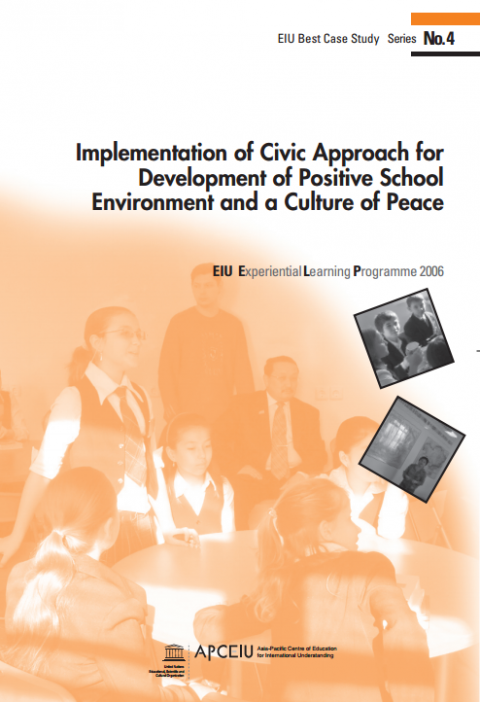 EIU Best Practices Series No. 4: Implementation of Civic Approach for Development of Positive School Environment and a Culture of Peace Year of publication: 2006 Corporate author: APCEIU This monograph is one of APCEIU's EIU Best Practices Series, which aims to encourage educators, scholars, and activists to implement and share local initiatives on EIU. The Series No.4 is an experimental research conducted by the Information and Research Center to promote culture of peace and teaching and learning outcomes that support positive development of school environment. Three pilot schools in Kazakhstan were analyzed upon implementation of teacher training workshops, instructional materials, and programs in civic and human rights education.
  EIU Best Practices Series No. 6: Practical Research on Current Issues: Studies on Global Perspectives in Schools in Japan Year of publication: 2007 Corporate author: APCEIU This monograph is one of APCEIU's EIU Best Practices Series, which aims to encourage educators, scholars, and activists to implement and share local initiatives on EIU. The Series No.6 is a research undertaken on two schools of Japan and Korea, in which students were tasked to conduct research on bilateral conflict issues and devise suggestions for peaceful resolution. Besides classroom discussions and presentations, student exchange visit further allowed active learning and engaging of issues, historical awareness and perception, and mutual understanding as global citizens.
 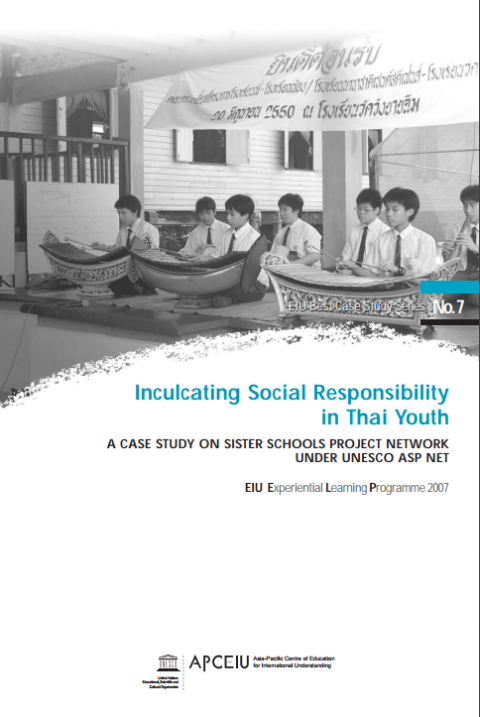 EIU Best Practices Series No. 7: Inculcating School Responsibility in Thai Youth: A Case Study on Sister Schools Project Network under UNESCO ASPNet Year of publication: 2007 Corporate author: APCEIU This monograph is one of APCEIU's EIU Best Practices Series, which aims to encourage educators, scholars, and activists to implement and share local initiatives on EIU. The Series No.7 is a case study of two Thai schools within the Sister Schools Project Network, which is under the UNESCO ASP NET and UNESCO Club. As schools visited other schools in the network, students became involved in fundraising to support one another, thereby naturally acquiring invaluable team building skills, intercultural understanding, and social responsibility. This case shows that sister school network system can foster values of sharing, caring, and loving, despite socio-economic disparity among students.
  GCED Curriculum Development and Integration Project (Sri Lanka): 2021 Final Report Year of publication: 2021 Corporate author: National Institute of Education (Sri Lanka) | Centre Asie-Pacifique d'éducation pour la compréhension internationale (APCEIU) This resource is a compiled documentation of the final outcomes of the Sri Lankan National Institute of Education (NIE) and APCEIU’s joint partnership to develop the GCED curriculum, particularly for the secondary school level. The report includes the materials created and used to evaluate, monitor, and execute the GCED curriculum, as well as the documentation of the process of its creation. It is written in both English and Sinhalese. In the compilation, you may find:- Introduction to the project (ENG)- Annexure of evaluative materials (ENG, SNH)- GCED Framework (ENG)- GCED Learning ModulesGrade 6 English (ENG)Grade 6 Sound Test (SNH)Grade 8 (SNH)Grade 8 English World of Work (ENG)Grade 8 School Try Out (SNH)
  GCED Curriculum Development and Integration Project (Lebanon): 2021 Final Report Year of publication: 2021 Corporate author: Center for Educational Research and Development (CRDP) | مركز آسيا والمحيط الهادي للتربية من أجل التفاهم الدولي (APCEIU) This resource is a compiled documentation of the final outcomes of the Center for Educational Research and Development (CRDP), Lebanon and APCEIU’s joint partnership to develop the GCED curriculum across both primary and secondary school levels. The report includes the materials created and used to evaluate, monitor, and execute the GCED curriculum, as well as the documentation of the process of its creation. It is written in both English and Arabic.In the compilation, you may find:- Report on the Implementation of the Project Stages- Digital Activities for GCED Integration in the Civics and National Education Curriculum: Grade 1 - 12 (ARA)- Digital Activities for GCED Integration in the Civics and National Education Curriculum: Grade 1 - 12 (ENG)- Teacher’s Guide: Grade 1 - 12 (ARA)- Teacher’s Guide: Grade 1 - 12 (ENG)- Training of Trainers (TOT): TOT Materials (ENG; ARA)- The Project of Training the Trainers on Global Citizenship Education and Integrating it into the Pre-university Educational Curricula: Preamble (ENG)- Technical Cards (ENG; ARA)
 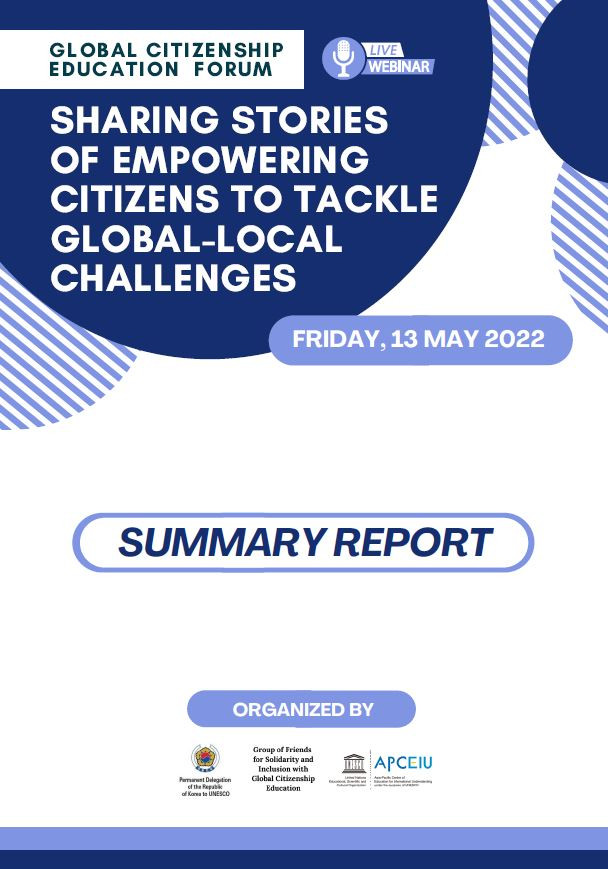 [Summary] Global Citizenship Education Forum: Sharing Stories of Empowering Citizens to Tackle Global-Local Challenges Year of publication: 2022 Corporate author: Permanent Delegation of the Republic of Korea to UNESCO | Group of Friends for Solidarity and Inclusion with Global Citizenship Education | APCEIU This report shares the overview of the Global Citizenship Education Forum held under the theme ‘Sharing Stories of Empowering Citizens to Tackle Global-Local Challenges’ on Friday, 13 May 2022. The event was co-organized by the Permanent Delegation of the Republic of Korea to UNESCO and the Asia-Pacific Centre of Education for International Understanding (APCEIU) in collaboration with the Group of Friends for Solidarity and Inclusion with GCED (Afghanistan, Armenia, Austria, Bangladesh, Canada, Colombia, Italy, Jordan, Kenya, Kuwait, Philippines, Republic of Korea, Saudi Arabia, Senegal and Serbia). This report shares the summary of the event, particularly the presentations on GCED activities implemented by practitioners from Armenia, Austria, Colombia, Jordan, Kenya and the Philippines to influence more GCED programmes/initiatives on various contexts and backgrounds.
 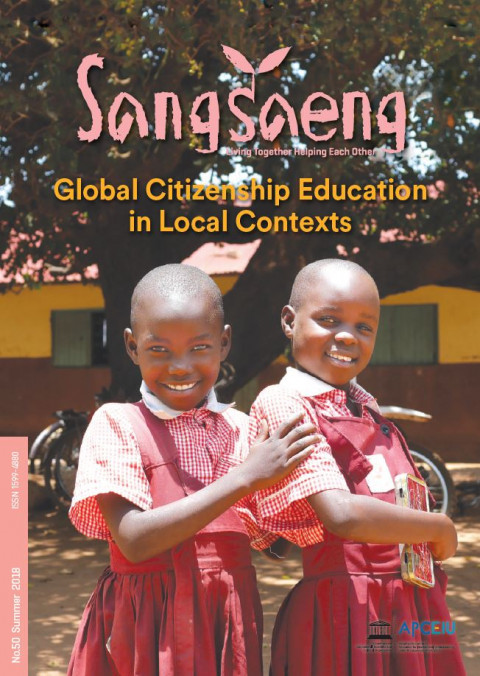 Global Citizenship Education in Local Contexts (SangSaeng no. 50 summer 2018) Year of publication: 2018 Corporate author: APCEIU The 50th issue of SangSaeng has been published with the theme “Global Citizenship Education in Local Contexts.” This edition reviews the divergent efforts to implement Global Citizenship Education(GCED) in the indigenous context of each region. Readers are invited to explore the fields of GCED from national and regional perspectives, as well as in formal, non-formal and informal education. 3 Director’s Message4 Special ColumnEngaging Learners’ Hearts and Minds8 Focus : Global Citizenship Education in Local Context8 Embracing Global Citizenship Education in a Tough Place12 Teaching Teachers to Teach GCED15 GCED Shapes New Cambodian History Curriculum19 Constructing Defences of Peace in the Minds of Future Leaders 22 Special ReportWhy [Use] Comics in School?26 Best Practices26 Beyond Zombie Apocalypse30 Transforming Space into Meaningful Learning Place34 InterviewThrough the Lens, Out of Africa, into Our Hearts and Minds38 LetterTowards a Green, Peaceful and Just World through GCED 40 Youth NetworkYouth for Learning, Exchanging, Growing and Taking Action43 Peace in my MemoryUnwanted Nation Living in Own Land47 Understanding the Asia-Pacific RegionTatau: A Pacific Journey50 APCEIU in Action Education à la citoyenneté mondiale dans des contextes locaux (SangSaeng N° 50 Eté 2018) Year of publication: 2018 Corporate author: APCEIU SangSaeng (상생), mot coréen d’origine chinoise, se compose de deux caractères : Sang (相), qui signifie « mutual » (les uns les autres) et Saeng (生), qui signifie « vie ». Mis ensemble, ils signifient « vivre ensemble », « s’entraider ». C’est notre vision pour la région Asie-Pacifique. SangSaeng (相生) se veut une plateforme de débats constructifs sur les sujets, méthodes et expériences dans le domaine de l’éducation à la compréhension internationale. SangSaeng vise aussi à promouvoir l’Éducation à la citoyenneté mondiale, une des trois priorités de l’Initiative mondiale pour l’éducation avant tout, lancée par les Nations Unies en 2012. SangSaeng est publié deux fois par an par le Centre Asie-Pacifique d’éducation pour la compréhension internationale (APCEIU) sous l’égide de l’UNESCO. Version française produite par le Bureau régional de l'UNESCO pour l'Afrique de l'Ouest (Sahel) et édiitée avec l'appui de l'APCEIU. 3 MESSAGE DU DIRECTEUR4 RUBRIQUE SPECIALE Susciter l'engagement du coeur et de l'esprit des apprenants8 FOCUS: ÉDUCATION À LA CITOYENNETÉ MONDIALE DANS DES CONTEXTES LOCAUX 8 ADOPTER L'EDUCATION À LA CITOYENNETÉ MONDIALE DANS UN CONTEXTE DIFFICILE Les écoles des camps de réfugiés ougandais renoncent à la différentiation et s'orientent vers une coexistance pacifique 12 APPRENDRE AUX ENSEIGNANTS À ENSEIGNER L’ECM Changer les temps implique de mettre en oeuvre et s'adapter au nouveau programme d'enseignement de l’ECM dans la nouvelle Corée 15 L’ECM FAÇONNE LE NOUVEAU PROGRAMME D'HISTOIRE DU CAMBODGE L'histoire a pris vie grâce à un nouveau programme d'enseignement qui prépare l'avenir avec un regard sur le passé 19 CONSTRUIRE DES DÉFENSES DE LA PAIX DANS L'ESPRIT DES FUTURS DIRIGEANTS Eduquer les jeunes à relever les défis de la paix et de la sécurité en Afrique de l'Ouest et dans le Sahel 22 REPORTAGE SPÉCIAL Pourquoi (utiliser) des bandes dessinées dans les écoles?26 BONNES PRATIQUES 26 Au-del à de l'apocalypse Zombie 30 Transformer l'espace en un lieu d'apprentissage significatif33 ENTRETIEN À travers l'objectif, en dehors de l'Afrique, dans nos coeurs et nos esprits38 LETTRE Vers un monde vert, pacifique et juste grâce à l’ECM 40 RÉSEAU DE JEUNES Des jeunes apprennent, échangent, grandissent et passent à l'action43 LA PAIX DANS MA MÉMOIRE Une nation non désirée sur ses propres terres47 COMPRENDRE LA REGION ASIE-PACIFIQUE Tatau : un voyage dans le Pacifique50 APCEIU EN ACTION 지역적 맥락 속에서의 세계시민교육 (상생 제50호 2018년 여름호) Year of publication: 2018 Corporate author: 유네스코 아시아태평양 국제이해교육원 3 발간사4 스페셜 칼럼: 학습자들의 머리와 마음을 사로잡는 교육8 포커스: 지역적 맥락 속에서 이루어지는 세계시민교육8 난관 속에서 세계시민교육을 수용하기12 교사들에게 가르치는 세계시민교육15 세계시민교육을 통해 제정된 캄보디아 역사교육과정19 미래의 지도자들의 마음 속에 평화의 방벽 쌓기 22 스페셜 리포트: 왜 학교에서 만화를 활용하는 것일까?26 모범사례26 좀비 재앙을 넘어서30 공간을 뜻깊은 배움의 장소로 탈바꿈하다34 인터뷰: 카메라 렌즈를 거쳐, 아프리카로부터 우리의 마음에게38 APCEIU에 보내는 편지 : 세계시민교육을 통해 친환경적이고, 평화롭고, 정의로운 세상으로 나아가기 40 유스 네트워크: 배우고, 주고 받고, 성장하고, 행동하는 청년들43 내 기억 속의 평화: 자기 땅에서 환영 받지 못하는 국가47 아시아-태평양 국가 지역 이해하기: 타투 : 태평양 지역에서의 여정50 교육원 활동
  ACER-APCEIU 세계시민교육 모니터링 가이드: 교사, 학교 관리자, 교육행정가를 위한 안내서 Year of publication: 2025 Author: Rachel Parker | Amy Berry | Payal Goundar | Karena Menzie-Ballantyne Corporate author: 호주교육연구위원회 | 유네스코 아시아태평양 국제이해교육원 『ACER-APCEIU 세계시민교육 모니터링 가이드: 교사, 학교 관리자, 교육행정가를 위한 안내서』는 APCEIU와 ACER가 2022년부터 2024년까지 3년에 걸쳐 호주, 라오스, 필리핀, 한국의 파트너들과 함께 수행한 공동연구의 결과물인 『ACER-APCEIU Global Citizenship Education Monitoring Toolkit for Teachers, Schools and System Leaders』를 한국의 맥락에 맞게 번역한 국문판이다.이 가이드는 다양한 수준의 교육 이해관계자가 세계시민교육에서 자신의 위치를 진단하고 목표와 계획을 수립하며, 실행과 평가를 지속적으로 이어가도록 설계된 탐구 순환 모형을 제시하며, 이를 각자의 맥락에 맞게 실천할 수 있도록 구체적인 지침과 방법을 안내한다.이 가이드의 주요 활용자는 정책 입안자, 교육부 및 교육청 등 유관 기관의 교육행정가, 학교장과 학교감 등 교육 리더십을 가진 이들뿐 아니라 정규·비정규 교육 전반에서 세계시민교육을 실천하는 모든 교사를 포함한다.