
Resources
Explore a wide range of valuable resources on GCED to deepen your understanding and enhance your research, advocacy, teaching, and learning.
306 Results found
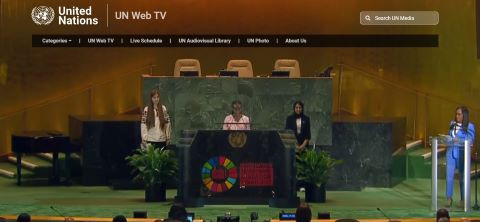 Vanessa Nakate (Climate Justice activist), Yelizaveta Posivnych (Student), Somaya Faruqi (Activist ) at the Transforming Education Summit (Leaders Day) Year of publication: 2022 Corporate author: United Nations (UN) Remarks by Vanessa Nakate, Climate Justice activist and UNICEF Goodwill Ambassador, Yelizaveta Posivnych, Student, Saint George Academy, New York; and Somaya Faruqi, Activist and former Captain of the Afghan Girls Robotics Team, on the rights of women and girls - Joint call to action, at the Youth Segment: The imperative for education transformation, at the transforming Education Summit (Leaders Day) - Opening segment.
 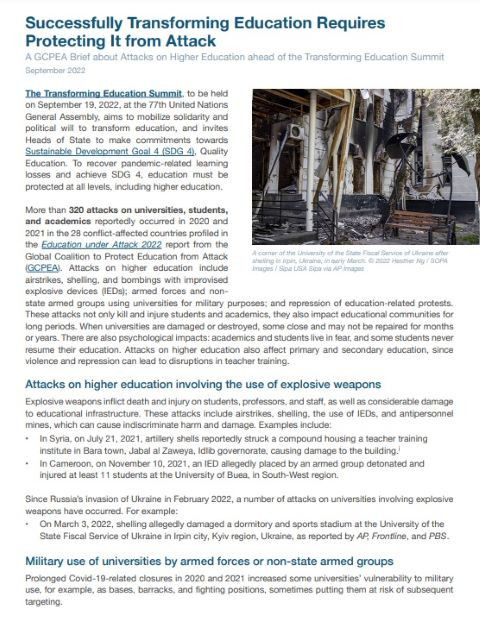 Successfully Transforming Education Requires Protecting It from Attack Year of publication: 2022 Corporate author: Global Coalition to Protect Education from Attack (GCPEA) The Transforming Education Summit, to be held on September 19, 2022, at the 77th United Nations General Assembly, aims to mobilize solidarity and political will to transform education, and invites Heads of State to make commitments towards Sustainable Development Goal 4 (SDG 4), Quality Education. To recover pandemic-related learning losses and achieve SDG 4, education must be protected at all levels, including higher education.
 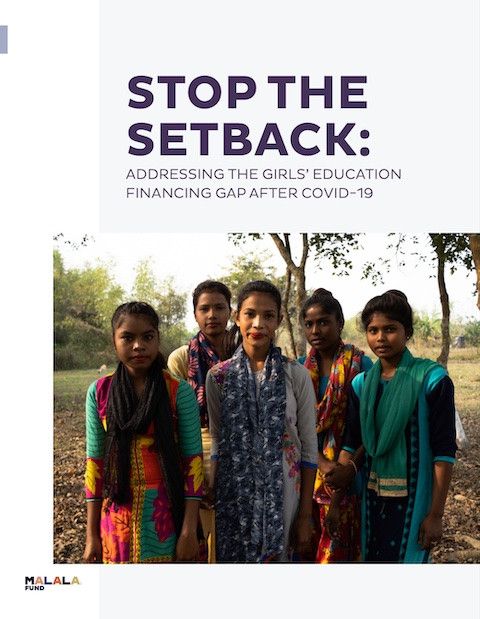 Stop the Setback: Addressing the Girls’ Education Financing Gap After COVID-19 Year of publication: 2021 Corporate author: Malala Fund Decades of research show that investing in girls’ education is one of the best investments we can make in the future peace, prosperity and sustainability of our planet. By taking the steps for girls’ education outlined in this report, leaders can build a better world in the pandemic’s wake — not just for girls, but for everyone.
  Climate Box: Climate Change Education and Awareness Program; Training Module for Teachers Year of publication: 2020 Corporate author: United Nations Development Programme (UNDP) The module contains materials for teachers, educators, tutors, educational program developers, and a wide range of people interested in climate change education. It is designed to build the capacity of teachers or education experts in climate education, as part of the formal qualification system.The objectives of the training module are:Raising climate awareness among school teachers to facilitate the introduction of climate education in primary, secondary, and high schools.Assisting teachers in the practical application of the Climate Box toolkit by facilitating the incorporation of the climate change topics into the school curriculum, extracurricular activities, and further education.Encouraging innovative pedagogical approaches to integrating climate change education into school education and raising awareness of climate change. The training module for teachers presents numerous examples on approaches to climate education, climate adaptation projects, and practices to reduce the individual carbon footprint from participating countries in the climate Box program. Its recommendations on the application of the training module consider the peculiarities of national education systems in different countries.
  From Justice for the Past to Peace and Inclusion for the Future: A Development Approach to Transitional Justice Year of publication: 2020 Author: Lorena Mellado | Chelsea Shelton | Aparna Basnyat | Krishna Velupillai | Chris Mahoney | Djordje Djordjević Corporate author: United Nations Development Programme (UNDP) Comprehensive transitional justice processes supports the achievement of Agenda 2030, by promoting justice, peace, quality education and gender equality as a vehicle towards for more inclusive justice systems.Through more than 10 years, UNDP has been supporting transitional justice processes with an integrated approach to support sustaining peace. This strategic report covers a wide range of UNDP’s support to transitional justice processes providing good practices, country cases and key strategic alliances with UN partners, such as OHCHR, UN Women, and UN peace missions.The report looks to: Outline the main areas of UNDP’s work in transitional justice Share successful experiences and current challenges from countries around the world Offer recommendations for strategic transitional justice programmingThe key areas highlighted in the report are participatory processes, institutional transformation for proper accountability, reparations programmes and conflict prevention and sustaining peace to promote resilience and social cohesion for affected communities.Key lessons and recommendations are also outlined for practitioners to consider when designing and implementing transitional justice programmes and to draw out key findings and recommendations as well as identifies opportunities for more investment in transitional justice moving forward.
  SDG Good Practices: A Compilation of Success Stories and Lessons Learned in SDG Implementation (1st Edition) Year of publication: 2020 Corporate author: UN. Department of Economic and Social Affairs (UN. DESA) This publication presents 16 SDG Good Practices from across the globe, received in response to the first open call for good practices, success stories and lessons learned in SDG implementation, promoted by UN DESA between 2018 and 2019.Sorted by geographical region, this publication describes the diverse examples in detail, featuring updates and reflections on the impact and adaptations to the COVID-19 pandemic and showcasing results and impact.As the world pursues a transformative recovery from COVID-19 and embarks on the Decade of Action for accelerating the implementation of the SDGs, it is hoped that these examples provide inspiration to Governments and stakeholders in their efforts to address crisis, reduce the risk of future potential emergencies and deliver on the ambitious and inclusive vision of the 2030 Agenda.
 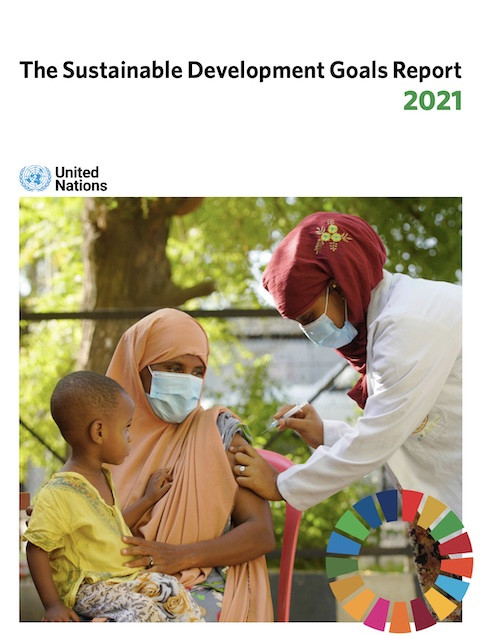 The Sustainable Development Goals Report 2021 Year of publication: 2021 Corporate author: United Nations (UN) As the pandemic continues to unfold, The Sustainable Development Goals Report 2021 outlines some significant impacts in many areas that are already apparent. The global extreme poverty rate rose for the first time in over 20 years, and 119 to 124 million people were pushed back into extreme poverty in 2020. There is a risk of a generational catastrophe regarding schooling, where an additional 101 million children have fallen below the minimum reading proficiency level, potentially wiping out two decades of education gains. Women have faced increased domestic violence, child marriage is projected to rise after a decline in recent years, and unpaid and underpaid care work is increasingly and disproportionately falling on the shoulders of women and girls, impacting educational and income opportunities and health. Notwithstanding the global economic slowdown, concentrations of major greenhouse gases continue to increase. With the global average temperature reaching about 1.2°C above pre-industrial levels, the climate crisis has well and truly arrived, and its impacts are being felt across the world. The pandemic has also brought immense financial challenges, especially for developing countries – with a significant rise in debt distress and dramatic decreases in foreign direct investment and trade. Yet, with a surge in global solidarity and leadership from the highest political level, countries can still deliver on the 2030 Agenda and the 2015 Paris Agreement on Climate Change. A global vaccination plan, designed and implemented by the countries that can produce vaccines today or will be able to do so if properly supported, is an urgent first step in that direction. A recommitment by Governments, cities, businesses, and industries to ensure that the recovery reduces carbon emissions, conserves natural resources, creates better jobs, advances gender equality and tackles growing poverty and inequalities is a further imperative. Rapport sur les objectifs de développement durable 2021 Year of publication: 2021 Corporate author: United Nations (UN) Le Rapport sur les objectifs de développement durable pement durable 2021 décrit certains effets importants qui se manifestent déjà dans de nombreux domaines. Le taux mondial d’extrême pauvreté a augmenté pour la première fois en plus de 20 ans, et entre 119 et 124 millions de personnes ont basculé dans l’extrême pauvreté en 2020. Un risque de catastrophe générationnelle se dessine en matière de scolarisation, alors que 101 millions d’enfants de plus sont passés sous le seuil minimum de compétence en lecture, ce qui pourrait réduire à néant deux décennies de progrès scolaires. Les femmes ont été confrontées à une hausse de la violence conjugale, le mariage d’enfants devrait augmenter après des années de baisse, et le travail domestique non rémunéré et sous-payé repose de plus en plus et de façon disproportionnée sur les femmes et les filles, avec des répercussions sur leurs possibilités d’édu- cation et de revenu et leur santé. Malgré le ralentissement économique mondial, la concentration des principaux gaz à effet de serre continue d’augmenter. La température moyenne mondiale s’établissant à environ 1,2 °C au-dessus des niveaux préindustriels, la crise climatique est bel et bien là et ses effets se font sentir partout dans le monde. La pandémie a également engendré d’immenses défis financiers, en particulier pour les pays en développement, avec une augmentation significative du surendettement et une baisse spectaculaire de l’investissement étranger direct et du commerce.Pourtant, avec un élan de solidarité mondiale et un leadership au plus haut niveau politique, les pays peuvent encore réaliser le Programme 2030 et l’Accord de Paris sur les changements climatiques adopté en 2015. Un plan mondial de vaccination, conçu et mis en œuvre par les pays qui peuvent aujourd’hui produire des vaccins ou qui le pourront dans le futur avec le soutien adéquat, est une première étape urgente pour y parvenir.Il est également impératif que les gouvernements, les villes, les entreprises et les industries s’engagent de nouveau à assurer une reprise qui prises et les industries s’engagent de nouveau à assurer une reprise qui réduise les émissions de carbone, préserve les ressources naturelles, crée de meilleurs emplois, fasse progresser l’égalité entre les sexes et fasse reculer la pauvreté et les inégalités croissantes.
 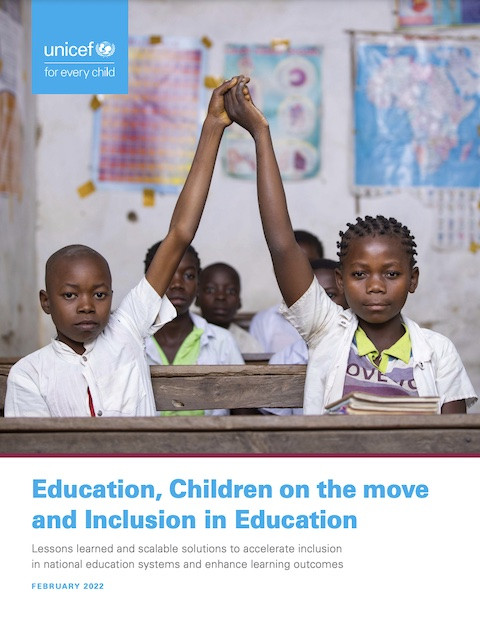 Education, Children on the Move and Inclusion in Education: Lessons Learned and Scalable Solutions to Accelerate Inclusion in National Education Systems and Enhance Learning Outcomes Year of publication: 2022 Author: Neven Knezevic | Katherine Curtiss | Eric Gero Corporate author: United Nations Children's Fund (UNICEF) This report summarizes how UNICEF and its partners have contributed to the creation of education solutions that support the skills development and educational attainment of children on the move in countries and regions across the world. Country case studies highlighting best practices from 19 countries and the East African and Sahel regions showcase UNICEF’s work with country governments on issues such as the inclusion of refugees in national education systems and improving relations between refugee children, their families, and their host communities.
 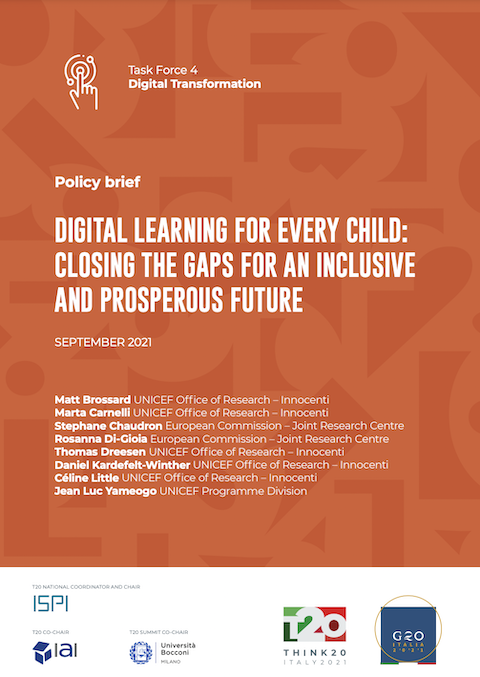 Digital Learning for Every Child: Closing the Gaps for an Inclusive and Prosperous Future Year of publication: 2021 Author: Matt Brossard | Marta Carnelli | Stephane Chaudron | Rosanna Di-Gioia | Thomas Dreesen | Daniel Kardefelt-Winther | Céline Little | Jean Luc Yameogo Corporate author: United Nations Children's Fund (UNICEF) Pre-COVID-19, half of the world’s children were already unable to read a simple text by the age of 10. School closures have deepened pre-existing learning disparities, within and among countries, due to inequities in access to technology. This brief summarises research findings and provides actionable recommendations for how to equitably scale up digital learning and provide children and young people with the skills to improve their prospects and safeguard their well-being. It pinpoints solutions for education systems’ use of digital and blended learning anchored in a sound pedagogical approach and urges the G20 and other countries to overcome the barriers that limit the potential benefits of digital learning.