
Resources
Explore a wide range of valuable resources on GCED to deepen your understanding and enhance your research, advocacy, teaching, and learning.
2,193 Results found
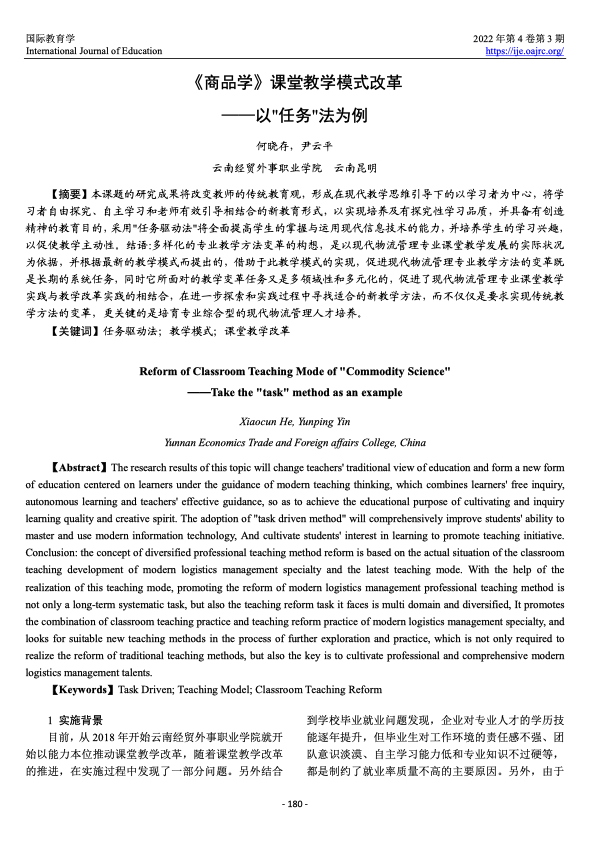 《商品学》课堂教学模式改革: 以"任务"法为例 Year of publication: 2022 Author: 何晓存 | 尹云平 本课题的研究成果将改变教师的传统教育观,形成在现代教学思维引导下的以学习者为中心,将学习者自由探究、自主学习和老师有效引导相结合的新教育形式,以实现培养及有探究性学习品质,并具备有创造精神的教育目的,采用"任务驱动法"将全面提高学生的掌握与运用现代信息技术的能力,并培养学生的学习兴趣,以促使教学主动性。结语:多样化的专业教学方法变革的构想,是以现代物流管理专业课堂教学发展的实际状况为依据,并根据最新的教学模式而提出的,借助于此教学模式的实现,促进现代物流管理专业教学方法的变革既是长期的系统任务,同时它所面对的教学变革任务又是多领域性和多元化的,促进了现代物流管理专业课堂教学实践与教学改革实践的相结合,在进一步探索和实践过程中寻找适合的新教学方法,而不仅仅是要求实现传统教学方法的变革,更关键的是培育专业综合型的现代物流管理人才培养。
  Rethinking Schooling for the 21st Century: The State of Education for Peace, Sustainable Development and Global Citizenship in Asia Year of publication: 2017 Corporate author: Mahatma Gandhi Institute of Education for Peace and Sustainable Development (MGIEP) Calls to gear up schools for the 21st century are ubiquitous today. Dominant international educational discourse hails the potential of 'the youth dividend' and digital technology for enhancing growth. Some Asian education systems are held up as models for an innovation-led utopian future. But across much of Asia, neither the reality of schooling nor the patterns of development with which it is associated give cause for blithe optimism.This study is informed by UNESCO’s commitment to realising the Sustainable Development Goals (SDGs) through educational reform worldwide. Since its inception, UNESCO has championed a humanistic vision of education — a vision today encapsulated in SDG 4.7. These ideals need to be strongly restated and defended in an era when educational debate worldwide has come to be framed by a narrowly economistic and instrumentalist agenda.Deriving urgent significance from this broader context, the present report analyses how far the ideals of SDG 4.7 – of 'education for peace, sustainable development and global citizenship' - are embodied in policies and curricula across 22 Asian societies. At one level, it seeks to develop benchmarks against which future progress can be assessed. It also argues forcefully that conceptions of the fundamental purposes of schooling need to be reconfigured, if the ideals to which the global community has subscribed are actually to be realised.
  Pacific education for sustainable development framework; endorsed by the Pacific Ministers of Education, 27 September 2006, Nadi Fiji Year of publication: 2006 Corporate author: UNESCO Apia This paper presents a Pacific developed and driven Framework as a mechanism to assist in the implementation of the Pacific Plan and the basis for a regional approach to coordinating actions to achieve its vision of a prosperous region where “all people can lead free and worthwhile lives.” It further recognises the commitment made by Pacific countries in adopting the UN Decade of Education for Sustainable Development. The Framework can be adapted for national policy as well as regional strategy documents. The Framework can also be used by both national and regional organisations to identify priority initiatives for implementation in Education for Sustainable Development (ESD) within the Pacific. L'éducation du Pacifique pour cadre de développement durable; approuvé par les ministres de L'éducation du Pacifique, le 27 Septembre 2006, Nadi Fiji Year of publication: 2006 Corporate author: UNESCO Apia Cet article présente un Pacifique développé et entraîné cadre comme un mécanisme pour aider à la mise en œuvre du Plan Pacifique et la base d'une approche régionale pour la coordination des actions pour réaliser sa vision d'une région prospère où «toutes les personnes peuvent mener une vie libre et valables. "Il reconnaît en outre l'engagement pris par les pays du Pacifique en adoptant la Décennie de l'éducation pour le développement durable des Nations Unies. Le cadre peut être adapté à la politique nationale, ainsi que les documents de stratégie régionale. Le cadre peut également être utilisé par les organisations nationales et régionales pour identifier les initiatives prioritaires pour la mise en œuvre de l'éducation pour le développement durable (EDD) dans le Pacifique.
  Sub-Regional Study on Transforming TVET in Ensuring Learning and Skills to Support School-to Work Transitions in Southeast Asian Countries Year of publication: 2023 Author: Jann Hidajat Tjakraatmadja | Hary Febriansyah | Yorga Permana | Lala Nurfitria | Farenza Fadil Corporate author: UNESCO Jakarta Technical and Vocational Education and Training (TVET) and the transition from school to work are critical for young individuals to be prepared for entering the job market. The school-to-work transition signifies the transition from education to professional work and involves stages such as finding a job, applying theoretical knowledge and adapting to work expectations. In line with SDG-4, there is a need to improve the relevance of TVET systems, equipping individuals with the necessary skills for employment, entrepreneurship and lifelong learning. Three strategic priorities include promoting lifelong learning opportunities, fostering skills for an inclusive and sustainable economy, and ensuring inclusive and resilient communities. UNESCO supports Member States to address current and future challenges in the field of TVET, including the transition from school to work. Recognising the significant role of TVET in achieving SDG-4, UNESCO works closely with countries like Brunei Darussalam, Indonesia, Malaysia, the Philippines, and Timor-Leste to enhance the relevance and effectiveness of their TVET systems. These countries have demonstrated a strong commitment to improving the quality of education and equipping individuals with the necessary skills for employment, entrepreneurship, and lifelong learning. In the discussion of innovations and trends in TVET systems, there is a need to respond to rapidly changing labour markets through leveraging labour market data, tracer studies, and employer insights, expanding work-based learning to support the transition from school to work, modernising TVET curricula with new skills and competencies, strengthening TVET through private sector and community engagement. TVET is important for the transition from school to work in the sub-region of Southeast Asia, in line with SDG-4. Standardised practices are needed for better employability and mobility. Challenges include labour market mismatches and negative perceptions, but there are opportunities to partner with industry, update curricula, promote inclusivity and gender equality, and adapt to changing labour markets. Using labour market data, expanding work-based learning, and engaging the private sector and local communities are critical. TVET can transform individuals and contribute to sustainable development in the subregion of South-East Asia, creating prosperous and inclusive societies.
 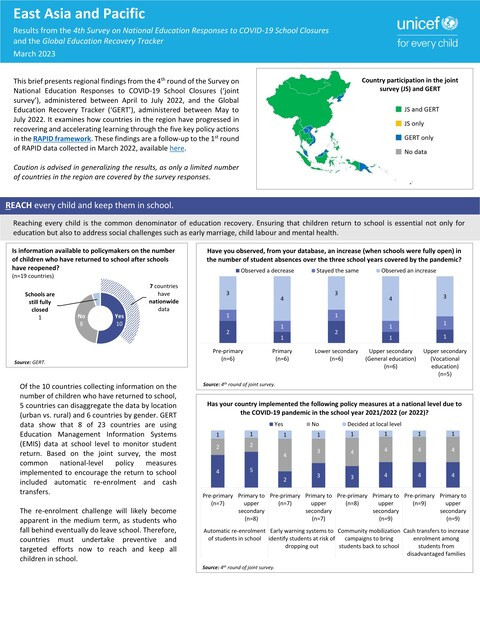 Education in a Post-COVID World: Towards a Rapid Transformation; East Asia and Pacific Regional Brief Year of publication: 2023 Corporate author: United Nations Children's Fund (UNICEF) On March 11, 2020, the World Health Organization declared COVID-19 a global pandemic, resulting in disruptions to education at an unprecedented scale. In response to the urgent need to recover learning losses, countries worldwide have taken RAPID actions to: Reach every child and keep them in school; Assess learning levels regularly; Prioritize teaching the fundamentals; Increase the efficiency of instruction; and Develop psychosocial health and wellbeing. This brief presents regional findings from the 4th round of the Survey on National Education Responses to COVID-19 School Closures (‘joint survey’), administered between April to July 2022, and the Global Education Recovery Tracker (‘GERT’), administered between May to July 2022. It examines how countries in the region have progressed in recovering and accelerating learning through the five key policy actions in the RAPID framework. These findings are a follow-up to the 1st round of RAPID data collected in March 2022.
 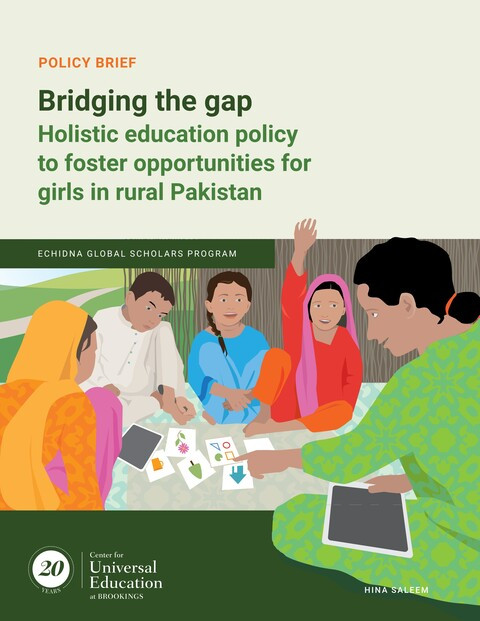 Bridging the Gap: Holistic Education Policy to Foster Opportunities for Girls in Rural Pakistan Year of publication: 2023 Author: Hina Saleem Corporate author: Center for Universal Education at Brookings Seven out of ten girls in rural Sindh are excluded from schooling. This happens for a myriad of reasons and occurs both in the presence and absence of operational school buildings. When schools are present, the challenges that children—especially girls—face due to their economic and social context often go unaddressed; children who are able to enroll in school often find their learning affected by classroom design and practices and experiences that mirror the exclusion they experience outside of school. At the broader level, this exclusion is reflected in limited representation of the needs and aspirations of sizable rural populations in Pakistan’s formal education system and the pathways beyond it. This policy brief presents findings from on-the-ground research in rural settlements in Sindh province that explores the disparities between boys and girls in enrollment and continuation of schooling in addition to overall inadequate education outcomes. It also provides policy recommendations to support all children and particularly girls in meeting their education needs and aspirations. Education policy must respond to these challenges of unmet education needs and aspirations by taking a holistic, welfare-based approach that supports children to overcome the effects of exclusionary conditions to meet their education needs. However, the benefits of such an approach can only be realized if teaching practices and learning experiences are contextualized, build a connection with local knowledge, question root causes of exclusion and support and prepare all children in negotiating pathways beyond education.
 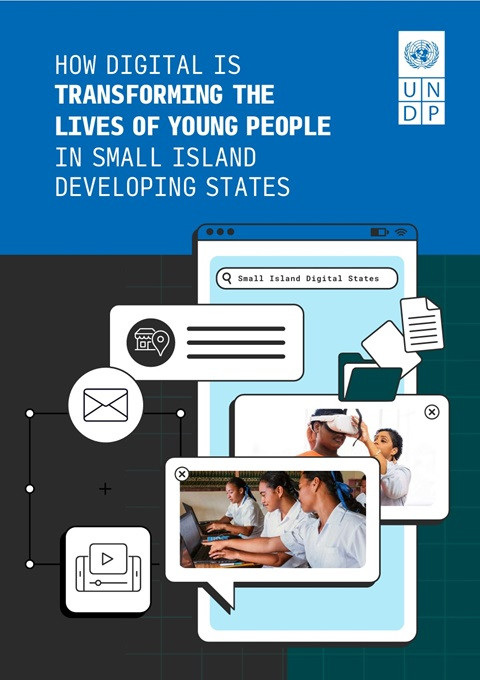 How Digital is Transforming the Lives of Young People in Small Island Developing States Year of publication: 2024 Corporate author: United Nations Development Programme (UNDP) Young people represent a sizeable and vital population in Small Island Developing States (SIDS). For them, digital technologies are more than just tools; they are gateways to new horizons. Digital is creating fresh opportunities, opening doors to unconventional careers, and redefining how knowledge is acquired and shared. Young people are using digital to start new businesses, explore new opportunities, learn new knowledge and skills, and to build global connections. However, young people are also cautious about digital – and they recognise risks and issues posed by digital channels, tools, and technologies. ‘How Digital is Transforming the Lives of Young People in SIDS’ explores these opportunities and challenges by hearing from young people – in their own words. Through a bespoke survey chatbot, running on messaging platforms most used by young people living in SIDS, more than 5,000 respondents from over 30 countries discuss how they’re using digital to transform their lives and livelihoods. And the barriers and challenges that they are facing on their digital journeys.
  Kit de Plaidoyer pour la promotion de l'éducation multilingue: y compris les exclus Year of publication: 2007 Corporate author: UNESCO Bangkok
 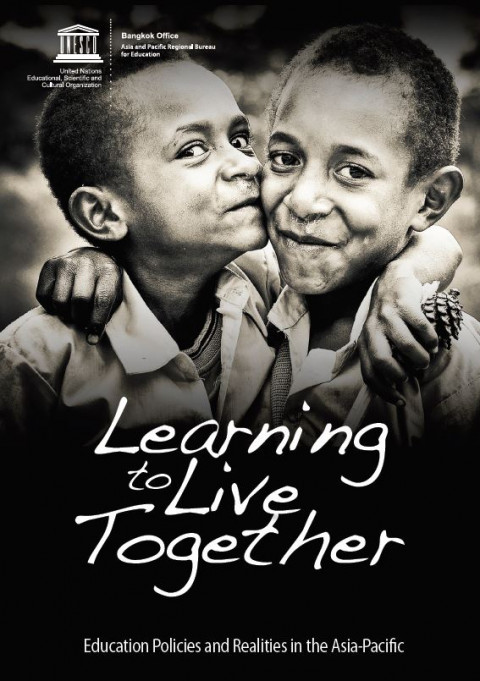 Learning to live together Year of publication: 2014 Corporate author: UNESCO Bangkok The importance of LTLT has increased in recent years. Indeed, relevant competencies appear to be gaining focus in international frameworks and educational initiatives across countries. This is all the more necessary as Voogt and Roblin (2012) argue, given the demands of our increasingly knowledge-based society in which “ideas and knowledge function as commodities” (p. 299 –300) and to which effective social and emotional skills are critical. It is perhaps all the more critical given the multivariate global challenges in the 21st Century and the need for unified global commitment to effectively combat these challenges. In this context, the significance of LTLT is reflected in both the rise of and growing interest in Global Citizenship Education (GCE), Education for Sustainable Development (ESD), Education for International Understanding (EIU) as well as peace and human rights education. The UN Secretary-General’s Global Education First Initiative, which lists ‘Fostering Global Citizenship’ as one of its three global priorities, also implicitly recognizes the significance of LTLT as a precursor to the building of a more peaceful society, one in which discrimination is intolerable and common challenges such as climate change and abject poverty are tackled together.Yet despite the significance of LTLT in the 21st Century, and despite numerous international initiatives to foster LTLT competencies, there is a large gap of evidence identifying how this supposition is translated into effective policy and curricula, and eventually into the reality of schools, teachers and learners. This report is a response to this gap, and attempts to understand how ten selected countries in the Asia-Pacific region – Afghanistan, Australia, Indonesia, Malaysia, Myanmar, Nepal, The Philippines, Republic of Korea, Sri Lanka and Thailand – have reflected and integrated LTLT into their education policies and initiatives. This variety of countries aims to reflect their diverse experiences in terms of reflecting LTLT through their education systems. By exploring a number of areas, namely policy, curricula, teachers and assessment, this study aims to identify what has so far been achieved in education systems of the Asia-Pacific region in the area of LTLT.This report is therefore targeted predominantly at education policy makers, researchers, academics as well as education practitioners of the Asia-Pacific region. Given its connection to Global Citizenship Education and other relevant international initiatives around sustainability and peace education, this report is also relevant to UNESCO’s partner organizations and the broader educational development community.This report will first present the research framework for the study, before exploring the social and economic contexts in the ten selected countries and wider regional factors in the Asia-Pacific in relation to global challenges in Chapter Two. Chapter Three will then examine national policy frameworks, including the vision of those policies in defining LTLT in education. Chapter Four focuses on the national curriculum in selected countries and the extent to which they incorporate learning objectives, subjects, and extra-curricular activities reflecting the concept of LTLT and related skills and competencies. In Chapter Five, teaching practices are examined, including the role of teachers and teacher education, as well as teaching methods and application of media and information literacy (MIL) in the classroom. Chapter Six then looks at assessment, and how far countries have attempted to develop assessment frameworks that measure the skills and competencies related to LTLT. Finally, Chapter Seven provides reflections and conclusions based on the main findings of the study, while also identifying trends across policy domains, shortcomings and some policy considerations.