
Resources
Explore a wide range of valuable resources on GCED to deepen your understanding and enhance your research, advocacy, teaching, and learning.
3,433 Results found
 Addressing Anti-semitism in Schools: Training Curriculum for Vocational Education Teachers Year of publication: 2020 Corporate author: UNESCO | OSCE. Office for Democratic Institutions and Human Rights (ODIHR) This OSCE/ODIHR and UNESCO co-publication aims to help vocational school teachers to prevent and respond to anti-Semitism. The curriculum, intended for teacher trainers, is designed to be comprehensive, robust, practical and adaptable. It suggests concrete ways to address anti-Semitism and counter prejudice in and through education, while promoting human rights, global citizenship education, and gender equality.The co-publication is part of a series of four training curricula, designed for trainers of (1) primary school teachers, (2) secondary school teachers, (3) vocational school teachers, and (4) school directors.
  Addressing Anti-semitism in Schools: Training Curriculum for School Directors Year of publication: 2020 Corporate author: UNESCO | OSCE. Office for Democratic Institutions and Human Rights (ODIHR) This OSCE/ODIHR and UNESCO co-publication aims to help school directors to prevent and respond to anti-Semitism. The curriculum, intended for school director trainers, is designed to be comprehensive, robust, practical and adaptable. It suggests concrete ways to address anti-Semitism and counter prejudice in and through education, while promoting human rights, global citizenship education, and gender equality.The co-publication is part of a series of four training curricula, designed for trainers of (1) primary school teachers, (2) secondary school teachers, (3) vocational school teachers, and (4) school directors.
  The Role of Education in Countering Violent Extremism Year of publication: 2013 Corporate author: Center on Global Counterterrorism Cooperation and Hedayah On 18 and 19 September 2013, the Center on Global Counterterrorism Cooperation (CGCC) and Hedayah co-hosted in New York City an expert roundtable on “The Role of Education in Countering Violent Extremism.” The meeting brought together a group of policy-makers, researchers and practitioners to discuss challenges and best practices related to efforts to counter violent extremism through education. The Role of Education in Countering Violent Extremism Year of publication: 2013 Corporate author: Center on Global Counterterrorism Cooperation and Hedayah Les 19 et 20 septembre 2013, le Centre de coopération internationale pour la lutte contre le terrorisme (Center on Global Counterterrorism Cooperation, CGCC) et Hedayah ont accueilli une table ronde d'experts, à New York, sur « le rôle de l'éducation pour lutter contre l'extrémisme violent » (The Role of Edcuation in Countering Violent Extremism). Cet événement a réuni des décideurs politiques, des chercheurs et des praticiens afin de discuter des défis et des meilleures pratiques dans les efforts réalisés pour lutter contre l'extrémisme violent par l'éducation.
  Education and Conflict: Complexity and Chaos Year of publication: 2003 Author: Lynn Davies Based on the author's extensive research and experience of education in several areas afflicted by conflict, the book explores the relationship between schooling and social conflict and looks at conflict internal to schools. It posits a direct link between the ethos of a school and the attitudes of future citizens towards 'others'. It also looks at the nature and purpose of peace education and war education, and addresses the role of gender and masculinity. Education and Conflict: Complexity and Chaos Year of publication: 2003 Author: Lynn Davies Basé sur une recherche approfondie de l'auteur et sur son expérience en terme d'éducation dans plusieurs zones affectées par des conflits, ce livre analyse la relation entre le fait d'aller à l'école et le conflit social, et s'attache aux conflits qui surviennent au sein des établissements scolaires. L’auteur postule un lien direct entre l'éthos adopté par une école donnée et le comportement de ses futures citoyens envers « les autres ». Il s'attache également à la nature et à l'objet de l'éducation pour la paix et de l'enseignement des conflits, et aborde la question du rôle joué par le genre et la masculinité.
  Schools and war: urgent agendas for comparative and international education Year of publication: 2005 Author: Lynn Davies Corporate author: Taylor & Francis This paper looks first at the contributions that education makes to conflict, through the reproduction of inequality and exclusion, through perpetuation of ethnic or religious divisions, through its acceptance of dominant aggressive masculinities, through selection, competition and fear, and through distorted curricular emphases on narrow cognitive areas of learning. However, the paper also outlines some ‘possibilities for hope’, such as resilient schools, the impact of peace education initiatives and the rise of global citizenship education.
  Inter-agency peace education programme: skills for constructive living; overview of the programme Year of publication: 2005 Author: Antonella Verdiani Corporate author: UN. Office of the United Nations High Commissioner for Refugees (UNHCR) | Inter-agency Network for Education in Emergencies (INEE) This manual is one of the components of the “Inter-Agency Peace Education Programme”. The programme is designed for education managers of ministries dealing with both formal and non-formal education and for agencies which implement education activities on behalf of the government. The implementation structure is based on the experience acquired over the eight years the programme has been in use, from 1998 to 2005. The programme has been evaluated by external experts and the new revised materials (2005) incorporate both the suggestions made in the evaluation and the feedback from the specialists who implemented it in the field. Programme Interinstitution d'éducation pour la paix: compétences pour la vie constructive; aperçu du programme Year of publication: 2005 Author: Antonella Verdiani Corporate author: UN. Office of the United Nations High Commissioner for Refugees (UNHCR) | Inter-agency Network for Education in Emergencies (INEE) Ce manuel est l'une des composantes du «Programme Interinstitution d'éducation pour la paix». Le programme est conçu pour les gestionnaires de l'éducation des ministères chargés de l'éducation formelle et non-formelle et pour les organismes qui mettent en œuvre des activités d'éducation au nom du gouvernement. La structure de mise en œuvre est basée sur l'expérience acquise au cours des huit années, le programme a été utilisé, de 1998 à 2005. Le programme a été évalué par des experts externes et les nouveaux matériaux révisés (2005) intègrent à la fois les suggestions formulées dans l'évaluation et les réactions des spécialistes qui œuvre dans le domaine.
 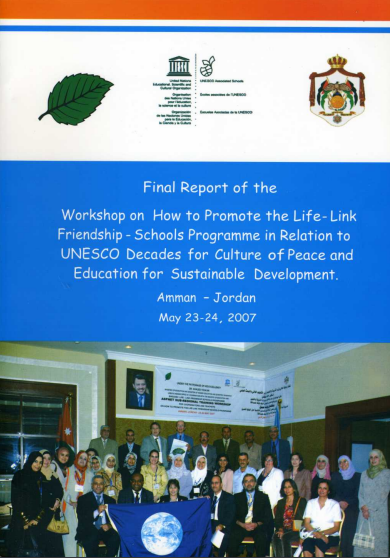 Final report of the workshop on how to promote the life-link friendship-schools programme in relation to UNESCO decades for culture of peace and education for sustainable development, Amman, Jordan, May 23-24, 2007 Year of publication: 2007 Corporate author: UNESCO Amman This chapter provides a brief summary of the speeches presented at the official opening and closing ceremonies as well as presentations delivered by the experts of Life-Link and UNESCO staff at the two day workshop The sub-regional workshop for ASPnet National Coordinators and Life-Link Friendship Schools Programme, organized in close collaboration with the Ministry of Education, was constructed according to the following format: (i). An organizing Committee was formed comprising of staff from the Ministry of Education and UNESCO Amman Office and Chairperson of Life-Link Programme. The committee oversaw the organization, preparation of documentation, venue, draft agenda, logistic and procedural aspects of the workshop. (ii). The selection of participants for the workshop was done by the National Commissions for UNESCO to Lebanon, Palestine, Iraq, Egypt, Oman and Jordan. The participating Arab Countries were selected by UNESCO Office-Amman and Life-Link. (iii).The selected participants comprised the National Coordinators and teachers for ASPnet in their countries. A member from Life-Link in Jordan was invited as an observer for the workshop. (iv).The resource persons (trainers) for the workshop were carefully selected on the basis of their expertise, experience and relevance to the main subjects of the workshop. The experts came from the Ministry of Education, Life-Link, UNESCO and UNRWA. (v). The format of the workshop was basically structured to firstly provide an overview and background of the Life-Link Friendship Schools Programme and ASPnet, followed by experts' presentations relevant to the main subjects of Life-Link Programme. The workshop also had three sessions of discussion on the different aspects of Life Link Programme. Participants were circulated to these sessions one after another. The workshop also had a session on how to plan for implementing peace actions as Extra Curricula Activities in schools. (vi). The ASPnet national workshop was organized under the patronage of his Excellency Dr. Khaled Toukan, the Minister of Education and the Minister of Higher Education & Scientific Research and Chairman of the Jordan National Commission for UNESCO.