
Resources
Explore a wide range of valuable resources on GCED to deepen your understanding and enhance your research, advocacy, teaching, and learning.
2,776 Results found
 Diriger et agir pour l’équité, l’inclusion et la justice sociale : boîte à outils pour les directions d’établissement d’enseignement Year of publication: 2020 Author: Julie Larochelle-Audet | Marie-Odile Magnan | Emmanuelle Doré | Maryse Potvin | Lise-Anne St-Vincent | Andréanne Gélinas-Proulx | Anastasie Amboulé Abath Corporate author: Observatoire sur la formation à la diversité et l’équité (OFDE) L’objectif principal de ce document est d’outiller les directions d’établissement, en exercice ou en formation, pour qu’ils puissent contribuer à la mise en œuvre d’une éducation permettant à tous et toutes d’avoir des opportunités équivalentes d’accéder aux services, aux ressourceset aux biens collectifs de la société québécoise et d’y participer en toute égalité et dignité. The main objective of this document is to equip school principals and those in training with the tools they need to contribute to the implementation of an education system that gives everyone equal opportunities to access the services, resources and public goods of Quebec society and to participate in them with full equality and dignity.
  Commission Canadienne des Droits de la Personne Corporate author: Commission Canadienne des Droits de la Personne La Commission canadienne des droits de la personne est l'organisme de surveillance des droits de la personne à l'échelon fédéral. La Commission est indépendante du gouvernement et agit dans l'intérêt public. Elle contribue à ce que chaque personne au Canada soit traitée équitablement, peu importe son identité. Elle est responsable de représenter l'intérêt public et de demander des comptes au gouvernement du Canada quant aux enjeux de droits de la personne. Sur cette page, vous trouverez des ressources pour mettre en place une politique inclusive dans vos secteurs de travail notamment sur la prévention du racisme, de l'intolérance religieuse et des droits aux travailleurs en situation de handicap The Canadian Human Rights Commission is Canada's human rights watchdog. We work for the people of Canada and operate independently from the Government. The Commission helps ensure that everyone in Canada is treated fairly, no matter who they are. We are responsible for representing the public interest and holding the Government of Canada to account on matters related to human rights. On this page, you'll find resources to help you implement an inclusive policy in your areas of work, including the prevention of racism, religious intolerance and the rights of workers with disabilities.
  Qui a peur des Juifs ? Antisémitisme, la tentation perpétuelle Year of publication: 2023 Corporate author: Illana Weizman Dans cette série podcast, la sociologue Illana Weizman questionne les expériences juives et l’hostilité subie par cette population en compagnie d’intellectuel-les, d’artistes, de chercheurs-euses, de militant-es ou de politiques rencontré·es des deux côtés de la frontière franco-suisse.Où en est la lutte contre l’antisémitisme aujourd’hui? Quand les courants antiracistes prônent l’écoute des concernés, n’est-il pas temps de l’appliquer pleinement aux Juifs? In this podcast series, sociologist Illana Weizman discusses the Jewish experience and the hostility suffered by this population in the company of intellectuals, artists, researchers, activists and politicians from both sides of the Franco-Swiss border. When anti-racist currents advocate listening to those concerned, isn't it time to apply this fully to Jews?
 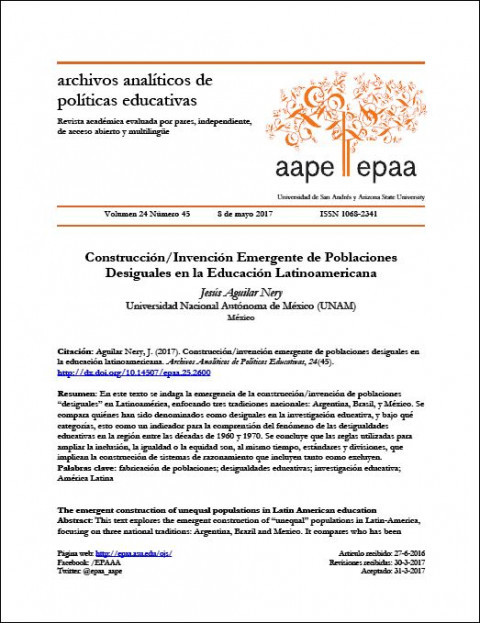 Construction / Emerging Invention of Unequal Populations in Latin American Education Year of publication: 2017 Author: Jesús Aguilar Nery Corporate author: Universidad de San Andrés | Arizona State University This text explores the emergent construction of “unequal” populations in Latin-America, focusing on three national traditions: Argentina, Brazil and Mexico. It compares who has been named as unequal in educational research and under what categories, and treats this comparison as an indicator for understanding the phenomenon of educational inequalities in the region between 1960 and 1970. It is concluded that the rules used to enforce inclusion, equality and equity are, at the same time, standards and divisions that involve the construction of systems of reasoning that also simultaneously include and exclude. Construcción/Invención Emergente de Poblaciones Desiguales en la Educación Latinoamericana Year of publication: 2017 Author: Jesús Aguilar Nery Corporate author: Universidad de San Andrés | Arizona State University En este texto se indaga la emergencia de la construcción/invención de poblaciones “desiguales” en Latinoamérica, enfocando tres tradiciones nacionales: Argentina, Brasil, y México. Se compara quiénes han sido denominados como desiguales en la investigación educativa, y bajo qué categorías, esto como un indicador para la comprensión del fenómeno de las desigualdades educativas en la región entre las décadas de 1960 y 1970. Se concluye que las reglas utilizadas para ampliar la inclusión, la igualdad o la equidad son, al mismo tiempo, estándares y divisiones, que implican la construcción de sistemas de razonamiento que incluyen tanto como excluyen.
 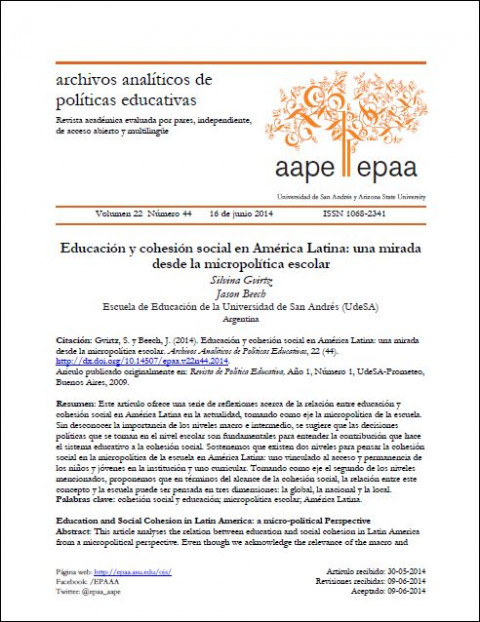 Education and Social Cohesion in Latin America: A Micro-political Perspective Year of publication: 2014 Author: Silvina Gvirtz | Jason Beech Corporate author: Universidad de San Andrés | Arizona State University This article analyses the relation between education and social cohesion in Latin America from a micropolitical perspective. Even though we acknowledge the relevance of the macro and mezzo levels, we argue that the political decisions that are made at the school level are crucial to understand the contribution of educational systems to social cohesion. We suggest that the relation between social cohesion and school micropolitics can be analysed in two dimensions: the first is related to the access and permanence of children in school, while the second is related to the curriculum. The article concentrates on the second level by analysing the relation between the curriculum and social cohesion from a local, a national, and a global perspective. Educación y Cohesión Social en América Latina: Una Mirada desde la Micropolítica Escolar Year of publication: 2014 Author: Silvina Gvirtz | Jason Beech Corporate author: Universidad de San Andrés | Arizona State University Este artículo ofrece una serie de reflexiones acerca de la relación entre educación y cohesión social en América Latina en la actualidad, tomando como eje la micropolítica de la escuela. Sin desconocer la importancia de los niveles macro e intermedio, se sugiere que las decisiones políticas que se toman en el nivel escolar son fundamentales para entender la contribución que hace el sistema educativo a la cohesión social. Sostenemos que existen dos niveles para pensar la cohesión social en la micropolítica de la escuela en América Latina: uno vinculado al acceso y permanencia de los niños y jóvenes en la institución y uno curricular. Tomando como eje el segundo de los niveles mencionados, proponemos que en términos del alcance de la cohesión social, la relación entre este concepto y la escuela puede ser pensada en tres dimensiones: la global, la nacional y la local.
 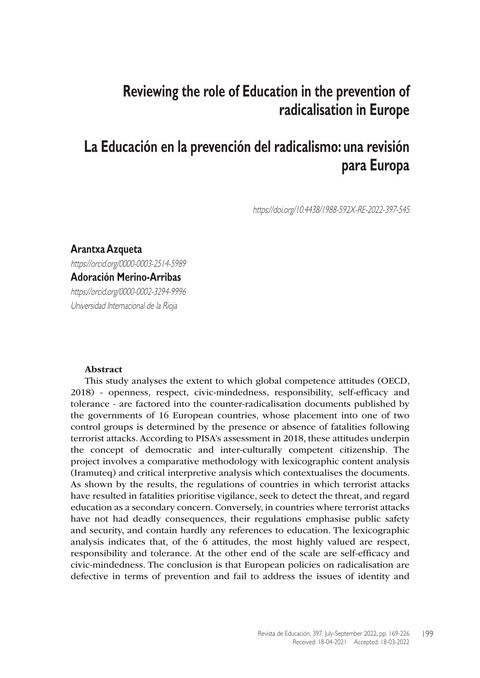 La educación en la prevención del radicalismo: una revisión para Europa Year of publication: 2022 Author: Arantxa Azqueta | Adoración Merino-Arribas Corporate author: Spain. Ministry of Education Esta investigación analiza si las actitudes de la competencia global (OECD, 2018) -apertura, respeto, conciencia cívica, responsabilidad, autoeficacia y tolerancia- se recogen en los documentos gubernamentales sobre prevención del radicalismo de 16 países europeos, aglutinados en dos grupos control, en función de la presencia o ausencia de víctimas mortales en los atentados. Estas actitudes, evaluadas por PISA en 2018, definen a una ciudadanía democrática e interculturalmente competente. Se emplea una metodología comparativa con un análisis de contenido lexicográfico mediante el software Iramuteq junto al análisis crítico-interpretativo que contextualiza los documentos.
 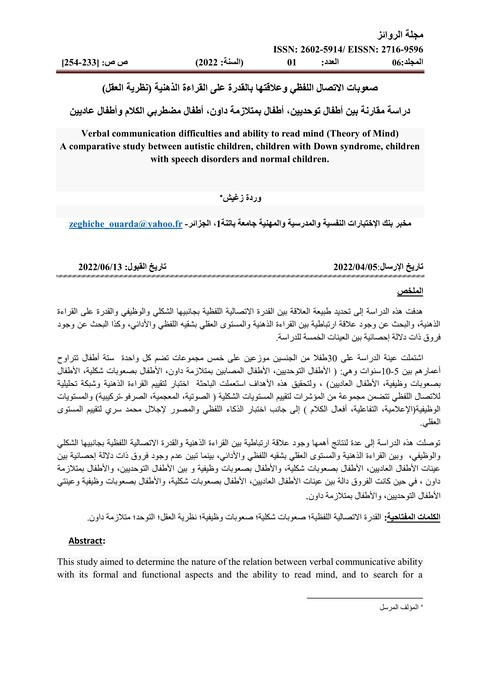 Verbal Communication Difficulties and Ability to Read Mind (Theory of Mind): A Comparative Study Between Autistic Children, Children with Down Syndrome, Children with Speech Disorders and Normal Children (Novels Magazine; Vol.6, No.1) Year of publication: 2022 Author: Zaghish Warda Corporate author: Batna 1 University This study aimed to determine the nature of the relation between verbal communicative ability with its formal and functional aspects and the ability to read mind, and to search for a correlation between mind reading and the mental level in both its verbal and performance aspects, as well as searching for the existence of statistically significant differences between the five samples of the study.The study sample included 30 children of both sexes distributed into five groups, each includes six children between the ages of 5-10 years: (Autistic children, children with Down syndrome, children with formal difficulties, children with functional difficulties,normal children), and to achieve these Objectives the researcher used a test to assess mental reading and an analysis grid for verbal communication, , in addition to the verbal and visual intelligence test of Ejlal Muhammad Serri to assess the mental level .This study reached several results: a correlation between mental reading and verbal communicative ability in its formal and functional aspects, and between mind reading and the mental level in both its verbal and performance aspects, while it was found that there were no statistically significant differences between the samples of normal children, children with formal difficulties, children with functional difficulties, autistic children, and children with Down syndrome, while the differences were significant between samples of normal children, children with formal difficulties, children with functional difficulties and the two samples of autistic children, and children with Down syndrome. صعوبات الاتصال اللفظي وعلاقتها بالقدرة على القراءة الذهنية (نظرية العقل): دراسة مقارنة بين أطفال توحديين، أطفال بمتلازمة داون، أطفال مضطربي الكلام وأطفال عاديين (مجلة الروائز; Vol.6, No.1) Year of publication: 2022 Author: Zaghish Warda Corporate author: Batna 1 University هدفت هذه الدراسة إلى تحديد طبيعة العلاقة بين القدرة الاتصالية اللفظية بجانبيها الشكلي والوظيفي والقدرة على القراءة الذهنية، والبحث عن وجود علاقة ارتباطية بين القراءة الذهنية والمستوى العقلي بشقيه اللفظي والأدائي، وكذا البحث عن وجود فروق ذات دلالة إحصائية بين العينات الخمسة للدراسة.اشتملت عينة الدراسة على 30طفلا من الجنسين موزعين على خمس مجموعات تضم كل واحدة ستة أطفال تتراوح أعمارهم بين 5-10سنوات وهي: ( الأطفال التوحديين، الأطفال المصابين بمتلازمة داون، الأطفال بصعوبات شكلية، الأطفال بصعوبات وظيفية، الأطفال العاديين) ، ولتحقيق هذه الأهداف استعملت الباحثة اختبار لتقييم القراءة الذهنية وشبكة تحليلية للاتصال اللفظي تتضمن مجموعة من المؤشرات لتقييم المستويات الشكلية ( الصوتية، المعجمية، الصرفو-تركيبية) والمستويات الوظيفية(الإعلامية، التفاعلية، أفعال الكلام ) إلى جانب اختبار الذكاء اللفظي والمصور لإجلال محمد سري لتقييم المستوى العقلي.توصلت هذه الدراسة إلى عدة لنتائج أهمها وجود علاقة ارتباطية بين القراءة الذهنية والقدرة الاتصالية اللفظية بجانبيها الشكلي والوظيفي، وبين القراءة الذهنية والمستوى العقلي بشقيه اللفظي والأدائي، بينما تبين عدم وجود فروق ذات دلالة إحصائية بين عينات الأطفال العاديين، الأطفال بصعوبات شكلية، والأطفال بصعوبات وظيفية و بين الأطفال التوحديين، والأطفال بمتلازمة داون ، في حين كانت الفروق دالة بين عينات الأطفال العاديين، الأطفال بصعوبات شكلية، والأطفال بصعوبات وظيفية.