
Resources
Explore a wide range of valuable resources on GCED to deepen your understanding and enhance your research, advocacy, teaching, and learning.
2,657 Results found
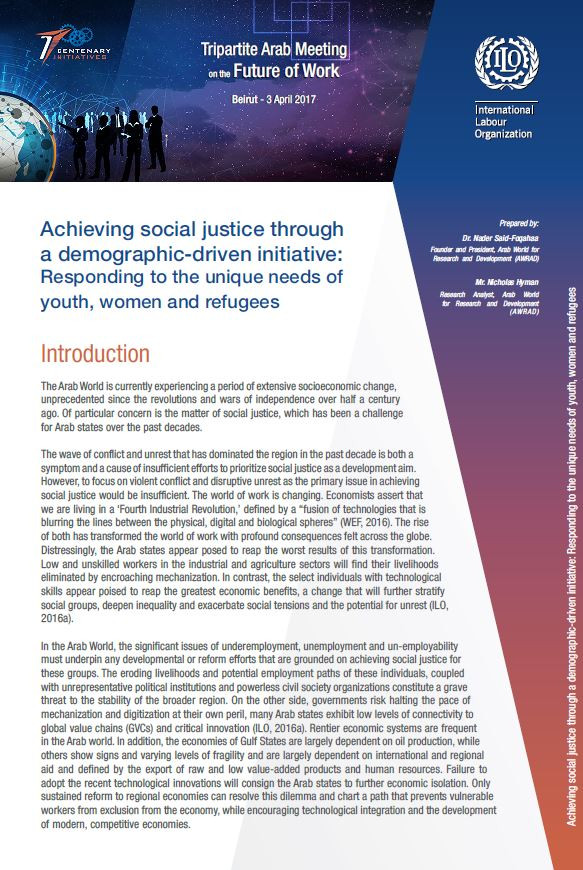 Achieving Social Justice Through a Demographic-driven Initiative: Responding to the Unique Needs of Youth, Women and Refugees Year of publication: 2017 Author: Nader Said-Foqahaa | Nicholas Hyman Corporate author: International Labour Organization (ILO) The Arab world is currently going through a period of great socio-economic change, unprecedented since the revolutions and wars of independence more than half a century ago. The issue of social justice, which has been a challenge to Arab states over the past decades, is a matter of particular concern. The authors attempt to establish a conceptual background of social justice, and to discuss its linkage with youth, children, women, and refugees. The paper concludes with recommendations on social justice in the Arab world. تحقيق العدالة الاجتماهية من خلال مبادرة ديموغرافية: تلبية الاحتياجات الفريدة للشباب والنساء واللاجئين Year of publication: 2017 Author: Nader Said-Foqahaa | Nicholas Hyman Corporate author: International Labour Organization (ILO) يمرّ العالم العربي حالياً بفترة من التغيير الاجتماعي الاقتصادي الكبير، الذي لم يسبق له مثيل منذ الثورات وحروب الاستقلال منذ أكثر من نصف قرن. وتُعتبر مسألة العدالة الاجتماعية التي شكّلت تحدياً للدول العربية على مدى العقود الماضية، مسألة مثيرة للقلق بشكل خاص. يحاول المؤلفون لوضع خلفية مفاهيمية للعدالة الاجتماعية، ومناقشة ربطها بالشباب والأطفال والمرأة واللاجئين. تنتهي الورقة بوضع توصيات حول العدالة الاجتماعية في الوطن العربي.
  Justice in Matters Involving Children in Conflict with the Law: Model Law on Juvenile Justice and Related Commentary Year of publication: 2013 Corporate author: UN. Office on Drugs and Crime (UNODC) This Model Law and the related Commentary are designed to provide legal guidance to States in the process of juvenile justice reform and assist them in drafting juvenile justice legislation. It translates compelling international juvenile justice standards and norms into a national context and aims at harmonizing national legislation with international requirements. International standards and norms in the area of juvenile justice are detailed. Правосудие: Вопросы, Касающиеся Детей, Находящихся в Конфликте с Законом Year of publication: 2013 Corporate author: UN. Office on Drugs and Crime (UNODC) Данный Типовой Закон и соответствующие комментарии являются руководством для проведения реформы правосудия по делам несовершеннолетних в различных странах и призван помочь в создании законодательства по делам несовершеннолетних. Данный Типовой Закон объединяет международные нормы и стандарты законодательства по делам несовершеннолетних, которые необходимо привести в соответствие с национальным законодательством с тем, чтобы гармонизировать национальное и международное законодательства. Данная работа детально описывает международные стандарты и нормы законодательства по делам несовершеннолетних.
  Education à la citoyenneté et aux droits de l'homme: manuel pour les jeunes en Mauritanie Year of publication: 2015 Author: Abdel-Wedoud (dit Deddoud Ould Abdallah) | Mohamed El Moctar Ould Sidina | Bamariam Koita | Sidi Mohamed Ould Mohamed Abdellahi Corporate author: Mauritania. Ministère de la culture et de l'artisanat | Mauritanian National Commission for Education, Science and Culture | UNESCO Rabat Ce Manuel, composé de 20 fiches thématiques, offre de manière inédite des connaissances sur les conventions et standards internationaux en matière de démocratie et de droits de l’homme, ainsi qu’une contextualisation aux cadres normatifs nationaux de la Mauritanie. Des questions clés, des exercices interactifs, et des références pour aller plus loin sont autant d’outils pédagogiques pour familiariser les jeunes avec des notions fondamentales, dans le cadre de l’éducation aussi formelle que non formelle. Car Si l’éducation à la citoyenneté est rattachée à un territoire national dans la mesure où est citoyenne toute personne disposant de droits et de devoirs attachés à une nationalité, à un État, à une histoire sociale et culturelle, l’éducation aux droits de l’homme se réfère quant à elle à un cadre normatif universel et déterritorialisé : sa mission est de cultiver le sentiment d’appartenance de chacun(e) à l’humanité, caractérisée par une dignité propre. Dans une démarche éducative, ce Manuel conjugue les deux dimensions, les interpé- nètre et les met en perspective. L’objectif est de permettre aux jeunes, avec l’aide de formateurs et d’animateurs, d’approfondir et de mettre en perspective leurs connaissances relatives aux valeurs de citoyenneté et aux principes de droits de l’homme, à travers un va-et vient constant entre l’idéal universel et le contexte politique, social, culturel et environnemental dans lequel ils se trouvent.Fruit de la collaboration entre l’UNESCO et le Ministère de la Culture et de l’Artisanat de Mauritanie, et bénéficiant du soutien de l’Agence espagnole pour la coopération internationale pour le développement (AECID), ce Manuel propose des pistes pour explorer et interroger les conditions d’exercice de la citoyenneté, ainsi que des problématiques sociétales émergeantes. Mieux comprendre, pour mieux agir, c’est aussi cela être un agent de changement, de paix et de développement.
  Education à la citoyenneté et aux droits de l'homme: manuel pour les jeunes au Maroc Year of publication: 2015 Corporate author: UNESCO Rabat | Conseil national des droits de l'homme (Morocco) Prepared by UNESCO, in collaboration with the Moroccan National Human Rights Council (CNDH) and the support of the Spanish Agency for International Development Cooperation (AECID), this manual aims to sensitize young Moroccan to the fundamental concepts of citizenship and human rights. This educational tool, which consists of 20 didactic cards that describe and explain Morocco national legislation on human rights, documents the human rights international conventions and instruments and puts them in perspective in the Moroccan legislative context. The manual also includes practical exercises adapted to a young audience. تعليم المواطنة وحقوق الإنسان. دليل لشباب المغرب Year of publication: 2015 Corporate author: UNESCO Rabat | Conseil national des droits de l'homme (Morocco) Prepared by UNESCO, in collaboration with the Moroccan National Human Rights Council (CNDH) and the support of the Spanish Agency for International Development Cooperation (AECID), this manual aims to sensitize young Moroccan to the fundamental concepts of citizenship and human rights. This educational tool, which consists of 20 didactic cards that describe and explain Morocco national legislation on human rights, documents the human rights international conventions and instruments and puts them in perspective in the Moroccan legislative context. The manual also includes practical exercises adapted to a young audience.
  Manuel d'apprentissage de la démocratie pour les jeunes en Tunisie Year of publication: 2011 Corporate author: UNESCO Rabat The main aim of these manual and guide is to raise awareness among Tunisian youth about the values of democracy, human rights and responsible citizenship, and empower youth to make their voice heard during this critical period in the Tunisian democratic transition.
  Rethinking Schooling for the 21st Century: The State of Education for Peace, Sustainable Development and Global Citizenship in Asia Year of publication: 2017 Corporate author: Mahatma Gandhi Institute of Education for Peace and Sustainable Development (MGIEP) Calls to gear up schools for the 21st century are ubiquitous today. Dominant international educational discourse hails the potential of 'the youth dividend' and digital technology for enhancing growth. Some Asian education systems are held up as models for an innovation-led utopian future. But across much of Asia, neither the reality of schooling nor the patterns of development with which it is associated give cause for blithe optimism.This study is informed by UNESCO’s commitment to realising the Sustainable Development Goals (SDGs) through educational reform worldwide. Since its inception, UNESCO has championed a humanistic vision of education — a vision today encapsulated in SDG 4.7. These ideals need to be strongly restated and defended in an era when educational debate worldwide has come to be framed by a narrowly economistic and instrumentalist agenda.Deriving urgent significance from this broader context, the present report analyses how far the ideals of SDG 4.7 – of 'education for peace, sustainable development and global citizenship' - are embodied in policies and curricula across 22 Asian societies. At one level, it seeks to develop benchmarks against which future progress can be assessed. It also argues forcefully that conceptions of the fundamental purposes of schooling need to be reconfigured, if the ideals to which the global community has subscribed are actually to be realised.
  Recommendation on Education for Peace, Human Rights and Sustainable Development: An Implementation Guide Year of publication: 2025 Corporate author: UNESCO There is no peace without education. With conflicts rising on so many fronts, there has never been a more urgent need for a transformed education geared towards building and sustaining peace.The Recommendation on Education for Peace and Human Rights, International Understanding, Cooperation, Fundamental Freedoms, Global Citizenship and Sustainable Development, adopted by all 194 Member States of UNESCO in 2023, articulates a humanistic and transformative vision of education that can help address contemporary and future affronts to peace. These challenges range from the resurgence of conflicts driven by systemic inequalities and injustices, the rise and spread of hate speech, racism and discrimination particularly online, to the adverse effects of digital technologies and the existential threat of climate change.UNESCO has developed this Guide as the first of several tools to assist Member States in unpacking and fully implementing the 2023 Recommendation. The Guide elaborates its contents, integrating the 2023 Recommendation’s transdisciplinary lens to connect key concepts and issues. It also provides concrete ideas and curated resources for action at different levels and types of education, while calling for a multi-stakeholder and whole-of-society approach that includes everyone and builds on existing positive efforts.The Guide is a timely addition to the pool of available collective resources to fully implement the 2023 Recommendation and foster an education that is transformative for a just and peaceful world.