
Resources
Explore a wide range of valuable resources on GCED to deepen your understanding and enhance your research, advocacy, teaching, and learning.
1,471 Results found
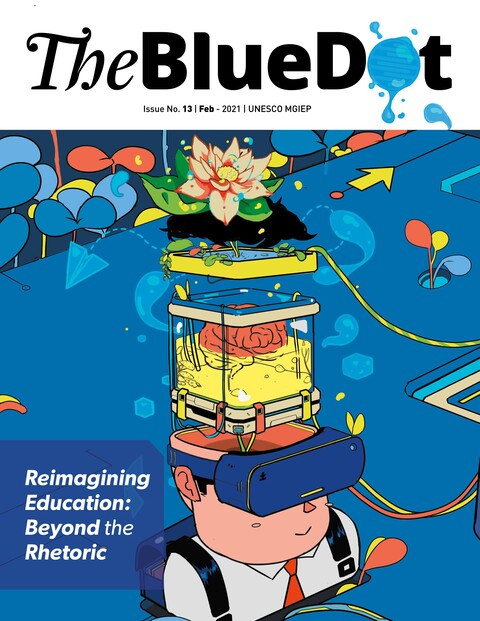 Reimagining Education: Beyond the Rhetoric (The Blue Dot; No.13, 2021) Year of publication: 2021 Corporate author: Mahatma Gandhi Institute of Education for Peace and Sustainable Development (MGIEP) The events of the year 2020, driven predominantly by the COVID-19 pandemic, have forced governments, policymakers, educators and organisations to rethink the purpose, structure and modality of existing education systems. Even while the world is struggling with climate change, decreased empathy, violent extremism, xenophobia and an increase in mental health issues in children, with a recent report by WHO highlighting that 800,000 people between the ages of 15-29 are dying by suicide ever year, globally1 , the COVID-19 virus singlehandedly shut down access to face-to-face school education for roughly half of the world’s student population. These ongoing and unexpected challenges bring to light the urgent need for education systems to be more adaptable, responsive, and resilient to future shocks and disasters. We can work to transform education in many ways, such as by translating our understanding of how the brain learns from the research laboratory to the classroom and leveraging the power of technology to ensure that learning can reach every child who hungers to learn. It is time we reimagine education to ensure learning continues with minimal disruption but also empowers students as compassionate human beings, prepared for an unpredictable future, but also as global citizens seeking a peaceful and kinder world. The purpose of education needs to change from being instrumental (based on human capital) to one that is constitutive (human-flourishing), accessible to all and structured such that learning can happen anytime and anywhere and always.
  Education for conflict prevention and peacebuilding: meeting the global challenges of the 21st century Year of publication: 2012 Author: Phyllis Kotite Corporate author: UNESCO International Institute for Educational Planning (IIEP) The 21st century is witnessing global concern over the interrelated effects of climate change, the economic crisis, energy depletion, food and water shortages, natural disasters and conflicts all of which have devastating effects on humanity and the future of the planet. These events impact education systems and can impair the ability of governments to provide quality education for their citizens. However, when governments and ministries of education analyse and anticipate the risk of such events through careful planning, education can play an important role in preventing violent conflict, and in supporting peacebuilding efforts. An estimated 1.5 billion people live in countries affected by repeated cycles of political and other forms of violence, and the same population is often affected by hunger and poverty. Furthermore, such countries have difficulty meeting development goals. For example, no low-income fragile or conflict-affected country has yet achieved a single MDG (World Bank, 2011). In 2010 world military expenditures reached US$1.6 trillion as a result of fifteen ongoing conflicts (SIPRI, 2011). Yet, it is estimated that only US$16 billion is needed to fill the education gap to reach the EFA goals (UNESCO, 2011b: 11). This paper argues that we have the knowledge, legal instruments and mechanisms to prevent conflict and to transfer resources to sustainable development and education to meet the challenges of the 21st century. The paper describes a range of conflict prevention initiatives and examines the role of policy-makers, youth, women, and the media in maintaining and restoring peace as part of a holistic vision of education. International institutions, governments and civil society are increasingly developing conflict prevention mechanisms and utilizing political and economic incentives to avoid conflicts. They are also creating new technology for sustainable development, adaptation to climate change and renewable forms of energy. Educational planning must therefore go beyond traditional mechanisms. It must take into consideration the unpredictable nature of our times; be flexible and rapid in implementation and responsive to local needs. Training and research in sustainable development; and skills for peaceful inter-human relations, good governance, the prevention of conflict and peacebuilding are priorities elaborated in the paper. In addition, specific recommendations are highlighted such as: capacity development for conflict prevention within the education sector and other ministries, analysing the root causes of conflict and the role that education can play in mitigating tensions. This paper is an elaboration of Chapter 1.2 of the IIEP-UNESCO Guidebook for Planning Education in Emergencies and Reconstruction (IIEP-UNESCO, 2010). A brief treatment of additional global challenges (e.g. water scarcity, food insufficiency, energy depletion and economic instability), which are beyond the educational focus of this paper, may be found in Annex I. Education for conflict prevention and peacebuilding: meeting the global challenges of the 21st century Year of publication: 2012 Author: Phyllis Kotite Corporate author: UNESCO International Institute for Educational Planning (IIEP) Le 21ème siècle est témoin de préoccupation mondiale sur les effets interdépendants du changement climatique, la crise économique, l'épuisement de l'énergie, la pénurie de nourriture et d'eau, les catastrophes naturelles et les conflits qui ont tous des effets dévastateurs sur l'humanité et l'avenir de la planète. Ces événements influent sur les systèmes d'éducation et peuvent nuire à la capacité des gouvernements à fournir une éducation de qualité pour leurs citoyens. Toutefois, lorsque les gouvernements et les ministères de l'éducation analysent et anticipent le risque de ces événements à travers une planification minutieuse, l'éducation peut jouer un rôle important dans la prévention des conflits violents, et à soutenir les efforts de consolidation de la paix. On estime que 1,5 milliard de personnes vivent dans des pays touchés par des cycles répétés de formes politiques et autres de la violence, et la même population est souvent affectée par la faim et la pauvreté. En outre, ces pays ont des difficultés à atteindre les objectifs de développement. Par exemple, aucun pays à faible revenu fragiles ou touchés par un conflit n'a encore atteint un seul OMD (Banque mondiale, 2011). En 2010 dépenses militaires mondiales ont atteint US $ 1,6 trillions en raison de quinze conflits en cours (SIPRI, 2011). Pourtant, on estime que seulement 16 milliards $ US est nécessaire pour combler le déficit de l'éducation pour atteindre les objectifs de l'EPT (UNESCO, 2011b: 11). Ce document fait valoir que nous avons les connaissances, les instruments juridiques et des mécanismes de prévention des conflits et de transférer des ressources pour le développement durable et l'éducation pour relever les défis du 21e siècle. Le document décrit une série d'initiatives de prévention des conflits et examine le rôle des décideurs politiques, les jeunes, les femmes et les médias dans le maintien et le rétablissement de la paix dans le cadre d'une vision holistique de l'éducation. Les institutions internationales, les gouvernements et la société civile sont de plus en plus de développer des mécanismes de prévention des conflits et de l'utilisation des incitations politiques et économiques pour éviter les conflits. Ils créent également une nouvelle technologie pour le développement durable, l'adaptation aux changements climatiques et les énergies renouvelables. Planification de l'éducation doit donc aller au-delà des mécanismes traditionnels. Il doit prendre en considération la nature imprévisible de notre temps; être flexible et rapide et répondre aux besoins locaux. Formation et recherche dans le développement durable; et les compétences pour les relations inter-humaines pacifiques, la bonne gouvernance, la prévention des conflits et de consolidation de la paix sont des priorités élaborées dans le document. En outre, des recommandations spécifiques sont mis en évidence, tels que: le renforcement des capacités de prévention des conflits dans le secteur de l'éducation et d'autres ministères, l'analyse des causes profondes des conflits et le rôle que l'éducation peut jouer pour atténuer les tensions. Ce document est une élaboration du Chapitre 1.2 du Guide de l'IIPE-UNESCO pour l'Éducation de la Planification en situation d'Urgence et de Reconstruction (IIPE-UNESCO, 2010).
 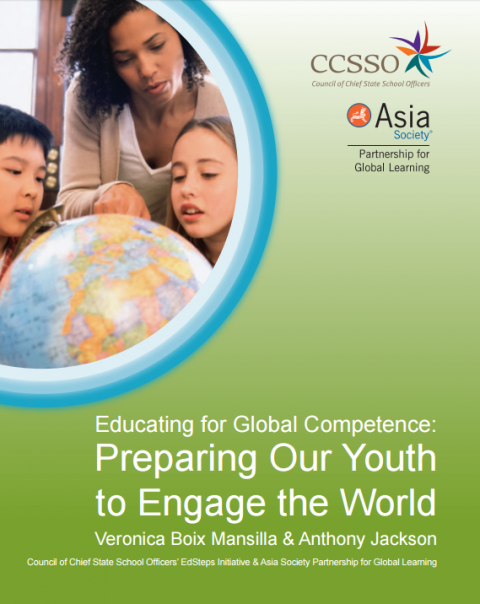 Educating for global competence: preparing our youth to engage the world Year of publication: 2011 Author: Veronica Boix Mansilla | Anthony Jackson Corporate author: Asia Society | Council of Chief State School Officers (CCSSO) Contemporary societies are marked by new global trends - economic, cultural, technological, and environmental shifts that are part of a rapid and uneven wave of globalization. The growing global interdependence that characterizes our time calls for a generation of individuals who can engage in effective global problem solving and participate simultaneously in local, national, and global civic life. Put simply, preparing our students to participate fully in today's and tomorrow's world demands that we nurture their global competence.This document introduces a definition of global competence developed by the Global Competence Task Force - a group of state education agency leaders, education scholars, and practitioners - under the auspices of the Council of Chief State School Officers EdSteps initiative (CCSSO-EdSteps) and the Asia Society Partnership for Global Learning (see page (iv) for task force participants). The definition builds on seminal work within the states and a broad range of organizations working to advance global knowledge and critical thinking skills. A process of careful articulation and vetting yielded the definition of global competence here proposed:Global competence is the capacity and disposition to understand and act on issues of global significance.Globally competent individuals are aware, curious, and interested in learning about the world and how it works. They can use the big ideas, tools, methods, and languages that are central to any discipline (mathematics, literature, history, science, and the arts) to engage the pressing issues of our time. They deploy and develop this expertise as they investigate such issues, recognize multiple perspectives, communicating their views effectively, and taking action to improve conditions.Educating for Global Competence: Preparing Our Youth to Engage the World is intended for classroom teachers, administrators, informal educators, policymakers, community leaders, researchers, parents, students, and all other stakeholders interested in preparing our youth for the 21st century. Becoming better at education for global competence involves rethinking practices and recognizing that there are no simple recipes for success. As such, this book is meant to be used flexibly - browse, make connections, and concentrate on the chapters that you find most pertinent to your work. Experiment with ideas, challenge concepts, and share with colleagues. Ultimately this book must work for you. It is meant to be read in the way that best meets your needs, inspires your curiosity, and proves fruitful in the classroom.Chapter one offers a rational for global education in our nation and worldwide. Chapter two introduces a conceptual framework for global competence and explains the key role of disciplinary and interdisciplinary foundations in student learning. Chapter three, four, five and six focus, respectively, on four core capacities associated with global competence: investigating the world, recognizing perspectives, communicating ideas, and taking action. Chapter seven considers core principles of instruction for teaching global competence. Chapter eight looks at what students and education institutions can do to promote global competence - and how they might create a culture of global competence for youth and adults. Finally, chapter nine places global competence in the larger framework of public education systems in and beyond the United States. Eduquer pour compétence globale: préparer nos jeunes à engager le monde Year of publication: 2011 Author: Veronica Boix Mansilla | Anthony Jackson Corporate author: Asia Society | Council of Chief State School Officers (CCSSO) Les sociétés contemporaines sont marquées par de nouvelles tendances mondiales - changements économiques, culturels, technologiques et environnementaux qui font partie d'une vague rapide et inégal de la mondialisation. L'interdépendance mondiale croissante qui caractérise notre temps appelle à une génération de personnes qui peuvent se livrer à la résolution de problème mondial efficace et participer simultanément à la vie civique locale, nationale et mondiale. Simplement, la préparation de nos étudiants de participer pleinement au monde les exigences d'aujourd'hui et de demain que nous entretenons leur compétence mondiale. Ce document présente une définition de la compétence globale développée par le Groupe de travail mondial Compétence - un groupe de chefs d'Etat de l'agence de l'éducation, spécialistes de l'éducation, et les praticiens - sous les auspices du Conseil de l'école Chief State initiative des officiers de EdSteps (CCSSO-EdSteps) et la Asia Partnership Society for global Learning (voir page (iv) pour les participants du groupe de travail). La définition se fonde sur le travail séminal dans les états et un large éventail d'organisations de travail pour faire avancer les connaissances mondiales et de la pensée critique. Un processus d'articulation minutieuse et vetting a abouti à la définition de la compétence globale proposée ici: la compétence globale est la capacité et la disposition pour comprendre et agir sur les questions d'importance mondiale. Globalement les personnes compétentes sont au courant, curieux et intéressés à en apprendre sur le monde et comment il fonctionne. Ils peuvent utiliser les grandes idées, des outils, des méthodes et des langues qui sont au cœur de toutes les disciplines (mathématiques, la littérature, l'histoire, la science et les arts) pour engager les questions pressantes de notre temps. Ils déploient et développer cette expertise comme ils enquêtent sur ces questions, reconnaissent de multiples points de vue, de communiquer leurs points de vue de manière efficace, et prendre des mesures pour améliorer les conditions. Eduquer pour Global Competence: Préparer les jeunes d'engager le monde est destiné aux enseignants, administrateurs, éducateurs informels, les décideurs, les leaders communautaires, les chercheurs, les parents, les étudiants et toutes les autres parties intéressées à préparer nos jeunes pour le 21e siècle. Devenir meilleur à l'éducation pour la compétence globale implique de repenser les pratiques et en reconnaissant qu'il n'y a pas de recettes simples pour le succès. En tant que tel, ce livre est destiné à être utilisé avec souplesse - parcourir, faire des liens, et de se concentrer sur les chapitres que vous trouverez les plus pertinents pour votre travail. Expérience avec des idées, des concepts de défi, et de partager avec des collègues. En fin de compte ce livre doit travailler pour vous. Il est destiné à être lu de la manière qui répond le mieux à vos besoins, inspire votre curiosité, et prouve fructueuse dans la salle de classe. Le premier chapitre offre un rationnel pour l'éducation mondiale dans notre pays et dans le monde. Le deuxième chapitre présente un cadre conceptuel pour la compétence globale et explique le rôle clé des fondations disciplinaires et interdisciplinaires dans l'apprentissage des élèves. Chapitre trois, quatre, cinq et six focus, respectivement, sur quatre capacités essentielles associées à la compétence mondiale: enquête dans le monde, reconnaissant les perspectives, communiquer des idées, et de prendre des mesures. Le chapitre sept considère les principes de base de l'enseignement pour l'enseignement de la compétence globale. Chapitre huit examine ce que les étudiants et les établissements d'enseignement peuvent faire pour promouvoir la compétence globale - et comment ils pourraient créer une culture de compétence globale pour les jeunes et les adultes. Enfin, le chapitre neuf places compétence globale dans le cadre plus large des systèmes d'éducation du public dans et au-delà des États-Unis.
  Educación para la ciudadanía y la convivencia: jóvenes por el empoderamiento y la transformación; ciclo cinco (décimo, undécimo, duodécimo) Year of publication: 2014 Corporate author: Secretaría de Educación del Distrito (SED) | Fe y Alegría These twelve modules make reference to a series of activities that focus on how children from all the educative grades understand and live citizenship, strengthening and facilitating the learning processes based on autonomy. This educative materials, which are aimed at being implemented inside the classrooms, attempt to serve as input resources for educators and other agents that work on or are interested in working with citizenship education and coexistence. The overall objective is to provide quality education. Address by Irina Bokova, Director-General of UNESCO on the occasion of the Geneva Conference on Preventing Violent Extremism – The Way Forward Year of publication: 2016 Corporate author: UNESCO. Director-General, 2009-2017 (Bokova, I.G.) This address presented by Irina Bokova, Director-General of UNESCO, on the occasion of the Geneva Conference on Preventing Violent Extremism - The Way Forward. Discours de Mme Irina Bokova, Directrice générale de l'UNESCO à l'occasion de l'Genevaconférenceon Prévenir l'extrémisme violent - Aller de l'avant Year of publication: 2016 Corporate author: UNESCO. Director-General, 2009-2017 (Bokova, I.G.) Cette adresse présentée par Irina Bokova, Directrice générale de l'UNESCO, à l'occasion de la conférence de Genève sur la prévention extrémisme violent - La voie à suivre
  Generation Z: Global Citizenship Survey Year of publication: 2017 Corporate author: Varkey Foundation The Varkey Foundation commissioned Populus to carry out research on a global scale into the attitudes of 15- to 21-year-olds on a variety of ethical, personal, community and political issues. We chose twenty countries to poll: Argentina, Australia, Brazil, Canada, China, France, Germany, India, Indonesia, Israel, Italy, Japan, New Zealand, Nigeria, Russia, South Africa, South Korea, Turkey, the UK and the US. We chose a range of countries that would give a geographic spread, include some of most populous nations, and would also include those that have particular political significance – as rising powers and/or countries that are important in global geopolitics and cultural influence.The first part of the survey asked about young people’s wellbeing, hopes and ambitions – from their relationships and future careers, to their physical and mental health.. The second part focused on their personal, community and religious values – from their attitudes towards abortion, same sex marriage and transgender rights, to the importance of religion in their lives and whether they feel equipped to contribute to their own community. Finally, it covered issues of global citizenship – attitudes towards migrants, the factors that make young people hopeful and fearful for the future, and their views on whether the world is becoming a better or worse place. This is the first time that there has been an international comparative study of the attitudes of young people on these matters. Not only have we asked them how they feel, what their attitudes are, and who influenced them: we have also reflected on what differences and similarities there may be in terms of their wellbeing, fears, hopes and views across the world.With this survey, we do not aim to document the events that loomed large in young people’s lives or the social forces that have shaped their emotions and opinions. That is a huge subject for expert analysis. Rather, we wanted to hold up a mirror to Generation Z and simply record the reflection that they give us – providing some illumination to help us all understand them better. Peace education in formal schools of West Africa: an implementation guide Year of publication: 2012 Corporate author: West Africa Network for Peacebuilding (WANEP) This guide, first and foremost, seeks to bring hope and provide opportunity for practitioners to use tried and tested techniques to develop capacities of young people to build requisite knowledge and skills to become credible and responsible leaders. It provides both a conceptual and practical framework of peace education and confirms the potential benefits of Peace Education, particularly in the formal sector. It has been developed based on the extensive experience of WANEP’s Peace Education programme across West Africa and this experience has been outlined in great detail throughout the manual. The guide lays emphasis on entry points for developing and initiating Peace Education programmes in schools and provides practical tools for engaging various stakeholders and the wide range of potential roles they can play. In terms of the content of a peace education programme, guidelines are provided on developing a comprehensive programme that integrates effectively key concepts such as Gender and Human Rights. Critical issues of sustainability, resource mobilisation and monitoring and evaluation are covered using practical case studies based on the WANEP experience. The concluding chapter is devoted to addressing some Frequently Asked Questions. This laudable initiative and recommend this guide for adoption by West African states and institutions especially the educational sector as a tool for inculcating a culture of peace and nonviolence amongst children.The guide is divided into six chapters.Chapter 1 consists of introduction and the conceptual definition of basic philosophy that influenced the peace education program of WANEP. It also examines the role of peace education on the psycho social behaviour of youths in West Africa.Chapter 2 highlights WANEP’s guiding principles to the development of its peace education in the sub region and also the basic steps it took to implement its program in the seven (7) pilot states.Chapter 3 looks at how to mobilise resources to sustain the peace education program especially within the context of West Africa.Chapter 4 highlights the challenges that WANEP encountered in implementing the program.Chapter 5 emphasises the importance of monitoring and evaluation for impact and success of a peace education program.Chapter 6 deals with frequently asked questions by interested stakeholders.