
Resources
Explore a wide range of valuable resources on GCED to deepen your understanding and enhance your research, advocacy, teaching, and learning.
3,790 Results found
 Justicia de Género, Ciudadanía y Diferencia en América Latina Year of publication: 2010 Author: Maxine Molyneux Este artículo hace un recorrido por las prácticas feministas ciudadanas y los estudios sobre género, justicia, ciudadanía y derechos en América Latina. La crítica al privilegio patriarcal realizada desde el feminismo expresa un deseo moderno de mayor libertad individual y reconocimiento colectivo. Unas peticiones que han producido tensiones y algunas contradicciones en relación a la cuestión de la «diferencia», especialmente en el encuentro con los pueblos indígenas. No obstante, el feminismo siempre se ha dedicado a lograr tanto el reconocimiento como la redistribución; si bien, ha alcanzado más éxito en los terrenos legales y políticos que en la redistribución de recursos públicos y privados. El análisis de los logros del feminismo en América Latina revela una historia de éxitos significativos, pero parciales; y una serie de desafíos para futuras investigaciones al respecto.
  Education and Countering Violent Extremism: a case study of schools in Pakistan Year of publication: 2015 Author: Hussain-Mohiud-Din Qadri This paper explores the role of education in combating the violent extremism by using the Pakistani education system as a case study. It undertakes a historical perspective of growth of the educational sector in Pakistan by delving deep into the pre-partition system. Education and Countering Violent Extremism: a case study of schools in Pakistan Year of publication: 2015 Author: Hussain-Mohiud-Din Qadri Cet article analyse le rôle de l'éducation dans la lutte contre l'extrémisme violent en prenant pour exemple le système éducatif pakistanais. Il développe une approche historique de la croissance du secteur éducatif, en analysant en détail le système précédant la partition du pays.
  National Consultation on the Situation of Prisons in Senegal: Improvement of the Condition of Detention, Social Integration and Prevention of Violent Extremism through Education, 23-24 May 2017, Dakar, Senegal: Report Year of publication: 2017 Corporate author: UNESCO Dakar Sustainable Development Goal (SDG) 4 on education highlights the need to include our society’s most vulnerable and most margined members, such as prisoners, in order to ensure that all learners acquire the knowledge, skills, values and attitudes that are needed to build just, peaceful, and sustainable societies.The situation in Senegalese prisons is of a major concern given the overall condition of detention as well as the context of insecurity that characterizes the sector. In 2016, the country had 37 penal institutions for a total prison population of 9,422 prisoners (including pre-trial detainees and remand prisoners), of which approximately 200 were minors.1 Despite the efforts to humanize the prisons by adopting the name, “House of Arrest and Corrections” [Maison d'arrêt et de correction (MAC)] instead of the term "prison," and improving the living conditions in prisons, the fate of prisoners is not satisfactory. The reintegration promoted by Senegal's correctional facilities has largely consisted of a series of education programs, such as literacy and painting, developed by a number of organizations, but the space provided by prison administration, line Ministries, and NGOs are limited and the impact so far has been insufficient. A prison is not just a building, but it is also an instrument of rehabilitation to regain a place in society. This obviously requires the development of training, education and vocational guidance to support smooth reintegration into society.In this context, UNESCO's Dakar Regional Multi-Sectoral Office organized, in partnership with the Senegal National Commission for UNESCO and experts, a “National Consultation on the Situation of Prisons in Senegal: Improvement of the Condition of Detention, Social Integration, and Prevention of Violent Extremism through Education” in Dakar, Senegal, from 23 to 24 May 2017.
  University College London (UCL) Centre for Holocaust Education Corporate author: UCL Centre for Holocaust Education The "Teacher resources" of the UCL Centre for Holocaust Education delivers three types of teaching documents : classroom materials with lesson plans and workshops, thematic lessons for teachers to increase their knowledge on the topic and pedagogical guidance to support and give suggestions for the classroom. University College London (UCL) Centre pour l'éducation holocauste Corporate author: UCL Centre for Holocaust Education Les «Ressources pédagogiques» du Centre UCL pour Holocaust Education délivre trois types de documents d'enseignement: matériel de classe avec des plans et des ateliers leçons, leçons thématiques pour les enseignants d'accroître leurs connaissances sur le sujet et l'orientation pédagogique pour soutenir et donner des suggestions pour la salle de classe.
 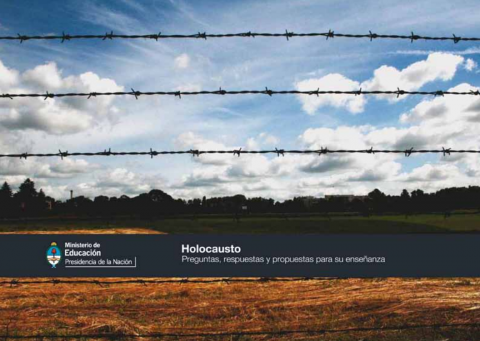 Holocausto : Preguntas, respuestas y propuestas para su ensenanza Year of publication: 2010 Corporate author: Argentina. Ministerio de Educacion This publication, released by the "Education and Memory" department of the Ministry of National Education of Argentina, is a handout to think about, debate and discuss some of the issues relevant to teaching about the Holocaust. Holocausto : Preguntas, respuestas y propuestas para su ensenanza Year of publication: 2010 Corporate author: Argentina. Ministerio de Educacion This publication, released by the "Education and Memory" department of the Ministry of National Education of Argentina, is a handout to think about, debate and discuss some of the issues relevant to teaching about the Holocaust. Holocauste: questions, réponses et propositions pour l'enseignement Year of publication: 2010 Corporate author: Argentina. Ministerio de Educacion Cette publication, publiée par le «Education et Mémoire » département du Ministère de l'Education Nationale de l'Argentine, est un document à réfléchir, débattre et discuter de certaines des questions relatives à l'enseignement de l'Holocauste. Educating Students about the Holocaust: A Survey of Teaching Practices More than half a century has passed since the horrific events of the Holocaust took place, but images of the state-sponsored, systematic persecution and annihilation of European Jewry by Nazi Germany are no less shocking than they were 60 years ago. Any discussion of the Holocaust inevitably leads to questions of not only how and why this event occurred in the modern era but, more importantly, how the legacy of the Holocaust can continue to raise international awareness of human rights abuses and genocide. One way of achieving this awareness is by providing holocaust education to the nation's young people. While this objective has obtained widespread support, there has been an absence of reliable nationwide information on how the Holocaust is actually taught in U.S. schools. This article attempts to fill that gap by presenting the results of a yearlong study commissioned by the United States Holocaust Memorial Museum of teaching practices in Holocaust education in the nation's secondary public schools in 2003-04. The study assessed secondary teaching practices in middle and high schools in the field of Holocaust education, and investigated teachers' rationales for teaching about the Holocaust. (By the publisher)