
Resources
Explore a wide range of valuable resources on GCED to deepen your understanding and enhance your research, advocacy, teaching, and learning.
3,454 Results found
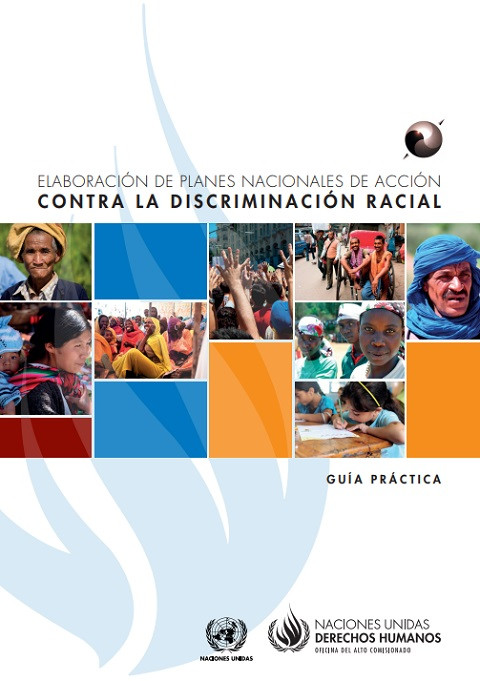 Elaboración de planes nacionales de acción contra la discriminación racial: Guía práctica Year of publication: 2014 Corporate author: United Nations (UN) Esta publicación es una guía práctica para la elaboración de planes nacionales de acción contra la discriminación racial. Los planes nacionales de acción son la base para el desarrollo de una política pública integral contra la discriminación racial y por lo tanto pueden ayudar a los Estados a dar cumplimiento a sus obligaciones internacionales de derechos humanos relacionadas con la eliminación de la discriminación racial.
  Anti-Semitism in Europe up to 1945 (Vol 1) Corporate author: Anne Frank House | OSCE. Office for Democratic Institutions and Human Rights (ODIHR) These teaching materials were developed by ODIHR and the Anne Frank House in Amsterdam, in co-operation with experts from several OSCE participating States. Part 1 examines the history of anti-Semitism. The version available here is an English translation of the Lithuanian version. L'antisémitisme en Europe jusqu'en 1945 (Vol 1) Corporate author: Anne Frank House | OSCE. Office for Democratic Institutions and Human Rights (ODIHR) Ces matériels pédagogiques ont été élaborés par le BIDDH (Bureau des Institutions Démocratiques et des Droits de l'Homme) et la Maison d'Anne Frank à Amsterdam, en coopération avec des experts de plusieurs Etats participants de l'OSCE. Partie 1 examine l'histoire de l'antisémitisme. La version disponible ici est une traduction anglaise de la version lituanienne.
  L'utilisation des médias sociaux dans l'éducation de l'Holocauste Corporate author: International Holocaust Remembrance Alliance (IHRA) Les médias sociaux est une forme en pleine expansion de la communication et de la communauté dans notre monde et dans l'éducation plus spécifiquement. éducateurs Holocauste sont chargés de déterminer la meilleure façon d'utiliser cet outil dans leur programmation sans programme ou l'intégrité objet compromettant. Ces lignes directrices décrivent les considérations et les pratiques dans le déploiement de médias sociaux dans l'environnement éducatif de l'Holocauste. Using social media in Holocaust Education Corporate author: International Holocaust Remembrance Alliance (IHRA) Social media is a rapidly expanding form of communication and community in our world and in education more specifically. Holocaust educators are tasked with determining how best to use this tool in their programming without compromising programme or subject integrity. These guidelines outline considerations and practices in deploying social media in the Holocaust educational environment.
 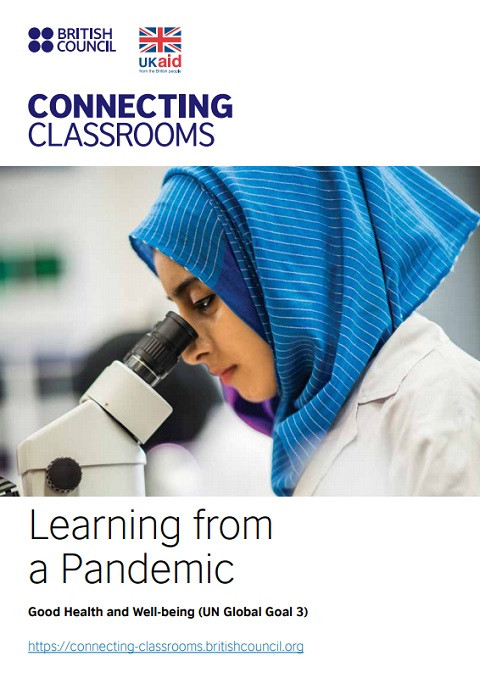 Connecting Classrooms: Learning From a Pandemic; Good Health and Well-Being (UN Global Goal 3) Year of publication: 2020 Corporate author: British Council | UK aid This resource will help you make a contribution to a recovery curriculum in schools, and beyond this, by providing interesting, engaging and relevant content that encourages pupils to recall, discuss and process some of their thoughts, feelings and memories. Over the course of six lessons, pupils will have opportunities to develop an understanding of:• Covid-19 in the context of some of the world’s most common communicable diseases and pandemics from the past• how communicable diseases like Covid-19 may start and spread, and how this is investigated• relevant prevention strategies to foster positive physical and mental health and well-being.In doing so, pupils will have the opportunity to develop core skills in critical thinking and problem solving, citizenship, student leadership, creativity and imagination and aspects of digital literacy. This learning unit is also designed to support the United Nations’ Global Goals for Sustainable Development (SDGs), in particular Goal 3: Good health and well-being.
  Innovating Technical and Vocational Education and Training: A Framework for Institutions Year of publication: 2020 Corporate author: UNESCO International Centre for Technical and Vocational Education and Training (UNEVOC) Global developments including the transition to greener economies, the application of digital technologies in the world of work, and the COVID-19 pandemic, amongst others, are changing the way we live and work. These developments are driving technical and vocational education and training (TVET) systems to improve their capacity to identify the future skills demands and to expand access to skills development opportunities. As TVET adapts itself to the impacts of significant social, environmental, and economic disruptions, innovative practices emerge with the potential to rejuvenate the future of skills development. Schools, training centres and colleges have the potential to play a leading role to drive innovation in their local skills and innovation ecosystem.This practical guide provides a systematic, institution-wide, measurable and evidence-based methodology that enables TVET institutions to streamline innovation into their strategic planning, products and services, ecosystem engagement, and teaching and learning processes.
  Action Against Hate Speech: A Resource for Teaching and Learning About Hate Speech Year of publication: 2017 Corporate author: Tony Blair Institute for Global Change | Generation Global This module is designed to prepare students for dialogue around the issue of hate speech. It builds upon other work on human rights, and explores the balancing act between freedom of expression and freedom from insult. Additionally, it prepares students for dialogue on these issues in our facilitated videoconferences and on our safe, secure, online community. This material helps you and your students to get involved in educating, advocating, and acting against hate speech in your communities.
  Action: Guidelines for Prevention of Violent Extremism Year of publication: 2018 Author: Carolyn Nash | Yulia Nesterova | Kenneth Primrose | Wing Yu Alice Chan | Raul A. Rios | María José Velásquez Flores | Aniqah Zowmi Corporate author: Mahatma Gandhi Institute of Education for Peace and Sustainable Development (MGIEP) The UNESCO MGIEP #YouthWagingPeace guidebook was launched by Director General of UNESCO at its 39th General Conference, 2017. The guidebook was a culmination of reaching out to 2000+ youth, and integrating 130+ submissions from 57 countries.After analysing these voices and experiences, and supplemented by the literature, the guide put forth a set of tangible action guidelines for education stakeholders.In this abridged version, stakeholders will find a curated set of critical ideas and lessons gleaned from the full guide, designed to be as accessible as possible. The hope is that teachers, parents, mentors, school administrators, policymakers, and anyone else committed to realizing positive change will find these Action Guidelines an effective resource for guiding immediate and effective actions in their communities.The Action Guidelines for Prevention of Violent Extremism is designed to identify engagement opportunities for all stakeholders. Some require time, preparation, and resources. Others are small steps that will help create safer societies and stronger communities. No action is too small to contribute to building a more resilient and just world.
 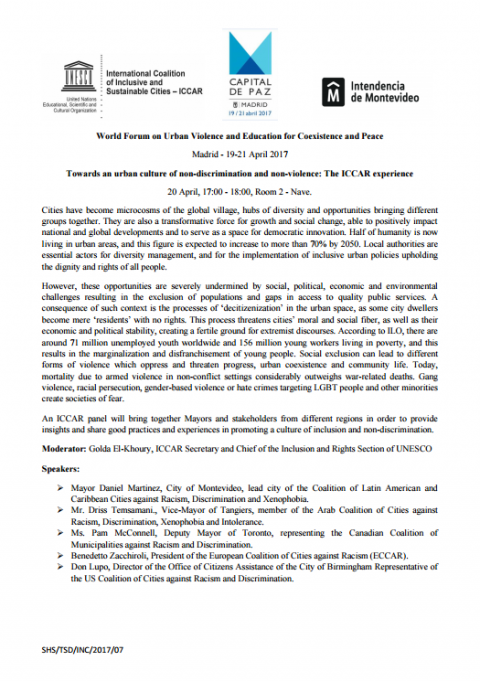 Towards an urban culture of non-discrimination and non-violence: The ICCAR experience Year of publication: 2017 Corporate author: International Coalition of Inclusive and Sustainable Cities This is a conference report for the World Forum on Urban Violence and Education for Coexistence and Peace.