
Resources
Explore a wide range of valuable resources on GCED to deepen your understanding and enhance your research, advocacy, teaching, and learning.
1,443 Results found
 Assessment for Advocacy to Transform Communities, Programmes and Policies in the Global South Year of publication: 2024 Corporate author: UNESCO | Global Education Monitoring Report Team | PAL Network This paper was commissioned by the Global Education Monitoring Report as background information to assist in drafting the 2024 Spotlight Report on basic education completion and foundational learning in Africa. It has not been edited by the team. The views and opinions expressed in this paper are those of the author(s) and should not be attributed to the Global Education Monitoring Report or to UNESCO. The papers can be cited with the following reference: “Paper commissioned for the 2024 Spotlight Report on basic education completion and foundational learning in Africa”.
 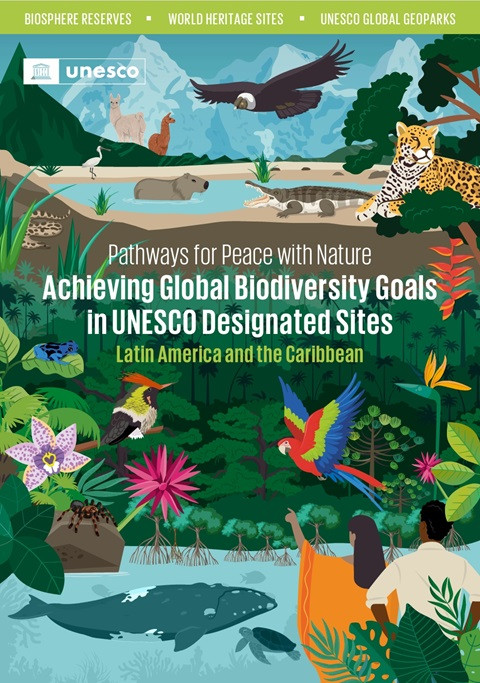 Pathways for Peace with Nature: Achieving Global Biodiversity Goals in UNESCO Designated Sites; Latin America and the Caribbean Year of publication: 2024 Corporate author: UNESCO UNESCO designated sites in Latin America and the Caribbean harbour over 60% of the region’s mapped species richness, i.e. over 14,000 species of mammals, reptiles, amphibians, birds, and fishes. They are also important for strengthening culture and nature linkages. However, biodiversity in these sites is threatened by human pressures and climate change and countries should take urgent action to halt and reverse biodiversity loss.This publication provides a regional overview of the status and trends of species in UNESCO designated sites, as well as key information to facilitate dialogue among all stakeholders. Additionally, it promotes the development of effective actions aimed at achieving global biodiversity goals.
 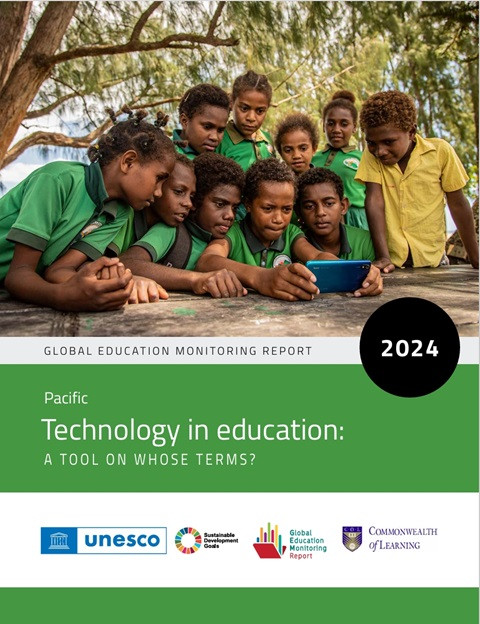 Global Education Monitoring Report 2024, Pacific: Technology in Education; A Tool on Whose Terms? Year of publication: 2024 Corporate author: UNESCO | Global Education Monitoring Report Team | Commonwealth of Learning Information transmission and connectivity is crucial in the Pacific, a region characterized by high geographic dispersion. While the application of ICT in education has significant potentials, it is hindered by the region's limited and costly infrastructure. This edition accompanies the 2023 Global Education Monitoring Report, which acknowledges technology as a useful tool but invites the education community to question on whose terms it is deployed. The report considered four key policy areas of the Pacific Regional Education Framework (PacREF) (2018–2030): In terms of quality and relevance, mobile technology has offered an affordable and flexible approach to learning, and social media have improved communication between institutions, parents and learners. Moodle is the most widely used digital platform in the region. Textbooks are being digitalised and digital resources made available. Yet content is not always developed or adapted to local languages and cultural contexts. Open and distance learning has historically expanded learning pathways in the Pacific, specially in higher education and as a response to natural hazards. The University of South Pacific is a leading example of open and distance learning connecting campus across 12 countries. With the aim to enhance student outcomes and well-being, efforts have been made to incorporate digital skills into curricula and initiatives have increased outside formal education. Yet regulations do not adequately address threats from the use of technology to privacy, safety and well-being. With a focus on the teaching profession, countries leverage technology to provide training opportunities and transform the teaching profession. However, ICT training varies greatly across the region and limited digital infrastructure hinders technology integration into classrooms and teacher training. Three conditions need to be met for technology's potential to be fulfilled: equitable access to technology, appropriate governance and regulation, and sufficient teacher capacity. Supporting this publication is seven background thematic studies that provide a comprehensive overview of education technology issues; Commonwealth of Learning’s short case studies on some of its projects; a survey administered to key informed respondents from the region; and a series of country profiles on PEER, a policy dialogue resource describing policies and regulations related to technology in the region’s education systems.
 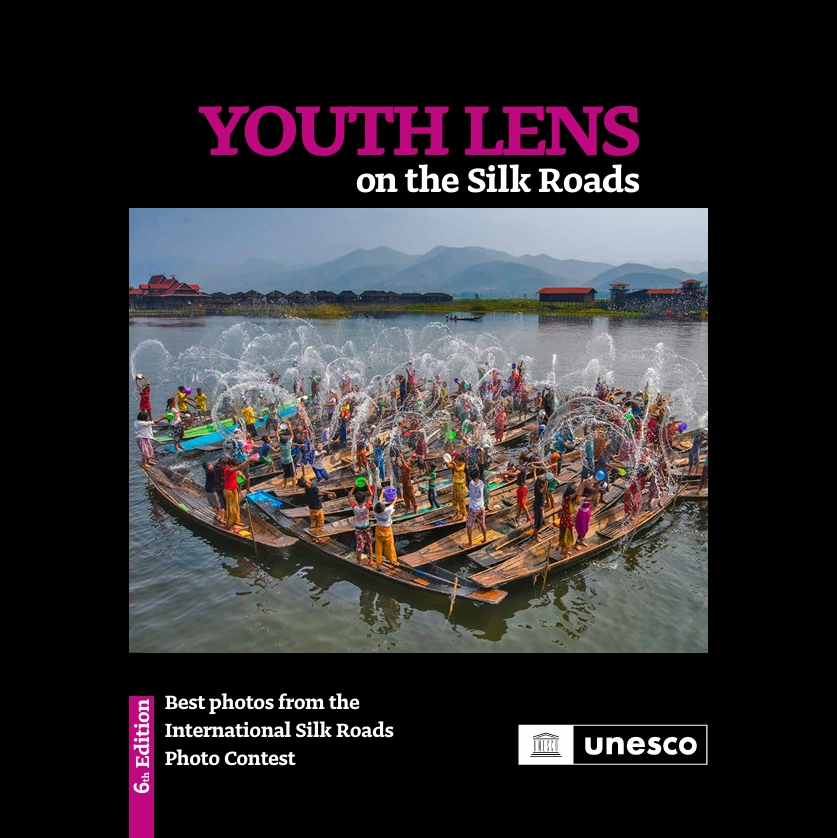 Youth Lens on the Silk Roads: Best Photos from the International Silk Roads Photo Contest; 6th Edition Year of publication: 2026 Corporate author: UNESCO This album presents the sixth edition of UNESCO’s Youth Eyes on the Silk Roads international photo contest. Organized by the UNESCO Silk Roads Programme, with the support of the Beijing International Peace Culture Foundation, this annual initiative invites talented young photographers from across the globe to explore the vibrant cultural heritage and diversity that thrive along these historic routes.The term “Silk Roads” symbolizes the vast network of historical trade routes linking East, South, and Southeast Asia with Central Asia, the Russian Steppes, the Indian Subcontinent, the Iranian and Anatolian Plateaus, and the Arabian Peninsula. These routes also extended into North and Northeast Africa and Europe, eventually reaching Western Europe and the Iberian Peninsula. Over centuries, these routes served as pathways for trade and vital corridors for cultural exchange, the dissemination of knowledge, and the blending of diverse traditions and practices. This intercultural exchange has significantly shaped contemporary societies, enriched identities, and fostered dialogue and mutual understanding among cultures.In this sixth edition, held under the theme ‘Life Celebrations’, young photographers have vividly documented festivities and cultural moments that highlight joy, unity, and shared heritage along the Silk Roads. Their powerful images capture how these celebrations and rituals continue to reflect and strengthen centuries-old connections between communities.The Youth Lens on the Silk Roads album presents 66 striking photographs from two age categories (14-17 and 18-25), illustrating the vibrant mosaic of cultural celebrations that unite communities across landscapes. Each image reveals the energy, resilience, and profound cultural richness of contemporary Silk Road societies. Together, these photographs celebrate the enduring legacy and dynamic spirit of the Silk Roads today.
  User Empowerment through Media and Information Literacy Responses to the Evolution of Generative Artificial Intelligence (GAI) Year of publication: 2024 Author: Divina Frau-Meigs Corporate author: UNESCO Key messages Artificial Intelligence and Generative AI are having a significant impact on people’s engagement with information, digital technology, and media. This raises concerns about control human agency and autonomy over information, decision making, gender equality, and freedoms in general. User empowerment through Media and Information Literacy (MIL) as a response to GAI, which is still in its infancy, needs to be fully deployed and public policy makers should be concerned in developing it well from the outset. MIL is necessary to build people’s ethical use of synthetic media, i.e. video, text, image or voice content fully or partially generated by AI-systems. The societal opportunities being deepened by GAI include: access to information, participation, employability, creativity, lifelong learning and creative industries. The societal potential risks being deepened by GAI include: disinformation, loss of data privacy, threats to integrity of elections, surveillance, lack of source reliability, discrimination, including gender-based and racial stereotypes, and copyrights violations. Building on familiarity in the face of urgency, AI literacy can be embedded in MIL to teach and train all sorts of communities (educators, librarians, youth workers, women networks, etc.). Ensuring explainable AI is key to both the design of MIL curricula and to the design of policy and governance around GAI. To build trust in information and education, source reliability needs to be revised to encompass the different types of “evidence” provided by GAI. MIL can train informed people from outside the technology industry to participate in the design, implementation and regulation of AI, in a manner that remains human-centered, gender-responsive and mindful of the public interest. Training for MIL is within the remit of governments and institutions of higher education, which have a duty to ensure MIL policy actions are sustained and strengthened over time, to be future-proof, in the face of an ever-evolving AI/GAI. L’autonomisation des utilisateurs grâce aux réponses apportées par l’éducation aux médias et à l’information à l’évolution de l’intelligence artificielle générative (IAG) Year of publication: 2024 Author: Divina Frau-Meigs Corporate author: UNESCO Messages clés L’intelligence artificielle et l’IA générative influent grandement sur les rapports des indivi- dus à l’information, aux technologies numériques et aux médias. Mais cela ne va pas sans inquiétudes quant à leur contrôle, au pouvoir d’action et à l’autonomie dont disposent les utilisateurs vis-à-vis de l’information, à la prise de décisions, à l’égalité des genres et aux libertés en général. . Pour constituer une réponse à l’IAG, technologie qui en est à ses balbutiements, l’autonomisation des utilisateurs grâce à l’éducation aux médias et à l’information (EMI) doit être pleinement déployée, et les autorités publiques doivent s’efforcer de la promouvoir dès le début. L’EMI est indispensable pour garantir une utilisation éthique des médias synthétiques, c’est-à-dire des vidéos, textes, images et sons totalement ou partiellement créés à l’aide de systèmes d’IA. L’IAG offre de nombreuses opportunités sociales dans différents domaines, dont l’accès à l’information, la participation, l’employabilité, la créativité, l’apprentissage tout au long de la vie et les industries créatives, entre autres. Il existe cependant des risques sociaux potentiels aggravés par l’IA générative, dont : la désinformation, la perte de contrôle sur la confidentialité des données, les menaces pour l’intégrité des élections, la surveillance, le manque de fiabilité des sources, la discrimination notamment fondée sur le genre et les stéréotypes raciaux et les violations des droits d’auteur. Pour mettre à profit la familiarité face à l’urgence, la maîtrise de l’IA pourrait être intégrée dans les programmes d’EMI afin d’éduquer et de former des communautés très diverses (éducateurs, bibliothécaires, animateurs pour la jeunesse, réseaux de femmes, etc.). Pour bien concevoir non seulement les programmes d’EMI mais aussi la gouvernance de l’IAG et les politiques connexes, l’IA explicable joue un rôle essentiel. Pour renforcer la confiance dans l’information et l’éducation, la fiabilité des sources doit être réexaminée pour englober tous les différents types de « preuves » fournies par l’IAG. L’EMI peut former des acteurs éclairés n’appartenant pas au secteur de la technologie afin qu’ils contribuent à la conception, à la mise en œuvre et à la réglementation de l’IA d’une manière qui reste centrée sur l’humain, sensible au genre et soucieuse de l’intérêt public. La formation dans le cadre de l’EMI relève des gouvernements et des établissements d’enseignement supérieur, qui doivent veiller à ce que les actions politiques en la matière soient soutenues et renforcées dans la durée, pour s’adapter aux évolutions constantes de l’IA/IAG.
  可持续发展教育: 路线图 Year of publication: 2022 Corporate author: 联合国教科文组织 (UNESCO) 本文是联合国教科文组织实施可持续发展教育所制定的路线图,旨在阐明地球面临的紧迫挑战,探讨教科文组 织通过教育应对这些挑战的下一步工作,并详细梳理新的侧重点和行动。
  International Conference on School Bullying: Recommendations by the Scientific Committee on Preventing and Addressing School Bullying and Cyberbullying Year of publication: 2020 Corporate author: UNESCO | France. Ministère de l'éducation nationale, de la jeunesse et des sports UNESCO and the French Ministry of Education, Youth and Sports organize an International Conference on School Bullying on 5 November 2020. The conference builds on commitments made at the July 2019 meeting of education ministers of the G7, under the French Presidency, and marks the celebration of the first-ever International Day Against Violence and Bullying at School including Cyberbullying.This document presents a summary of a first set of recommendations made by the Scientific Committee on three key issues:- How should the definition of school bullying be revisited to develop more comprehensive and targeted initiatives to tackle bullying in all its forms? What aspects should be considered for a more inclusive definition?- How effective national responses to bullying should look like, based on existing evidence? What are the key components and characteristics of a comprehensive approach to bullying and cyberbullying?- What additional or specific strategies and actions should be taken into consideration when planning and implementing responses to cyberbullying? Conférence internationale sur la lutte contre le harcèlement entre élèves: Recommandations du Comité scientifique sur la lutte contre le harcèlement et cyber-harcèlement Year of publication: 2020 Corporate author: Organisation des Nations Unies pour l'éducation, la science et la culture (UNESCO) | France. Ministère de l'éducation nationale, de la jeunesse et des sports L’UNESCO et le Ministère français de l’Éducation nationale, de la Jeunesse et des Sports organisent une Conférence internationale sur la lutte contre le harcèlement entre élèves le 5 novembre 2020. La conférence s’appuie sur les engagements pris lors de la réunion des ministres de l’Éducation du G7 sous la présidence française en juillet 2019, et marque la célébration de la première Journée internationale contre la violence et le harcèlement à l’école, y compris le cyber-harcèlement.Ce document présente un résumé d’une première série de recommandations formulées par le Comité scientifique sur trois questions clés :- Comment revisiter la définition du harcèlement en milieu scolaire afin d’élaborer des réponses plus complètes et mieux ciblées pour lutter contre le harcèlement sous toutes ses formes ? Quels sont les aspects à prendre en considération pour une définition plus inclusive ?- Sur la base des données existantes, à quoi devraient ressembler des réponses nationales efficaces au harcèlement ? Quelles sont les principales composantes et caractéristiques d’une approche holistique pour lutter contre le harcèlement et le cyber-harcèlement ?- Quelles stratégies et actions supplémentaires ou spécifiques devraient être prises en considération lors de la planification et de la mise en œuvre des réponses au cyber-harcèlement ?
 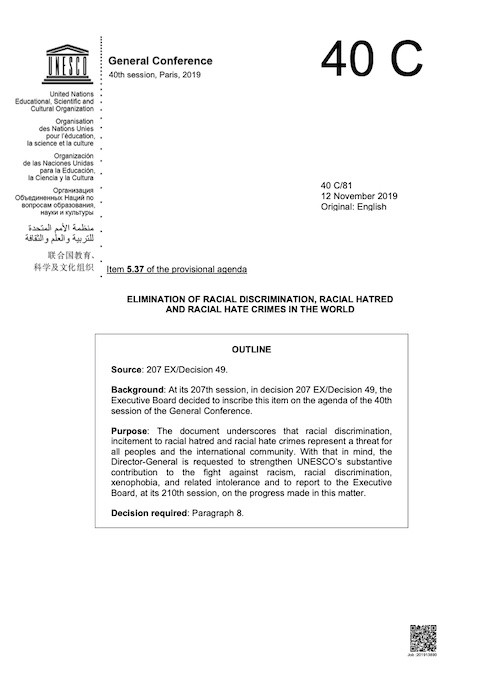 Ликвидация расовой дискриминации, расовой ненависти и преступлений на почве расовой ненависти во всем мире (Генеральная конференция; 40-я сессия) Year of publication: 2019 Corporate author: Организация Объединенных Наций по вопросам образования, науки и культуры (UNESCO) На своей 207-й сессии Исполнительный совет в решении 207 EX/49 постановил включить данный пункт в повестку дня 40-й сессии Генеральной конференции. В настоящем документе отмечается, что расовая дис- криминация, подстрекательство к расовой ненависти и преступления на почве расовой ненависти представляют собой угрозу для всех народов и международного сообщества. С учетом этого Генераль- ному директору предлагается укрепить содержательный вклад ЮНЕСКО в борьбу с расизмом, расовой дискриминацией, ксенофо- бией и связанной с ними нетерпимостью и представить Исполнитель- ному совету на его 210-й сессии доклад о достигнутых в данной обла- сти результатах.