
Resources
Explore a wide range of valuable resources on GCED to deepen your understanding and enhance your research, advocacy, teaching, and learning.
3,446 Results found
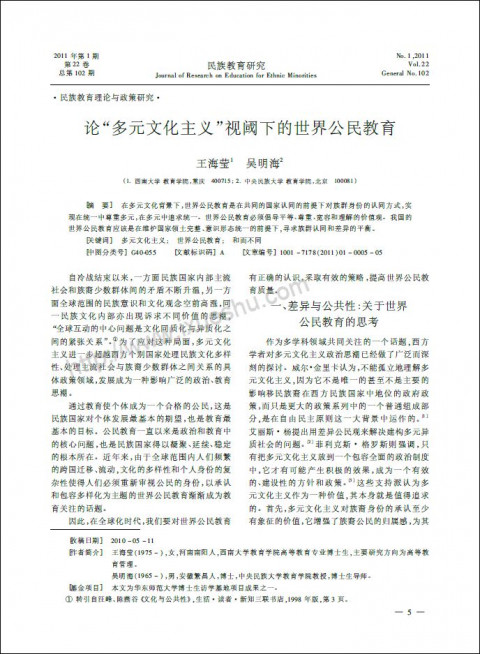 On Global Citizenship Education in Perspective of “Multiculturalism” Year of publication: 2011 Author: Wang Haiying | WU Minghai Under multicultural circumstances,global citizenship education is identity recognition of ethnic groups by mutual acknowledgment of the states. It is respect for multiculturalism in unity and pursuit of unity under multiculturalism. In global citizenship education, the value of equality,respect,tolerance and understanding should be advocated. The prerequisite to identity of ethnic groups and balance in diversity in China is to preserve national territory integrity and ideological unity. 论 “多元文化主义” 视阈下的世界公民教育 Year of publication: 2011 Author: Wang Haiying | WU Minghai 在多元文化背景下,世界公民教育是在共同的国家认同的前提下对族群身份的认同方式,实现在统一中尊重多元,在多元中追求统一。世界公民教育必须倡导平等、尊重、宽容和理解的价值观。我国的世界公民教育应该是在维护国家领土完整、意识形态统一的前提下,寻求族群认同和差异的平衡.
 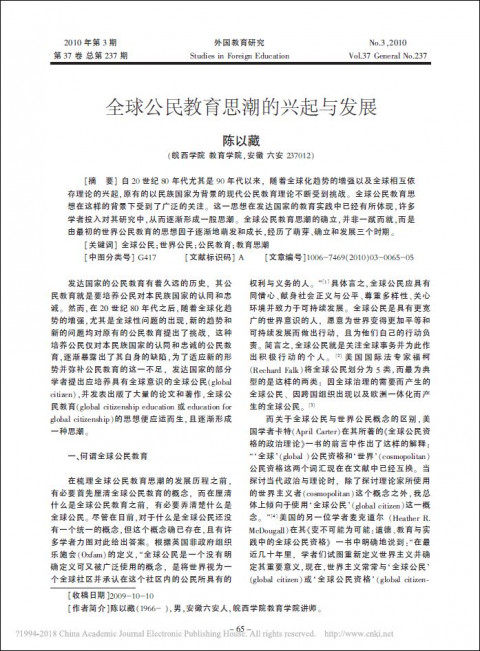 The Rising and Development of the Global Citizenship Education Thoughts Year of publication: 2010 Author: Chen Yicang Since the 1980s, especially the 1990s,modern citizenship education theories which are based on nation states have been increasingly challenged with the strengthening of the trend of globalization and the rising of the theory about global interconnectedness. The thought of global citizenship education has been discussed intensely and been partly put into practice in some developed countries,and gradually the ideological trend of global citizenship education has come into being. The establishment of global citizenship education thoughts is not finished overnight,which has experienced three stages of sprouting,establishment and development based on the growth of initial worldwide citizenship education thought factors. 全球公民教育思潮的兴起与发展 Year of publication: 2010 Author: Chen Yicang 自20世纪80年代尤其是90年代以来,随着全球化趋势的增强以及全球相互依存理论的兴起,原有的以民族国家为背景的现代公民教育理论不断受到挑战。全球公民教育思想在这样的背景下受到了广泛的关注。这一思想在发达国家的教育实践中已经有所体现,许多学者投入对其研究中,从而逐渐形成一股思潮。全球公民教育思潮的确立,并非一蹴而就,而是由最初的世界公民教育的思想因子逐渐地萌发和成长,经历了萌芽、确立和发展三个时期。
 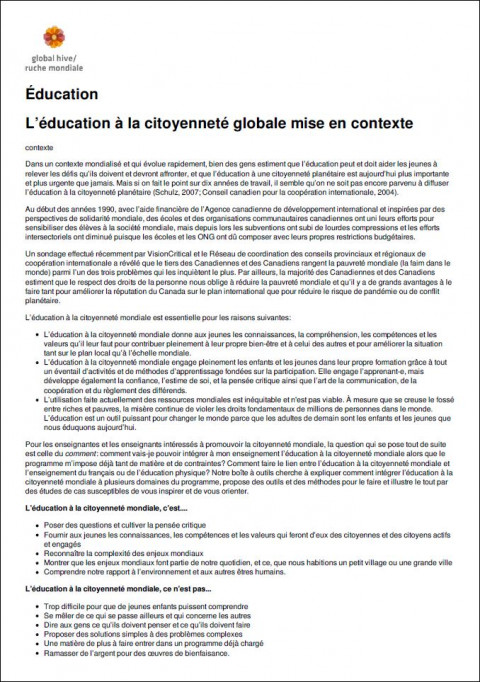 L'éducation à la citoyenneté globale mise en contexte Corporate author: Global Hive L’éducation à la citoyenneté mondiale est essentielle pour les raisons suivantes:L’éducation à la citoyenneté mondiale donne aux jeunes les connaissances, la compréhension, les compétences et les valeurs qu’il leur faut pour contribuer pleinement à leur propre bien-être et à celui des autres et pour améliorer la situation tant sur le plan local qu’à l’échelle mondiale.L’éducation à la citoyenneté mondiale engage pleinement les enfants et les jeunes dans leur propre formation grâce à tout un éventail d’activités et de méthodes d’apprentissage fondées sur la participation. Elle engage l’apprenant-e, mais développe également la confiance, l’estime de soi, et la pensée critique ainsi que l’art de la communication, de la coopération et du règlement des différends.L’utilisation faite actuellement des ressources mondiales est inéquitable et n'est pas viable. À mesure que se creuse le fossé entre riches et pauvres, la misère continue de violer les droits fondamentaux de millions de personnes dans le monde.L’éducation est un outil puissant pour changer le monde parce que les adultes de demain sont les enfants et les jeunes que nous éduquons aujourd’hui.Pour les enseignantes et les enseignants intéressés à promouvoir la citoyenneté mondiale, la question qui se pose tout de suite est celle du comment: comment vais-je pouvoir intégrer à mon enseignement l’éducation à la citoyenneté mondiale alors que le programme m’impose déjà tant de matière et de contraintes? Comment faire le lien entre l’éducation à la citoyenneté mondiale et l’enseignement du français ou de l’éducation physique? Notre boîte à outils cherche à expliquer comment intégrer l’éducation à la citoyenneté mondiale à plusieurs domaines du programme, propose des outils et des méthodes pour le faire et illustre le tout par des études de cas susceptibles de vous inspirer et de vous orienter.
 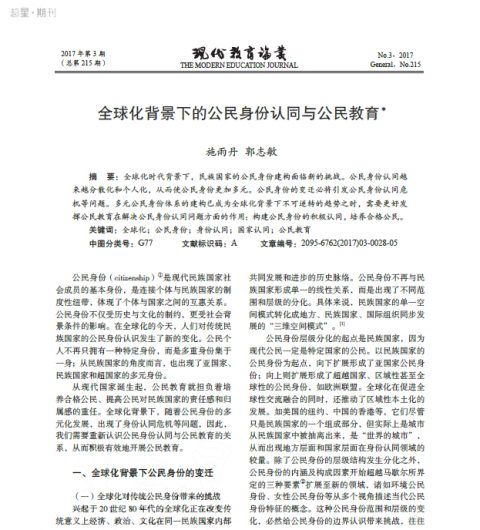 Citizenship identity and citizenship education in globalization Year of publication: 2017 Author: Shi Yudan | Guo Zhimin In the era of globalization, the construction of citizenship in national states has been faced up with new challenges. The recognition of citizenship has become more and more decentralized and personal. Consequently, citizenship has thus become more diverse. These changes in citizenship will trigger conflicts between citizenship identity and national identity. As the trend of constructing a diverse multi-citizenship system has been regarded as unstoppable, it is necessary to highlight the role of citizenship education in solving problems of citizenship identity in order to build positive recognition of citizenship and cultivate qualified citizens. 全球化背景下的公民身份与公民教育 Year of publication: 2017 Author: Shi Yudan | Guo Zhimin 全球化时代背景下,民族国家的公民身份建构面临新的挑战。公民身份认同越来越分散化和个人化,从而使公民身份更加多元。公民身份的变迁必将引发公民身份认同危机等问题。多元公民身份体系的建构已成为全球化背景下不可逆转的趋势之时,需要更好发挥公民教育在解决公民身份认同问题方面的作用:构建公民身份的积极认同,培养合格公民。
  [Summary] SDG 4 Data Digest 2018: Data to Nurture Learning; Executive Summary Year of publication: 2018 Corporate author: UNESCO Institute for Statistics (UIS) The 2018 edition of the SDG 4 Data Digest: Data to Nurture Learning builds on last year’s report, which proposed a conceptual framework and tools to help countries improve the quality of their data and fulfil their reporting requirements. In this report, we present the wide range of national and cross-national learning assessments currently underway and the assessment experiences of practitioners in the field. The report draws on these experiences to present pragmatic approaches that can help countries monitor progress and make the best possible use of data for policymaking purposes. [Resumen] Compendio 2018 de Datos sobre el ODS 4: Estadísticas para Fomentar el Aprendizaje; resumen Year of publication: 2018 Corporate author: UNESCO Institute for Statistics (UIS) La edición del Compendio 2018 de Datos sobre el ODS 4: Estadísticas para Fomentar el Aprendizaje apoya y expande el contenido del informe del año precedente, que proponía a los países un marco conceptual y un conjunto de herramientas para mejorar la calidad de sus estadísticas y cumplir con las obligaciones en materia de informes. En este documento, presentamos una amplia gama de evaluaciones de aprendizaje nacionales e internacionales que se realizan actualmente, así como las experiencias en evaluaciones de expertos en la materia. En el informe se elabora sobre esas experiencias para ofrecer soluciones pragmáticas que ayuden a monitorear el progreso y a lograr el mejor uso posible de los datos con miras a la formulación de políticas.
  The Connotation and Implementation of the Teaching Method of the UN Global Citizenship Education Initiative Year of publication: 2017 Corporate author: Eastern Education In response to increasingly complex global challenges and the development of a new generation of future citizens with world values, UNESCO published Global Citizenship Education: Topics and Learning Objectives in 2015. This guide makes a detailed distinction and description of the connotation, teaching objectives, teaching methods, and assessment methods of global civic education according to the age level of the learning objects, and summarizes relevant recommendations after inputting field tests. This article will give a brief introduction and interpretation of this guide, and point out the implications for the development of global citizenship education in China.