
Resources
Explore a wide range of valuable resources on GCED to deepen your understanding and enhance your research, advocacy, teaching, and learning.
2,199 Results found
 Life and Society Curriculum Guide (Secondary 1-3) Year of publication: 2010 Corporate author: Curriculum Development Council (Hong Kong) The 21st century is a rapidly-developing era in which students face social, economic and political changes, which also bring diverse and complicated values. These have created opportunities and challenges on students’ personal development, learning and future careers. Schools have to provide an appropriate curriculum to cater for the needs of students on their personal growth and future development so Life and Society (S1-3) has been drawn up for this very purpose.With the advent of the first decade of the Millennium, Hong Kong has been experiencing rapid changes on the economic, social and political fronts. Facts such as greater economic integration with the mainland (particularly with the Pan-Pearl River Delta Region), opportunities and challenges brought about by rapid economic growth on the mainland, increasing global economic interdependence, greater social diversity and Hong Kong’s move towards universal suffrage for the selection of the Chief Executive and the Legislative Council will bring the next generation face to face with new social, economic and political landscapes as well as new ideologies. In a curriculum document prepared by the Curriculum Development Council the following statements were written: “…contemporary society has undergone significant changes and rapid development…” and “students…need to have an in-depth understanding of themselves, the local community, the nation and the world if they are to become confident, informed and responsible persons.”1 With the second decade just around the corner, schools must ensure that students become knowledgeable with these trends so that they can participate fully in the development of the society in the future.The introduction of Liberal Studies as a core subject in the senior secondary curriculum requires junior secondary students to acquire solid foundation knowledge on Personal Development and Interpersonal Relationships, Hong Kong Today, Modern China and Globalization, etc. The current S1-3 EPA and Social Studies were developed during the last century to meet educational needs at that time but they do not provide the essential learning experiences students need for tomorrow. Life and Society (S1-3) integrates and updates the curriculum for these two subjects and provides a broader perspective on life and society. It effectively supports progress in Liberal Studies and other PSHE subjects at senior secondary level.The open and flexible curriculum framework of the Personal, Social and Humanities Education Key Learning Area (hereafter “PSHE KLA”) enables schools to adopt different modes of curriculum organization to achieve the learning targets stated in Personal, Social and Humanities Education Key Learning Area Curriculum Guide (hereafter “PSHE KLA Guide”) (pp. 23-24). This curriculum framework has been implemented in schools for almost decade. In order to facilitate further development of the PSHE curriculum framework, a set of essential learning elements has been developed in Life and Society (S1-3) to serve as a frame of reference, against which schools can analyse and assess their own school-based curricula. This set of essential learning elements is a guide of schools to plan and make decisions on their curricula. Vie et Société Programme d'études (secondaire1-3) Year of publication: 2010 Corporate author: Curriculum Development Council (Hong Kong) Le 21ème siècle est une époque qui se développe rapidement dans lequel les élèves sont confrontés à des changements sociaux, économiques et politiques, qui apportent également des valeurs diverses et complexes. Celles-ci ont créé des opportunités et des défis sur le développement personnel des élèves, l'apprentissage et les carrières futures. Les écoles doivent fournir un programme approprié pour répondre aux besoins des étudiants sur leur croissance personnelle et le développement futur de manière Vie et société (S1-3) a été élaboré à cet effet très.Avec l'avènement de la première décennie du millénaire, Hong Kong a connu des changements rapides sur le plan économique, social et politique. Les faits tels qu'une plus grande intégration économique avec le continent (en particulier avec le delta de la rivière région Pan-Pearl), les opportunités et les défis posés par la croissance rapide de l'économie sur le continent, ce qui augmente l'interdépendance économique mondiale, une plus grande diversité sociale et le mouvement de Hong Kong vers le suffrage universel pour la sélection du chef de la direction et le Conseil législatif apportera le visage de la prochaine génération pour faire face à de nouveaux paysages sociaux, économiques et politiques, ainsi que de nouvelles idéologies. Dans un document de programme préparé par le Curriculum Development Council les déclarations suivantes ont été écrites: «... la société contemporaine a subi des changements importants et le développement rapide ...» et «étudiants ... besoin d'avoir une compréhension en profondeur d'eux-mêmes, la communauté locale, la nation et le monde si elles doivent devenir confiants, informés et responsables. "1 avec la deuxième décennie juste autour du coin, les écoles doivent veiller à ce que les élèves deviennent informés de ces tendances afin qu'ils puissent participer pleinement au développement de la société dans le avenir.L'introduction d'études libérales comme un sujet central dans le programme du secondaire supérieur, les élèves du premier cycle secondaire d'acquérir des connaissances de base solide pour le développement personnel et les relations interpersonnelles, Hong Kong Aujourd'hui, la Chine moderne et la mondialisation, etc. Les études actuelles S1-3 EPT et sociales ont été mis au point au cours du siècle dernier pour répondre aux besoins éducatifs à ce moment-là, mais ils ne fournissent pas les expériences d'apprentissage essentielles les élèves ont besoin pour demain. Vie et société (S1-3) intègre et met à jour le programme d'études pour ces deux sujets et fournit une perspective plus large sur la vie et la société. Il prend en charge efficacement les progrès réalisés dans les études libérales et d'autres sujets PSHE au niveau secondaire supérieur.Le cadre du Personnel, Social et Sciences Humaines Zone Clé pour les Apprentissages (ci-après « PSSH ZCA ») programme ouvert et flexible permet aux écoles d'adopter différents modes d'organisation du programme pour atteindre les objectifs d'apprentissage énoncés dans le Guide Pédagogique de Personnel, Social et Sciences Humaines Zone Clé pour les Apprentissages Curriculum Guide (ci-après «Guide de PSSH ZCA") (pp. 23-24). Ce cadre de programme a été mis en place dans les écoles pour presque dix ans. basée école Afin de faciliter la poursuite du développement du cadre du curriculum PSSH, un ensemble d'éléments essentiels d'apprentissage a été développé dans la vie et la société (S1-3) pour servir de cadre de référence, contre laquelle les écoles peuvent analyser et d'évaluer leur propre programmes. Cet ensemble d'éléments essentiels d'apprentissage est un guide des écoles à planifier et à prendre des décisions sur leurs programmes. 生活与社会课程指引(中一至中三) Year of publication: 2010 Corporate author: Curriculum Development Council (Hong Kong) The 21st century is a rapidly-developing era in which students face social, economic and political changes, which also bring diverse and complicated values. These have created opportunities and challenges on students’ personal development, learning and future careers. Schools have to provide an appropriate curriculum to cater for the needs of students on their personal growth and future development so Life and Society (S1-3) has been drawn up for this very purpose.With the advent of the first decade of the Millennium, Hong Kong has been experiencing rapid changes on the economic, social and political fronts. Facts such as greater economic integration with the mainland (particularly with the Pan-Pearl River Delta Region), opportunities and challenges brought about by rapid economic growth on the mainland, increasing global economic interdependence, greater social diversity and Hong Kong’s move towards universal suffrage for the selection of the Chief Executive and the Legislative Council will bring the next generation face to face with new social, economic and political landscapes as well as new ideologies. In a curriculum document prepared by the Curriculum Development Council the following statements were written: “…contemporary society has undergone significant changes and rapid development…” and “students…need to have an in-depth understanding of themselves, the local community, the nation and the world if they are to become confident, informed and responsible persons.”1 With the second decade just around the corner, schools must ensure that students become knowledgeable with these trends so that they can participate fully in the development of the society in the future.The introduction of Liberal Studies as a core subject in the senior secondary curriculum requires junior secondary students to acquire solid foundation knowledge on Personal Development and Interpersonal Relationships, Hong Kong Today, Modern China and Globalization, etc. The current S1-3 EPA and Social Studies were developed during the last century to meet educational needs at that time but they do not provide the essential learning experiences students need for tomorrow. Life and Society (S1-3) integrates and updates the curriculum for these two subjects and provides a broader perspective on life and society. It effectively supports progress in Liberal Studies and other PSHE subjects at senior secondary level.The open and flexible curriculum framework of the Personal, Social and Humanities Education Key Learning Area (hereafter “PSHE KLA”) enables schools to adopt different modes of curriculum organization to achieve the learning targets stated in Personal, Social and Humanities Education Key Learning Area Curriculum Guide (hereafter “PSHE KLA Guide”) (pp. 23-24). This curriculum framework has been implemented in schools for almost decade. In order to facilitate further development of the PSHE curriculum framework, a set of essential learning elements has been developed in Life and Society (S1-3) to serve as a frame of reference, against which schools can analyse and assess their own school-based curricula. This set of essential learning elements is a guide of schools to plan and make decisions on their curricula.
 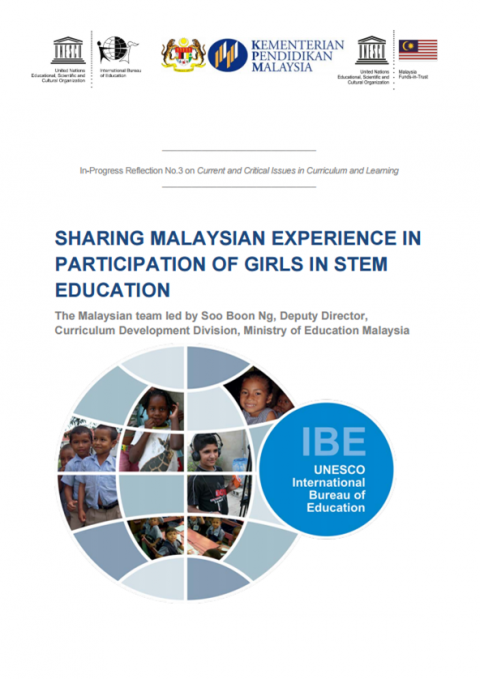 Sharing Malaysian experience in participation of girls in STEM education Year of publication: 2016 Corporate author: UNESCO International Bureau of Education (IBE) The Malaysia government has placed STEM as a focus in developing the country towards achieving the status of a developed nation. The government acknowledges the role of women as equal partners in nation building. Thus, various policies ranging from economy, education, women’s welfare and human resources have been formulated through the years. These policies have resulted in among others, the increase in women researchers from 35.8% in 2004 to 49.9% in 2012 as well as more women’s participation in selected STEM courses at the tertiary level. A total of 84 girls’ day schools with 6 of them as residential STEM Girls’ schools have been built since 1939. There are many female role models in STEM for the girls to emulate. This has been made possible by the successful implementation of the various policies related to women in STEM as well as innovative measures in facing the continuing challenges in STEM education.
  School knowlegde and curriculum standard Year of publication: 2000 Author: Zhong Qiquan Based on curriculum sociology, criticism towards school knowledge has been expanded. This article first discusses the problems of education in both Japan and China and then emphasizes the important relationship between quality value and curriculum standard. The four elements of school curriculum: curriculum objectives, curriculum content, curriculum implementation and curriculum evaluation are also clarified with regard to design curriculum standard. 学校知识与课程标准 Year of publication: 2000 Author: Zhong Qiquan 基于课程社会学,对于学校知识的批判增加。文章首先讨论了中国和日本的教育问题,并强调了“素质价值”与课程标准间的重要关系。文章讨论了课程构成的四要素:课程目标、课程内容、课程实施和课程评价,及其与课程标准编制的关系。
  Regional handbook on life skills programmes for non-formal education Year of publication: 2012 Corporate author: UNESCO Bangkok The Regional Handbook on Life Skills Programme for Non-formal Education (NFE) was developed for education policy makers, experts in curriculum development, materials development and trainers of personnel in the field of NFE, NFE practitioners such as Community Learning Centres (CLCs) personnel, teachers and facilitators, and researchers. It aims to provide information about life skills programmes and to serve as a practical guide to implement educational programmes to enhance life skills. It is expected to help NFE personnel with adopting, adapting and integrating life skills programmes in NFE. This Handbook consists of two parts as follows: Part one- overview of Life Skills Programme for Non-formal Education (NFE), Part Two- Practical Guide on Integrating Life Skills Programme in NFE. Part One provides answers to various questions related to life skills and life skills progrmmes. Part Two intends to provide practical information about the systematic planning and implementation of life skills programmes for NFE. It offers suggested steps for curriculum development, development of teaching and learning materials, delivery of life skills programmes and monitoring and evaluation strategies. Details of this process are elaborated for NFE practitioners at various levels, but in particular at the community level. This Handbook was developed based on the project outputs of UNESCO Bangkok's 'Life Skills Learning through Non-formal Education" carried out in Asia and the Pacific region from 2003-2006 within the framework of Asia-Pacific Programme of Education for All (APPEAL). The project consisted of country studies, regional meetings, pilot projects and action research in selected countries in the region. A group of experts from the region consolidated the main outputs of the project and developed this Handbook through a series of workshops in 2006-2007 in coordination with UNESCO Bangkok and the office of Non-formal and Informal Education (ONIE) of Thailand Ministry of Education. In addition, resource materials of various organizations including United Nations agencies, government institutions, universities and NGOs were also collected and used for developing this Handbook. Manuel régional sur les programmes de compétences de vie pour l'éducation non formelle Year of publication: 2012 Corporate author: UNESCO Bangkok Le manuel régional sur le programme des compétences de vie pour l'éducation non-formelle (ENF) a été développé pour les décideurs politiques de l'éducation, des experts dans l'élaboration des programmes, le développement des matériaux et formateurs de personnel dans le domaine de l'ENF, les praticiens ENF tels que les centres d'apprentissage communautaires (CJC) personnel , les enseignants et les animateurs et les chercheurs. Il vise à fournir des informations sur les programmes de compétences de vie et de servir comme un guide pratique pour mettre en œuvre des programmes éducatifs pour améliorer les compétences de la vie. Il est prévu pour aider le personnel de l'ENF à l'adoption, l'adaptation et l'intégration des programmes de compétences de vie en ENF. Ce manuel se compose de deux parties: Partie de un aperçu le programme des compétences de vie pour l'éducation non formelle (ENF), en deux parties Guide pratique sur le programme des compétences de vie de l’Intégration dans ENF. La première partie fournit des réponses aux diverses questions liées aux compétences de vie et les compétences de la vie programmes. La deuxième partie a l'intention de fournir des informations pratiques sur la planification et la mise en œuvre des programmes de compétences de vie pour ENF systématique. Il propose des étapes suggérées pour l'élaboration des programmes, le développement de matériel pédagogique et d'apprentissage, la prestation de compétences pour la vie des programmes et des stratégies de Suivi et d'évaluation. Les détails de ce processus sont élaborés pour les praticiens ENF à différents niveaux, mais en particulier au niveau de la communauté. Ce manuel a été élaboré sur la base des résultats du projet de «Life Skills de l'UNESCO Bangkok L'apprentissage par l'éducation non formelle» réalisée en Asie et dans la région du Pacifique 2003-2006 dans le cadre du Programme Asie-Pacifique d'éducation pour tous (APPEAL). le projet consistait en études de pays, des réunions régionales, des projets pilotes et la recherche-action dans certains pays de la région. un groupe d'experts de la région a regroupé les principaux résultats du projet et a développé ce manuel à travers une série d'ateliers en 2006-2007 coordination avec l'UNESCO Bangkok et le bureau de l'éducation non formelle et informelle (ONIE) de la Thaïlande Ministère de l'éducation. En outre, des ressources documentaires de diverses organisations, y compris les organismes des Nations Unies, les institutions gouvernementales, les universités et les ONG ont également été recueillies et utilisées pour le développement de cette Manuel.
  Good practices in education for sustainable development: teacher education institutions Year of publication: 2007 Author: Rosalyn McKeown Corporate author: UNESCO Chair in Reorienting Teacher Education towards Sustainability | International Network of Teacher Education Institutions The case studies in this document reflect individual and institutional efforts to reorient curriculum, programs, practices, and policies to address sustainability at institutions of teacher education. The studies come from Africa, Asia, the Caribbean, Europe, and North America. The case studies deal with professional development for in-service teachers, curriculum revision at the pre-service level, research with students in a local school, greening of a building and its garden, creating a network of universities, starting a journal, and creating new undergraduate and graduate programs. The diversity of efforts is broad; the impact is deep. The dedication of teacher educators around the world is evident on every page of this document. Les bonnes pratiques en matière d'éducation pour le développement durable: institutions de formation des enseignants Year of publication: 2007 Author: Rosalyn McKeown Corporate author: UNESCO Chair in Reorienting Teacher Education towards Sustainability | International Network of Teacher Education Institutions Les études de cas présentées dans ce document reflètent les efforts individuels et institutionnels pour réorienter le curriculum, les programmes, les pratiques et les politiques de lutte contre le développement durable dans les établissements de formation des enseignants. Les études viennent d'Afrique, d'Asie, des Caraïbes, en Europe et en Amérique du Nord. Les études de cas portent sur le développement professionnel des enseignants en service, la révision des programmes au niveau pré-services, la recherche avec les étudiants dans une école locale, l'écologisation d'un bâtiment et son jardin, la création d'un réseau d'universités, à partir d'un journal, et la création de nouveaux programmes de premier cycle et des cycles supérieurs. La diversité des efforts est large; l'impact est profond. Le dévouement des formateurs d'enseignants à travers le monde est évident sur chaque page de ce document.