
Resources
Explore a wide range of valuable resources on GCED to deepen your understanding and enhance your research, advocacy, teaching, and learning.
1,182 Results found
 Guía de situaciones de aprendizaje significativas en el aula para la ciudadanía global y el desarrollo sostenible en secundaria Year of publication: 2024 Author: Helena Rodriguez de Guzmán Corporate author: Entreculturas | Spanish Agency for International Development Cooperation (AECID) Esta propuesta didáctica pretende impulsar nuevos modelos de educación para que éstos sean más atractivos, más conscientes y con una profunda y mayor influencia en el ejercicio de la ciudadanía. Diseñada desde los fundamentos de la Educación Transformadora, apuesta por dar la oportunidad a todo el alumnado a adquirir las competencias necesarias para una ciudadanía global y crítica desde el acompañamiento a su crecimiento vital de forma integral, tal y como propone la UNESCO (UNESCO, 2022). A su vez, este recurso didáctico aporta herramientas que apoyan las estrategias educativas que promueve la LOMLOE cuyo objetivo principal es garantizar la formación integral del alumnado contribuyendo al desarrollo de su personalidad, el ejercicio pleno de los derechos humanos y a una ciudadanía activa y democrática en la sociedad actual.
  Les limites planétaires : trois question à François Laugier Year of publication: 2024 Corporate author: Vie Publique Sur les 9 limites planétaires définies, 6 sont déjà atteintes. Mais qu'entend-on par «limite planétaire» ? Que se passe-t-il lorsqu'une limite planétaire est franchie. Out of the 9 planetary limitation defined, 6 are already reached. But what do we call "planetary limitations"? What happens when a limitation is crossed?
  Being and Knowing: Teaching Profile for Sustainable Development and Global Citizenship Year of publication: 2023 Corporate author: InteRed Document of a pedagogical nature that describes the characteristics of the teaching profile necessary to educate in Sustainable Development and Global Citizenship. Identify what skills are necessary to carry out transformative education that responds to global challenges as proposed by social movements, NGOs and civil society. This publication is the result of collaborative work carried out during the years 2022 and 2023 by a Movement 4.7 team formed for this purpose. Ser y Saber: Perfil docente para el Desarrollo Sostenible y la Ciudadanía Global Year of publication: 2023 Corporate author: InteRed Documento de carácter pedagógico que describe qué características tiene el perfil docente necesario para educar en el Desarrollo Sostenible y la Ciudadanía Global. Identifica qué competencias necesarias para llevar a cabo una educación transformadora que dé respuesta a los retos globales conforme proponen movimientos sociales, ONG y sociedad civil. Esta publicación es el resultado de un trabajo colaborativo realizado durante los años 2022 y 2023 por un equipo del Movimiento 4.7 conformado con ese fin.
 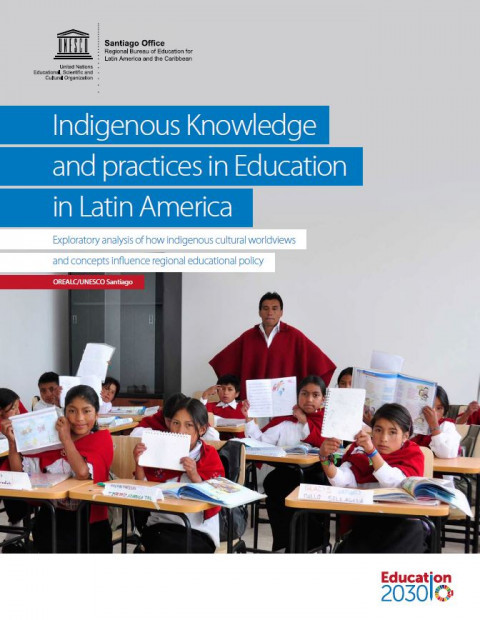 Indigenous Knowledge and practices in Education in Latin America: Exploratory Analysis of How Indigenous Cultural Worldviews and Concepts Influence Regional Educational Policy Year of publication: 2017 Corporate author: UNESCO Santiago This study presents a preliminary exploration of the approaches, processes and tools through which indigenous worldviews and concepts of knowledge and well-being can and have influenced education policies in Latin America. First, it addresses the principal theoretical approaches used in the area of indigenous knowledge and education policies, taking into account the persistence of an “epistemic otherness” and the need for a dialogue between the predominant approaches. Second, it addresses the normative framework and intercultural educational policies, emphasizing how and to what extent the countries in the region take indigenous knowledge into consideration and include it in their education policies and practices. Third, it presents a number of “relevant practices” in terms of dialogue with indigenous knowledge in education policies, taking into account the factors that favour the relevance of education to indigenous views and cultural practices, facilitating their replicability and sustainability. Furthermore, these practices respond to key criteria like recognizing learners as ‘carriers’ and producers of culture, valuing the use of schools as centres of social and cultural activities and favouring the inclusive learning of indigenous and non-indigenous students. Finally, the study unveils challenges for the advancement of the dialogue between indigenous knowledge and education policies, at the same time proposing key concepts to be approached in depth. Conocimiento Indígena y Políticas Educativas en América Latina: Análisis exploratorio de cómo las cosmovisiones y conceptos culturales indígenas de conocimiento inciden, y pueden incidir, en la política educativa en la región Year of publication: 2017 Corporate author: UNESCO Santiago El presente estudio explora la idea de una ‘alternativa epistémica’, construyendo desde el conocimiento y los valores que sustentan las prácticas sociales y educacionales indígenas de la región. En particular, explora cómo estos valores y formas de conocimiento han sido adoptados en las políticas educacionales de tres países de la región andina: Bolivia, Ecuador y Perú, que hace poco atravesaron reformas políticas y constitucionales con el fin de reconocer la composición de sus poblaciones multiculturales, multiétnicas y multilingüísticas. Esta publicación es una invitación a considerar el conocimiento indígena como una fuente legítima de inspiración para las políticas educacionales que puedan contribuir al bienestar de todos y a la sostenibilidad del planeta.
  Learning-service and Citizenship Education Year of publication: 2011 Author: Josep M.ª Puig Rovira | Mònica Gijón Casares | Xus Martín García | Laura Rubio Serrano Corporate author: Universidad de Barcelona The aim of this article is to present the methodology of service learning as an especially significant contribution to citizenship education. Service learning is an activity that combines community service and curricular learning. It is an educational setup in which a circular link is formed between participation in services created to meet a community need and the learning of knowledge and values. The project presents an initiative for education in values and citizenship based on experience, participation and critique. Service learning is at the same time an excellent instrument for making education more inclusive and for helping students develop a set of basic skills that can only be acquired through a comprehensive, contextualized activity. Through service learning, students acquire a real, committed engagement with the search for the common good; this acquisition of commitment is a key formative mechanism in achieving a complete education for citizenship. The article begins by analyzing the different elements that make up citizenship education and the pedagogical means required for their acquisition. The concepts of ‘practice’ and ‘citizenship practice’ are the basis for proposing service learning as an ideal methodology for educating participative citizens who can contribute to the common good. The rest of the article is devoted to analyzing each of the constitutive aspects of service learning. This portion of the article begins by presenting a more-precise definition of ‘service learning’ and continues with an analysis of the components of service learning: social needs, the learning of contents and competences, community service, partnerships between institutions and the required networking. The article concludes by reviewing the different levels at which service learning has an impact and identifying and organizing the various personal acquisitions and institutional achievements that this type of educational activity provides. Aprendizaje-servicio y Educación para la Ciudadanía Year of publication: 2011 Author: Josep M.ª Puig Rovira | Mònica Gijón Casares | Xus Martín García | Laura Rubio Serrano Corporate author: Universidad de Barcelona El objetivo de este artículo es presentar la metodología del aprendizaje-servicio como una aportación especialmente relevante para la Educación para la Ciudadanía. El aprendizaje- servicio es una actividad que combina el servicio a la comunidad con el aprendizaje curricular. Es una propuesta educativa que vincula de una manera circular la participación en servicios pensados para satisfacer alguna necesidad de la comunidad y el aprendizaje de conocimientos y valores. Con ella, la educación en valores se pone en práctica de una manera participativa y crítica. Al mismo tiempo, también es un buen instrumento para hacer una educación más inclusiva y para desarrollar un conjunto de competencias básicas que solo pueden adquirirse a través de un trabajo global y contextualizado. Incorporar la intervención real y comprometida de los educandos en la búsqueda del bien común es un mecanismo formativo imprescindible para lograr una completa Educación para la Ciudadanía. Para lograr este objetivo, el escrito empieza analizando los distintos aprendizajes que supone la Educación para la Ciudadanía, así como los medios pedagógicos para alcanzarlos. Los conceptos de práctica y de práctica de ciudadanía permiten proponer el aprendizaje-servicio como una metodología idónea para lograr la formación de una ciudadanía participativa y capaz de contribuir al bien común. A continuación, se analizan los aspectos constitutivos del aprendizaje-servicio. Se presenta primero una aproximación más exacta a su definición y luego se desglosan sus componentes: las necesidades sociales, el aprendizaje de contenidos y competencias, el servicio a la comunidad, el partenariado entre instituciones y el trabajo en red que requiere. Al final del artículo se muestran los distintos niveles en los que impacta el aprendizaje-servicio, y se señalan y ordenan las distintas adquisiciones personales y logros institucionales que proporciona este tipo de actividad educativa.
  Raising a Child for Sustainable Development: Problems and Solution Year of publication: 2019 Author: Fathy Mohamed Corporate author: Assiut University This paper aims to study the problems that hinder raising a child for sustainable development. After discussing the problems, the paper ends with a vision to activate education for sustainable development in kindergarten institutions. تربية الطفل من أجل التنمية المستدامة: المشكلات والحل Year of publication: 2019 Author: Fathy Mohamed Corporate author: Assiut University تهدف هذه الورقة لدراسة المشكلات التي تعوق تربية الطفل من أجل التنمية المستدامة. بعد مناقشة المشكلات تنتهي الورقة بوضع رؤية لتفعيل التربية من أجل التنمية المستدامة في مؤسسات رياض الأطفال.