
Resources
Explore a wide range of valuable resources on GCED to deepen your understanding and enhance your research, advocacy, teaching, and learning.
3,790 Results found
 Discussion Papers Journal (Vol 2) Dans le volume II, auteur chinois Pan Guang offre un compte de préhension de la façon dont les Juifs ont fait leur chemin à Shanghai au cours de la Seconde Guerre mondiale alors que l'écrivain polonais Andrzej Mirga détails la persécution nazie des Roms et des Sintis au cours de la même période. professeur argentin Juan E. Méndez nous amener au 21e siècle avec une discussion sur l'arrestation de 2011 et dans l'attente du procès des accusés de crimes de guerre serbe Ratko Mladic. Et la valeur intemporelle de l'Holocauste est explorée comme l'Afrique du Sud Tali Nates montre comment l'éducation contribue à guérir les divisions opérées par l'apartheid en Afrique du Sud et savant russe Ilya Altman expose la mémoire et l'éducation de l'Holocauste dans la Russie contemporaine. D'autres contributeurs sont Edward Mortimer et Kaja Shonick Glahn (UK / Allemagne), David Matas (Canada), Lenore Weitzman (USA), et Robert Krell (Canada). (Par l'éditeur)
  Teaching the Holocaust in School History: Teachers or Preachers? If we expose students to a study of human suffering we have a responsibility to guide them through it. But is this the role of school history? Is the rationale behind teaching the Holocaust primarily historical, moral or social? Is the Holocaust to be taught as a historical event, with a view to developing students' critical historical skills, or as a tool to combat continuing prejudice and discrimination? These profound questions lie at the heart of Lucy Russell's fascinating analysis of teaching the Holocaust in school history. She considers how the topic of the Holocaust is currently being taught in schools in the UK and overseas. Drawing on interviews with educationalists, academics and teachers, she discovers that there is in fact a surprising lack of consensus regarding the purpose of, and approaches to, teaching the Holocaust in history. Indeed the majority view is distinctly non-historical: there is a tendency to teach the Holocaust from a social and moral perspective and not as history. This book attempts to explain and debate this phenomenon. (By the publisher)
 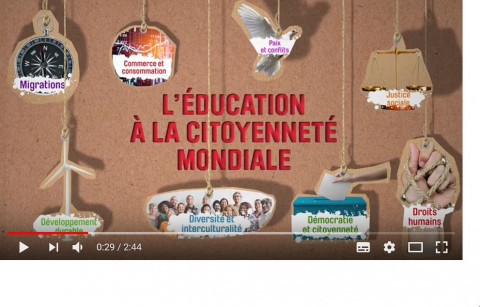 [Vidéo] Pédagogie du projet et éducation à la citoyenneté mondiale Year of publication: 2018 Corporate author: Annoncer la Couleur (ALC) Quels sont les avantages de la pédagogie du projet ? En quoi cette pédagogie est particulièrement propice pour faire de l'éducation à la citoyenneté mondiale ?
  [Vidéo] L'éducation à la citoyenneté au Sud Year of publication: 2016 Corporate author: ONG Défi Belgique Afrique (DBA) Un projet d'éducation au développement de la jeuness africaine
  [Vidéo] L'école apprend la citoyenneté Year of publication: 2016 Corporate author: Mission laïque française Organisé au Maroc en mai 2016, le congrès du réseau d'enseignement français à l'étranger mlfmonde a réuni 300 personnes autour du thème "l'école apprend la citoyenneté", élément central du projet éducatif de la Mission laïque française.
  T.E.A.C.H : Teaching emotive and controversial History 3-19 Many historical topics, including the Crusades, the Transatlantic Slave Trade or the Arab-Israeli conflict, can be considered emotive and controversial. The TEACH report found, in interviews with teachers carried out before 2007, that some teachers sometimes feel uncertain how best to approach such topics in such a way as to do the topics justice while respecting the feelings of particular groups of pupils. At no point did any teacher interviewed for the TEACH report claim to have avoided teaching about the Holocaust at Key Stage 3 for fear of offending Muslim children. The TEACH report outlines the sort of good practice in teaching sensitive topics which is available for teachers to share, not least through the Historical Association's programme of subject-specific training. (By the publisher)
  Citizens but not Adults? Injunction to be Responsible and Citizens in Official Coming of Age Rituals in Switzerland Year of publication: 2018 Author: Maxime Felder | Laurence Ossipow | Isabelle Csupor Corporate author: Lien social et Politiques Swiss municipalities organize ceremonies for their residents reaching the official age of full citizenship. In the six studied municipalities, local authorities invite them to a municipal council’s meeting, offer them a dinner or an aperitif, or organize them a show and a debate with role models. Speeches are central to these ceremonies, and authority representatives encourage their audience to be “good” citizens. Call to vote is the leitmotiv, but discourses reveal broader definitions of citizenship, insisting sometimes on a local commitment and volunteering, and sometimes on the necessity to fight climate change and inequalities. Comparing officials’ speeches to statements of young people participating in these events reveals “tensions”. Indeed, authority representatives address young citizens without considering them as fully adult, and they do not consider themselves as such neither. However, some of them are already involved in forms of vernacular citizenship, and are progressively leaving the municipality to study, work or travel. Ultimately, these ceremonies allow officials to stage their interest in the youth, which they consider as both uncompleted and essential to the renewal of democracy. Citoyen·ne·s, mais pas encore adultes ? Les injonctions à la responsabilité et à la citoyenneté dans les rituels d’accession à la majorité en Suisse Year of publication: 2018 Author: Maxime Felder | Laurence Ossipow | Isabelle Csupor Corporate author: Lien social et Politiques Les communes suisses organisent un rituel pour célébrer l’accession à la majorité civile et civique de leurs résident·e·s qui atteignent l’âge de dix-huit ans. Dans les six communes que nous avons étudiées, les autorités invitent les jeunes à participer à une séance du conseil communal, les convient à un repas ou un apéritif, ou leur organisent une soirée de témoignages, de spectacle ou encore de jeux en plein air. Ces événements font place à des discours dans lesquels des représentant·e·s des autorités enjoignent les jeunes à être de « bonnes » et « bons » citoyens. Si l’appel au vote est toujours le leitmotiv, les discours se centrent aussi sur des définitions plus larges de la citoyenneté, insistant tantôt sur l’engagement associatif et local, tantôt sur la nécessité d’agir pour l’écologie ou contre les inégalités. Le croisement de ces analyses avec celles des entretiens menés avec de jeunes participant·e·s fait émerger des tensions. En effet, les autorités s’adressent à des jeunes qu’elles ne considèrent pas tout à fait comme des adultes (et qui ne se considèrent pas non plus comme tel·le·s), qui sont pour certain·e·s déjà engagé·e·s dans ces formes de citoyenneté vernaculaire, et qui s’apprêtent à quitter leur commune pour étudier ou voyager. Ces promotions citoyennes permettent ainsi de mettre en scène l’intérêt des élu·e·s pour les jeunes, considéré·e·s comme des citoyen·ne·s en apprentissage dont dépend le renouvellement de la démocratie.
  Los derechos humanos, el holocausto y los genocidos recientes Year of publication: 2008 Corporate author: Ecuador. Ministerio de Educacion This resource guide designed for high school students in Ecuador broaches Holocaust history through broader thematics such as Human Rights, mass violence and a comparative analysis with other genocides. It is an valuable document for understanding worldwide issues.
 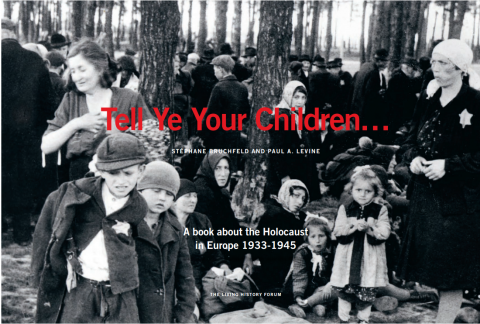 Tell Ye Your Children - A book about the Holocaust in Europe 1933-1945 Year of publication: 2012 Author: Stephane Bruchfeld, Paul. A. Levine This book is published by the Living History Forum. This Swedish public authority uses the teaching of the Holocaust and other crimes against humanity to promote tolerance, democracy and human rights. This booklet covers the rise of National Socialism until the end of the war, providing facts and information to encourage discussions.