
Resources
Explore a wide range of valuable resources on GCED to deepen your understanding and enhance your research, advocacy, teaching, and learning.
3,446 Results found
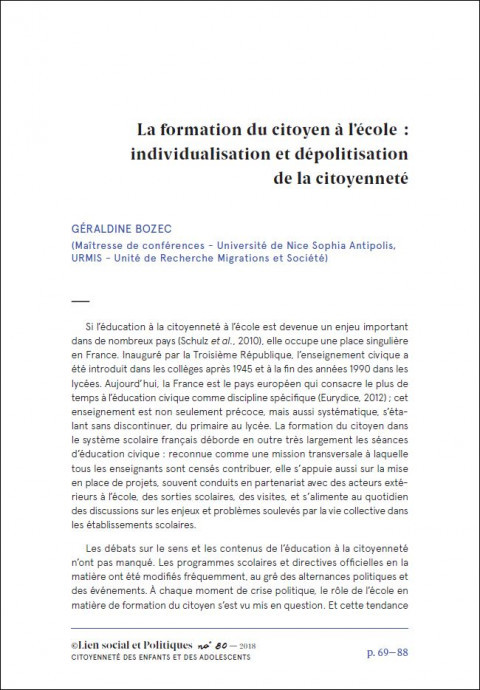 Educating Citizens at School: Individualization and Depoliticization of Citizenship Year of publication: 2018 Author: Géraldine Bozec Corporate author: Lien social et Politiques This text analyzes the features and the figures of the legitimate citizen in the sphere of school, through both official guidelines and school staff’s conceptions and practices. Data from two qualitative fieldwork surveys in French schools are used. The analysis focuses on the political dimension of citizenship: the relationship between individuals and power and their agency in collective and political life. Overall, citizens’ participation is a secondary dimension in school citizenship education, which rather emphasizes the intellectual autonomy of the critical citizen. The school hardly offers tools enabling students to understand political life, its issues, its actors and its concrete processes. The avoidance of political issues that is observed in classrooms is related to a particular conception of school political neutrality, but still more to the objective of cohesion officially attributed to school and recognized by teachers as legitimate. In other respects, citizenship is increasingly intended to be translated into the school life itself, whose modes of organization must move closer to those of adult political democracy. The article shows the limitations of such an analogy between the school and political society and identifies several obstacles that hinder the implementation of this “democratic school”. Lastly, it highlights the gap between the emphasis on the figure of individual citizen in the school space and the relationship to groups entailed by the actual practice of citizenship. La formation du citoyen à l’école : individualisation et dépolitisation de la citoyenneté Year of publication: 2018 Author: Géraldine Bozec Corporate author: Lien social et Politiques Ce texte analyse les qualités et les figures du citoyen légitime dans la sphère de l’école, en s’intéressant à la fois aux directives officielles et aux représentations et pratiques des acteurs scolaires. Les données de deux enquêtes qualitatives conduites dans des établissements scolaires français sont ici mobilisées. Le regard porte prioritairement sur la dimension politique de la citoyenneté : le rapport de l’individu au pouvoir et sa capacité d’action dans la vie collective et politique. Globalement, la participation du citoyen apparait comme une dimension relativement secondaire dans l’éducation scolaire à la citoyenneté, au profit de l’autonomie intellectuelle du citoyen critique. L’école offre peu d’outils permettant aux élèves d’appréhender la vie politique, ses enjeux, ses acteurs et ses processus concrets. L’évitement des sujets politiques que l’on observe dans les classes renvoie non seulement à une conception particulière de la neutralité politique, mais aussi et surtout à l’objectif de cohésion qui est attribué officiellement à l’école et que les enseignants reconnaissent comme légitime. La citoyenneté est par ailleurs censée s’exprimer de plus en plus dans la vie même de l’établissement, dont les modes de fonctionnement doivent se rapprocher de la démocratie politique adulte. Le texte montre les limites d’une telle analogie entre la sphère scolaire et la société politique et identifie divers obstacles qui pèsent sur la mise en oeuvre de cette « démocratie scolaire ». Il met enfin en évidence le décalage entre l’insistance sur la figure d’un individu-citoyen dans l’espace scolaire et l’inscription dans des collectifs que suppose l’exercice réel de la citoyenneté.
 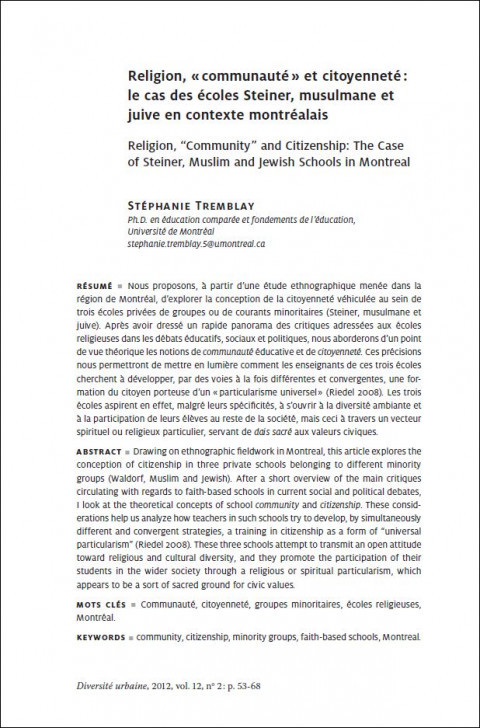 Religion, « communauté » et citoyenneté : le cas des écoles Steiner, musulmane et juive en contexte montréalais Year of publication: 2012 Author: Stéphanie Tremblay Corporate author: Diversité urbaine Nous proposons, à partir d’une étude ethnographique menée dans la région de Montréal, d’explorer la conception de la citoyenneté véhiculée au sein de trois écoles privées de groupes ou de courants minoritaires (Steiner, musulmane et juive). Après avoir dressé un rapide panorama des critiques adressées aux écoles religieuses dans les débats éducatifs, sociaux et politiques, nous aborderons d’un point de vue théorique les notions de communauté éducative et de citoyenneté. Ces précisions nous permettront de mettre en lumière comment les enseignants de ces trois écoles cherchent à développer, par des voies à la fois différentes et convergentes, une formation du citoyen porteuse d’un « particularisme universel » (Riedel 2008). Les trois écoles aspirent en effet, malgré leurs spécificités, à s’ouvrir à la diversité ambiante et à la participation de leurs élèves au reste de la société, mais ceci à travers un vecteur spirituel ou religieux particulier, servant de dais sacré aux valeurs civiques.
  Holocaust Memorial Days : An overview of remembrance and education in the OSCE region Year of publication: 2015 Corporate author: OSCE. Office for Democratic Institutions and Human Rights (ODIHR) This publication provides an overview of governmental and non-governmental practices in the OSCE area to commemorate the Holocaust. It is intended to promote remembrance and education by publicizing and facilitating the exchange of good practices. The publication shows that most OSCE governments, as well as many local and municipal authorities, schools, civil society organizations, religious groups and others, are actively involved in Holocaust commemoration activities. While many of these activities take place throughout the year, there is a particular focus on promoting Holocaust remembrance, research and education during Holocaust Memorial Days. Across the world, 27 January, the International Day of Commemoration in Memory of the Victims of the Holocaust, is devoted to educating future generations about the Holocaust. This overview provides a snapshot of the types of Holocaust education activities that have been developed to mark Holocaust Memorial Days, while also identifying where and how the Holocaust is taught in schools throughout the region. (By the publisher)
  Never again ! Does Holocaust education have an effect on pupils' citizenship values and attitudes? Year of publication: 2006 Corporate author: Scottish Executive. Department of Social Research As the education for citizenship agenda continues to make an impact on schools, this research sets out to examine whether teaching the Holocaust, in the upper primary, either as part of a study on World War 2 or as a topic on its own, has an impact, both immediate and longer term, on pupils’ citizenship values and attitudes, and particularly those values and attitudes relating to various minority or disadvantaged groups in Scotland. (By the author) Authentic Pedagogy and the Holocaust: A Critical Review of State Sponsored Holocaust Curricula Year of publication: 2005 Author: Samuel Totten | Karen L. Riley Over the past decade and a half, states in all regions of the United States have formed Holocaust councils, advisory groups, and other agencies for the purpose of developing educational programs in response to a growing interest in the Holocaust. Some states have called upon educators and Holocaust agencies within the state to develop curricula and/or resource materials for use in social studies and English classrooms. Furthermore, many states now either strongly recommend the teaching of the Holocaust or mandate that it be taught in their public schools. In the present paper, we present a critical analysis of the instructional strategies advocated in state–sponsored Holocaust curricula. We ground our evaluation within the framework of authentic pedagogy—particularly the work of Fred Newmann. More than an attempt to simply criticize these works, we offer constructive alternatives to inadequate and/or poorly designed instructional strategies. Fundamental to the intent of this paper is its usefulness as a guide for evaluating instructional activities designed to support the teaching of content knowledge about the Holocaust. (By the author)
 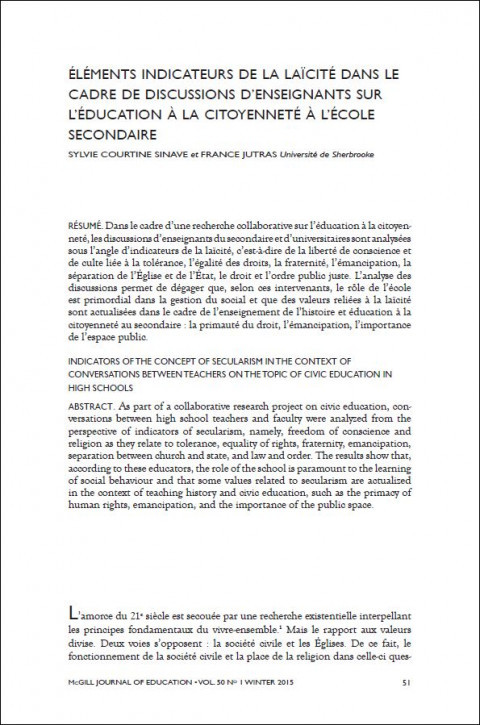 Indicators of the Concept of Secularism in the Context of Conversations Between Teachers on the Topic of Civic Education in High Schools Year of publication: 2015 Author: Sylvie Courtine Sinave | France Jutras Corporate author: McGill University. Faculty of Education As part of a collaborative research project on civic education, conversations between high school teachers and faculty were analyzed from the perspective of indicators of secularism, namely, freedom of conscience and religion as they relate to tolerance, equality of rights, fraternity, emancipation, separation between church and state, and law and order. The results show that, according to these educators, the role of the school is paramount to the learning of social behaviour and that some values related to secularism are actualized in the context of teaching history and civic education, such as the primacy of human rights, emancipation, and the importance of the public space. Éléments indicateurs de la laïcité dans le cadre de discussions d’enseignants sur l’éducation à la citoyenneté à l’école secondaire Year of publication: 2015 Author: Sylvie Courtine Sinave | France Jutras Corporate author: McGill University. Faculty of Education Dans le cadre d’une recherche collaborative sur l’éducation à la citoyenneté, les discussions d’enseignants du secondaire et d’universitaires sont analysées sous l’angle d’indicateurs de la laïcité, c’est-à-dire de la liberté de conscience et de culte liée à la tolérance, l’égalité des droits, la fraternité, l’émancipation, la séparation de l’Église et de l’État, le droit et l’ordre public juste. L’analyse des discussions permet de dégager que, selon ces intervenants, le rôle de l’école est primordial dans la gestion du social et que des valeurs reliées à la laïcité sont actualisées dans le cadre de l’enseignement de l’histoire et éducation à la citoyenneté au secondaire : la primauté du droit, l’émancipation, l’importance de l’espace public.
  The Legitimacy of Diversity in Education: A Reflection on Inclusion Year of publication: 2011 Author: Luc Prud’homme | Raymond Vienneau | Serge Ramel | Nadia Rousseau Corporate author: Éducation et francophonie The objective of this article is to explore the theme of diversity in the classroom from the perspective of scholastic inclusion, or its alternative, scholastic and social exclusion. The article examines concepts that foster the positive and constructive recognition of diversity in the school setting, along with the social and cultural dimension of inclusion and the pedagogy of inclusion. La légitimité de la diversité en éducation : réflexion sur l’inclusion Year of publication: 2011 Author: Luc Prud’homme | Raymond Vienneau | Serge Ramel | Nadia Rousseau Corporate author: Éducation et francophonie Le présent texte a pour objectif de proposer une réflexion sur le thème de la diversité à l’école, et ce, sous l’angle de l’inclusion scolaire ou de son alternative, l’exclusion scolaire et sociale. Le texte examine ainsi certaines conceptions favorisant une reconnaissance positive et constructive de la diversité en contexte scolaire. Ensuite, il explore la dimension sociale et culturelle de ce phénomène pour enfin traiter la question de l’inclusion et de la pédagogie de l’inclusion.