
Resources
Explore a wide range of valuable resources on GCED to deepen your understanding and enhance your research, advocacy, teaching, and learning.
3,387 Results found
 Plan de Educación para la Ciudadanía Global 2019 Year of publication: 2019 Corporate author: UNRWA España El presente Plan de Educación para la Ciudadanía Global para el año 2019 responde a la necesidad de marcar unas líneas de trabajo en este campo por parte de UNRWA España durante este año que guíen su intervención; recojan aprendizajes y potencien el valor añadido adquirido por la organización en este tiempo; se adapten a los cambios de contexto a nivel global, nacional y local; y que sigan contribuyendo construir una ciudadanía global solidaria, comprometida, corresponsable, protagonista y activa con los derechos humanos, el desarrollo sostenible y la justicia social desde la misión-visión de UNRWA España.
  Diccionario de Educación para el Desarrollo Year of publication: 2007 Author: Gema Celorio | Alicia López de Munain Corporate author: Hegoa | ACSUR | Unión Europea El Diccionario de Educación para el Desarrollo pretende facilitar un cuerpo teórico útil para orientar la actividad de las entidades y colectivos comprometidos con este enfoque educativo. Más de 20 años de trabajo en este ámbito han permitido acumular un conocimiento y una práctica importantes. Hoy en día, la diversidad de enfoques existentes, los cambios en el panorama internacional que señalan nuevos retos y generan nuevas prácticas, en suma, el propio carácter multidisciplinar de la Educación para el Desarrollo, hacían necesaria la clarificación de discursos y conceptos a los que puede contribuir esta obra.El Diccionario de Educación para el Desarrollo identifica y agrupa, por un lado, los conceptos esenciales constituyentes del discurso propio de este enfoque; y, por otro, señala los significados, aspectos, componentes, rasgos y debates más relevantes no sólo para la comprensión de cada término incluido sino, sobre todo, para su interpretación desde una perspectiva crítica.Un buen número de voces y un amplio equipo multidisciplinar de autores y autoras que han colaborado con sus artículos, hacen de este Diccionario una interesante referencia para todas aquellas personas interesadas por la cooperación, la justicia, la equidad y la construcción de un mundo más justo y solidario.
  Comparison on Educational Discourses About Global Citizenship Education Using Network Text Analysis (Global Studies Education; Vol. 11, No. 2) Year of publication: 2019 Author: Kyunghee Park | JiEun Shin Corporate author: Association of | Global Studies Education The purpose of this study is to analyze the differences between ‘global citizenship education’, ‘democratic civic education’, ‘multicultural education’, ‘education for international understanding’, and ‘peace education’. For this, 3,072 research papers from 2000 to 2018 selected, and network text analysis(NTA) was conducted to confirm the characteristics and changes of the five educational discourses. As a result, the commonness and specificities of them were derived through the ‘closeness centrality’ and ‘betweenness centrality’ on the NTA. ‘Global citizenship education’, ‘multicultural education’, and ‘education for international understanding’ have crossed the content area. And ‘education for international understanding’ was based on a multicultural society. The values-oriented between ‘global citizenship education’ and ‘democratic civic education’ were distinguished. Finally, it is suggested that the five educational discourses need to be on the approach of lifelong learning, and they are education oriented toward change in consciousness. 네트워크 텍스트 분석을 활용한 세계시민교육 관련 교육담론 비교 (글로벌교육연구; Vol. 11, No. 2) Year of publication: 2019 Author: 박경희 | 신지은 Corporate author: 글로벌교육연구학회 세계시민교육과 관련한 교육담론들에 대해 국제사회 및 학계에서 일련의 기준들을 제시하였지만 여전히 교육담론에 대한 비교와 논의는 복잡하다. 따라서 이 연구는 세계시민교육, 민주시민교육, 다문화교육, 국제이해교육, 평화교육의 계열적 특성을 살펴봄으로써 5개 교육담론 간 특징을 규명하는데 목적이 있다. 이를 위해 2000년부터 2018년까지 발표된 국내 학위논문 및 학술지 3,072건을 분석하였고, 네트워크 텍스트 분석(NTA)을 통해 연구주제어의 특성과 관계를 확인하였다. 연구결과, 5개 교육담론의 네트워크 근접중심성과 매개중심성을 통해 담론들의 공통점과 특수성을 발견하였다. 세계시민교육, 다문화교육, 국제이해교육은 유사한 영역이 교차되어 논의되어왔으며, 그 중 국제이해교육은 다문화사회를 기반으로 한 교육에 집중해 온 것으로 나타났다. 그리고 세계시민교육과 민주시민교육은 지향하는 가치가 구분되는 것으로 확인되었다. 마지막으로 연구에서 살펴본 교육담론에 대하여 학교, 지역사회의 경계가 없는 평생학습 차원에서의 접근과, 의식전환교육이라는 인식과 관련한 교육적 시사점을 제안하였다.
  Global Citizenship Education and Ecopedagogy at the Intersections: Asian Perspectives in Comparison (Asian Journal of Education; Vol. 17, Special Issue) Year of publication: 2016 Author: Greg William Misiaszek | Lauren Ila Misiaszek Corporate author: Seoul National University. Education Research Institute This article provides a preliminary comparative analysis of environmental pedagogies in the context of widening spheres of citizenship due to intensifying globalization, with a particular focus on the East Asian context. In it, the authors specifically focus on Global Citizenship Education models and critical, Freirean-based ecopedagogies. The article includes analysis of research with expert scholars of citizenship and/or environmental pedagogies from six continents that focused on the intersectionalities between these two pedagogies and the effects of globalization on this work. The authors further explore the ways self-identified East Asian participants perceive differences in conceptualizations of citizenship between East Asia and the “West.”
  A Desirable and Practical Approach to Global Citizenship Education: An Exploration of “Global Storylines” in Scotland (Studies in Foreign Education; Vol. 47, No. 3) Year of publication: 2020 Author: Rao Shuqi Corporate author: Northeast Normal University The problems that global citizenship education has to deal with are threefold. “Global Storylines”, which provides corresponding solutions to practical difficulties, has emerged as the most effective approach to global citizenship education in Scotland. Firstly, global citizenship education has enjoyed a long continuity of government support. Through integrating with the current curriculum landscape, “Global Storylines” experiences secure curriculum status. Secondly, by utilizing “storylines” and educational drama, global society and global issues are introduced in subtle forms, which benefits students’ experienced-based learning. The contradiction between students’ cognitive need and ability is resolved accordingly. Thirdly, WOSDEC as the co-creator of “Global Storylines” offers a professional learning program. Teachers are universally supported in terms of theoretical knowledge, practical skills and being involved in the teaching community of global citizenship education.
  Global Citizenship Education in Hong Kong Year of publication: 2015 Author: Jun Xing Corporate author: IACSIT Press Education is in the midst of massive reforms in different parts of the world. Over the last few decades, there is an increasing call for global citizenship education(GCE) in the academy. In this paper, the author will first explain why the concept is a game changer in higher education, and then explorethe opportunities as well challenges for GCE, particularly in the Hong Kong academy, from the perspectives of public policies, curriculum and pedagogy. Finally, the author wants to explore how the pedagogy of service learning (SL) can serve as a powerful vehicle to achieve the intended learning outcomes of GCE while, in the meantime, GCEcan inform the theory and practice of international SL.
 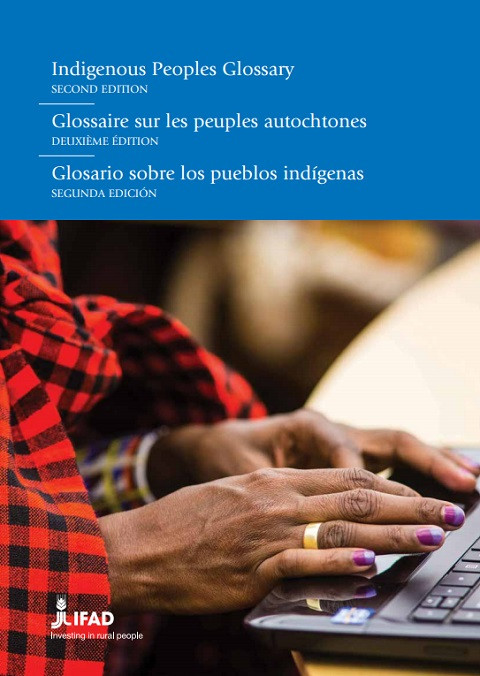 Indigenous Peoples Glossary Year of publication: 2018 Corporate author: International Fund for Agricultural Development (IFAD) The purpose of this glossary is to ensure consistency and accuracy of terminology in English, French and Spanish, and standardize the terminology used in relation to indigenous peoples in official documentation and publications, and in all aspects of meeting preparations. It is intended for use by IFAD staff, indigenous peoples' organizations and other interested parties. Terms and definitions are accompanied by details of the source document and its date of publication.
  What's in a Word? The Problem with 'Development' with Dr Karen Pashby Year of publication: 2020 Author: Karen Pashby Corporate author: Bridge 47 Dr Karen Pashby is a Reader at Manchester Metropolitan University and is also part of Bridge 47's Knowledge Exchange Partnership.In this episode, Karen explores development through a post/de-colonial lens, discussing how development is viewed in public discourse and how these effects the field of Development Education.
 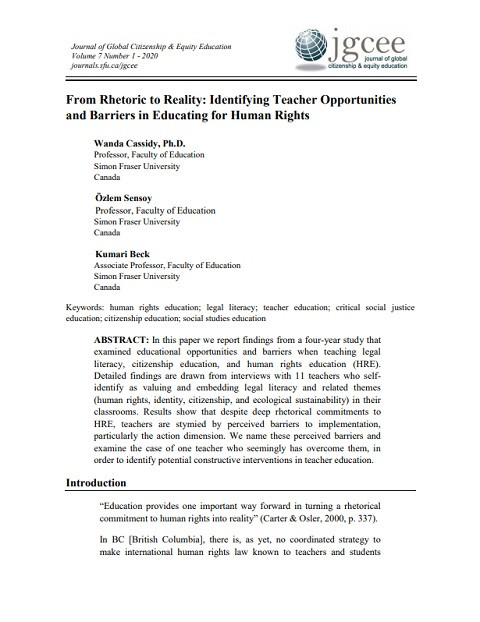 From Rhetoric to Reality: Identifying Teacher Opportunities and Barriers in Educating for Human Rights (Journal of Global Citizenship & Equity Education; Vol. 7, No. 1) Year of publication: 2020 Author: Wanda Cassidy | Özlem Sensoy | Kumari Beck Corporate author: Centennial College In this paper we report findings from a four-year study into legal literacy that examined educational opportunities and barriers when teaching about legal literacy, citizenship education, and human rights education. Detailed findings are drawn from interviews with eleven teachers who self-identify as valuing and embedding legal literacy and related themes (human rights, identity, citizenship, and ecological sustainability) in their classrooms. Results show that despite deep rhetorical commitments to human rights education, teachers are stymied by perceived barriers to implementing HRE, particularly the action dimension. We name these perceived barriers and examine the case of one of the teachers who seemingly has overcome them, in order to identify potential constructive interventions in teacher education.