
Resources
Explore a wide range of valuable resources on GCED to deepen your understanding and enhance your research, advocacy, teaching, and learning.
3,229 Results found
 Global education in Lithuania: challenges and opportunities Year of publication: 2014 Author: Indrė Augutienė | Zina Baltrėnienė Corporate author: Lithuanian Development Education and Cooperation Network of Non-governmental Institutions (Association LITDEA) | Lithuanian National Non-Governmental Development Cooperation Organisations‘ Platform (NGDO Platform) The publication has been produced implementing the project ‘‘Quality Partnership for Development-EU Presidency project for the Lithuanian EU Presidency, 2013“ (no. DCINSA ED/2013/319-124). Today we live in a constantly changing world which is bound by the spirit of relations between people, countries and cultures and which presents various challenges and opportunities. Every day we have to solve numerous economic, social and environmental issues connecting us with other countries, their cultures and citizens and providing an opportunity for all of us to become part of a global society.In order to accept the opportunities provided by the globalisation processes and cope with the emerging challenges it is necessary to create the conditions for people to acquire the knowledge on global realities, emerging global development problems and to relate them with their own life. It is also important to provide the opportunities for people to acquire the skills and enhance own values facilitating active global citizenship and responsibility. Global problems increasingly impact on the lives of everybody throughout the world, therefore we must realise that we are part of the world with the still prevailing poverty, social inequality, climate change and global warming problems. In the current society it is especially important to ensure that different forms of education enhance people‘s understanding about the above challenges and their impact on personal, communal, national and global development.Global Education is directed toward formation and development of people‘s skills, knowledge and values facilitating understanding and response to the challenges of the 21st century. So far the concept of Global Education was not validated in any national documents. Today non-governmental organisations are actively discussing this issue with the academic society and with the Ministries of Foreign Affairs/and Education and Science representing the state in the above area. Besides, Lithuania has not developed a uniform Global Education strategy yet, but the dimension of Global Education is included in several specific national policy documents. In view of this, this article reviews the prerequisites for integration of global education set forth in the main legal acts defining Lithuania‘s sustainable development, development cooperation and education. This document provides a review of the Global Education concept, prerequisites for its implementation and description of the current situation in Lithuania. It also includes the proposals for a successful development of Global Education activities in our country. Éducation globalein Lithuania: challenges and opportunities Year of publication: 2014 Author: Indrė Augutienė | Zina Baltrėnienė Corporate author: Lithuanian Development Education and Cooperation Network of Non-governmental Institutions (Association LITDEA) | Lithuanian National Non-Governmental Development Cooperation Organisations‘ Platform (NGDO Platform) La publication a été réalisée la mise en œuvre du projet « Partenariat Qualité pour le projet de développement de l'UE Présidence de la présidence lituanienne de l'UE, 2013 »(no. DCINSA ED / 2013 / 319-124). Aujourd'hui, nous vivons dans un monde en constante évolution qui est lié par l'esprit des relations entre les peuples, les pays et les cultures, et qui présente divers défis et opportunités. Chaque jour, nous devons résoudre de nombreux problèmes économiques, sociaux et environnementaux qui nous relie avec d'autres pays, leurs cultures et leurs citoyens et de fournir une occasion pour nous tous de faire partie d'une société mondiale. Pour acept les possibilités offertes par les processus de mondialisation et faire face aux nouveaux défis, il est nécessaire de créer les conditions pour les gens à acquérir les connaissances sur les réalités mondiales, les problèmes de développement mondiaux émergents et à les relier à leur propre vie. Il est également important de fournir les possibilités pour les personnes à acquérir les compétences et de renforcer les valeurs propres à faciliter la citoyenneté mondiale active et la responsabilité. Les problèmes mondiaux de plus en plus d'impact sur la vie de tout le monde à travers le monde, nous devons donc réaliser que nous faisons partie du monde avec la pauvreté qui prévaut encore, les inégalités sociales, le changement climatique et les problèmes de réchauffement planétaire. Dans la société actuelle, il est particulièrement important de veiller à ce que les différentes formes d'éducation d'améliorer la compréhension des gens sur les défis ci-dessus et de leur impact sur le développement personnel, communautaire, national et mondial. Éducation globaleis dirigée vers la formation et le développement des compétences, les connaissances des personnes et des valeurs qui facilitent la compréhension et la réponse aux défis du 21e siècle. Jusqu'à présent, le concept de l'éducation globalewas pas validée dans les documents nationaux. Aujourd'hui, les organisations non-gouvernementales discutent activement de cette question avec la société académique et avec les Ministères des Affaires Étrangères / et de l'éducation et de la science représentant l'état dans la zone ci-dessus. Par ailleurs, la Lituanie n'a pas encore mis au point une formation globalestrategy uniforme, mais la dimension de l'éducation globaleis inclus dans plusieurs documents spécifiques de la politique nationale. Compte tenu de cela, cet article examine les conditions préalables à l'intégration de l'éducation globaleset énoncées dans les principaux actes juridiques définissant le développement durable, la coopération au développement et de l'éducation de la Lituanie. Ce document fournit un examen de la globaleconcept Éducation, conditions préalables à sa mise en œuvre et la description de la situation actuelle en Lituanie. Il comprend également les propositions pour un développement réussi d’activités mondiales de l'éducation dans notre pays.
  Issue to Action: English; Teaching Toolkit for a Fairer World Year of publication: 2020 Author: Stephanie Flett | Lesley Bloomer Corporate author: Scotdec | European Union (EU) These materials were created by English teachers in Scotland. The first activity introduces the need to hear multiple stories of the world and our place in it. There then follows three units with a focus on climate change, refugees and how we engage with the ‘other’. They include short introductory activities as well as a series of lessons exploring the topics in more detail. A range of stimuli is included – poetry, biography, images and film clips. All activities are mapped to Curriculum for Excellence benchmarks and reference the relevant SDG.
 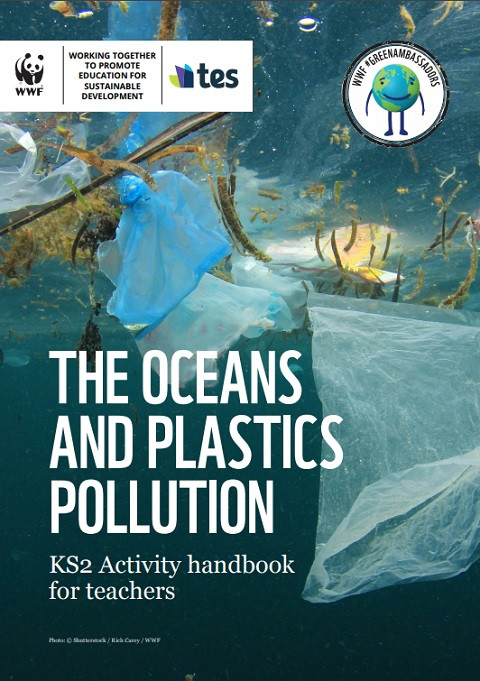 The Oceans and Plastics Pollution: KS2 Activity Handbook for Teachers Year of publication: 2019 Corporate author: World Wide Fund for Nature (WWF) | Tes This resource enables pupils to explore the role of the oceans in our lives and why healthy oceans are so vital to our future. By looking at the impact of plastics pollution on the oceans, pupils will also consider what steps we can all take to safeguard these precious waters for generations to come. It contains a range of activities aimed at teachers of 7-11 year-olds. It is intended that this resource will be used in cross-curricular work and all activities can be linked to the National Curricula of England, Northern Ireland, Scotland and Wales. Teachers will find that the material can be adapted for use with different ages and abilities.The six activities engage pupils in active learning methods, encouraging them to work together to solve problems, to think creatively, and to see themselves as active participants in their communities and the wider world. With a growing awareness of the part that they can play in creating a better future for our oceans, pupils will take a step on the journey to becoming global citizens and sustainability champions of the future.
  La pédagogie de projet au cœur de l'éducation pour un développement durable Year of publication: 2016 Corporate author: Université Virtuelle Environnement et Développement durable (UVED) Dans cette vidéo, Francine Pellaud discute des intérêts et des conditions de réussite de la pédagogie de projet, dans le cadre d'une éducation à l'environnement et au développement durable.
 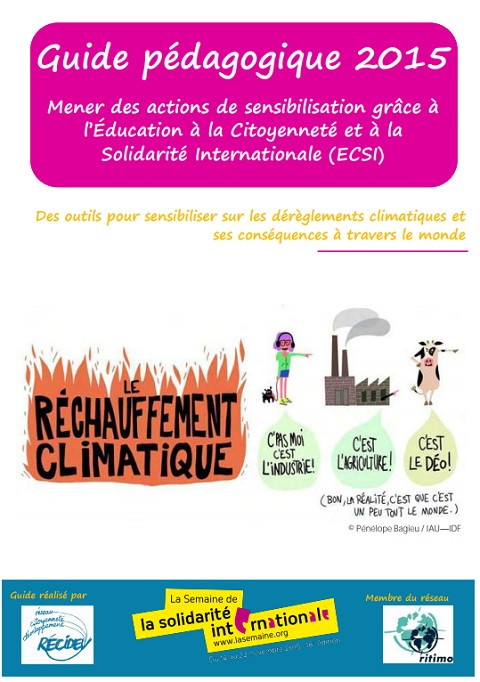 Guide pédagogique 2015: Mener des actions de sensibilisation grâce à l'Education à la Citoyenneté et à la Solidarité Internationale (ECSI): Des outils pour sensibiliser sur les dérèglements climatiques et ses conséquences à travers le monde Year of publication: 2015 Corporate author: RéCiDev Besançon (Réseau Citoyenneté Développement) Ce guide pédagogique est destiné aux acteurs de la semaine de solidarité internationale qui se déroule tous les ans autour de la 3ème semaine de novembre en France. Il propose des outils d'Education à la citoyenneté et à la solidarité internationale (ECSI) pour mener des actions de sensibilisation sur le dérèglement climatique et ses conséquences à travers le monde. Il comprend :- une première partie théorique sur les valeurs et la pédagogie de l'ECSI- une seconde partie pratique qui présente des outils pédagogiques- une troisième partie qui donne des informations pratiques sur les acteurs et les ressources en ECSI.
  Preparing Our Youth for an Inclusive and Sustainable World: The OECD PISA Global Competence Framework Year of publication: 2018 Corporate author: Organisation for Economic Co-operation and Development (OECD) OECD Programme for International Student Assessment (PISA), the global yardstick for educational success, includes global competence in its metrics for quality, equity and effectiveness in education. The global competence assessment in PISA 2018 is composed of two parts: a cognitive assessment and a background questionnaire. The cognitive assessment is designed to elicit students' capacities to critically examine global issues; recognise outside influences on perspectives and world views; understand how to communicate with others in intercultural contexts; and identify and compare different courses of action to address global and intercultural issues. In the background questionnaire, students will be asked to report how familiar they are with global issues; how developed their linguistic and communication skills are; to what extent they hold certain attitudes, such as respect for people from different cultural backgrounds; and what opportunities they have at school to develop global competence. Answers to the school and teacher questionnaires will provide a comparative picture of how education systems are integrating global, international and intercultural perspectives throughout the curriculum and in classroom activities.
  Rethinking Learning: A Review of Social and Emotional Learning for Education Systems Year of publication: 2020 Author: Nandini Chatterjee Singh | Anantha Duraiappah Corporate author: Mahatma Gandhi Institute of Education for Peace and Sustainable Development (MGIEP) This publication titled ‘Rethinking Learning: A Review of Social and Emotional Learning for Education Systems’, published by the UNESCO Mahatma Gandhi Institute of Education for Peace and Sustainable Development (MGIEP) reviews the latest research on Social and Emotional Learning (SEL), its impact on student health and school climate and its transformative role in building happier classrooms. It seeks to inform and impress upon Member States the urgent need to mainstream social and emotional learning in education systems.
  No Poverty: Educational Resource for Teachers and Facilitators Year of publication: 2017 Corporate author: Concern Worldwide No Poverty – Educational resource for teachers and facilitators contains activities, statistics and information to explore the extent of poverty in the world, it’s causes and consequences as well as the aims of the sustainable development goals which aspire to address this issue. The booklet includes statistics, three activities complete with resources ready to photocopy and key terminology.
  Ensuring High Quality Primary Education for Children from Mobile Populations: A Desk Study Year of publication: 2017 Author: Stephanie Bengtsson | Caroline Dyer Corporate author: Educate A Child (EAC) | German Federal Ministry for Economic Cooperation and Development (GIZ) This study focuses on provision for primary school-aged children amongst communities of refugees and Internally Displaced People (IDPs), mobile pastoralists and seasonally migrating workers. For refugee and IDP children, policy, coordination and implementation challenges include: inconsistent ratification and enforcement of conventions and agreements protecting refugees and IDPs; the disproportionate impact of forced displacement on low and middle income countries (LMICs); the lack of a shared agenda among a wide range of stakeholders with differing mandates; and inadequate forced displacement terminology. Promising and emerging policy, coordination and implementation strategies include: expanding existing rights documents and agreements and building policy from the ground up; enshrining forcibly displaced people’s rights to education in national laws and policy; genuine engagement with affected communities; utilising the Education Cluster and other existing multi-stakeholder networks for knowledge sharing and collaboration; and collaborating across sectors to address the needs of the whole child. Financing challenges include: unpredictable and low funding for refugee and IDP education; weak capacity to absorb funds at the national and local level; an over-reliance on short-term financing mechanisms; donor dependence and a lack of funding sustainability; and inappropriate distribution of funds within education programming.