
Resources
Explore a wide range of valuable resources on GCED to deepen your understanding and enhance your research, advocacy, teaching, and learning.
3,454 Results found
 Learning to live together: an intercultural and interfaith programme for ethics education: Traning guides series 1; international train the trainers course; a report Year of publication: 2012 Corporate author: United Nations Children's Fund (UNICEF) | Interfaith Council on Ethics Education for Children | Arigatou Foundation In 2010, Arigatou International offered an International Train the Trainers course designed to help those providing training programmes on the use of the Learning to Live Together. The University of Edinburgh helped develop and evaluate the Train the Trainers as a pilot project.
  Learning to live together: an intercultural and interfaith programme for ethics education: Executive Summary Year of publication: 2015 Corporate author: United Nations Children's Fund (UNICEF) | Interfaith Council on Ethics Education for Children | Arigatou Foundation What is the Learning to Live Together? How was it developed? Where and how can it be used? In the Executive Summary you can find answers to all these questions, as well as information about outstanding projects that show the potential of the programme. Apprendre à vivre ensemble: Un programme interculturel et interreligieux pour l’enseignement de l’éthique: Résumé Year of publication: 2015 Corporate author: United Nations Children's Fund (UNICEF) | Interfaith Council on Ethics Education for Children | Arigatou Foundation What is the Learning to Live Together? How was it developed? Where and how can it be used? In the Executive Summary you can find answers to all these questions, as well as information about outstanding projects that show the potential of the programme. Aprender a vivir juntos: Un programa intercultural e interreligioso para la educación ética: Resumen Year of publication: 2015 Corporate author: United Nations Children's Fund (UNICEF) | Interfaith Council on Ethics Education for Children | Arigatou Foundation What is the Learning to Live Together? How was it developed? Where and how can it be used? In the Executive Summary you can find answers to all these questions, as well as information about outstanding projects that show the potential of the programme. Learning to live together: an intercultural and interfaith programme for ethics education: Executive Summary Year of publication: 2015 Corporate author: United Nations Children's Fund (UNICEF) | Interfaith Council on Ethics Education for Children | Arigatou Foundation What is the Learning to Live Together? How was it developed? Where and how can it be used? In the Executive Summary you can find answers to all these questions, as well as information about outstanding projects that show the potential of the programme.
  Pedagogical Guide for an Intercultural, Anti-racist and Gender Perspective Education: Ideas, Experiences and Tools Year of publication: 2017 Author: Carolina Stefoni | Andrea Riedemann | Fernanda Stang | Andrea Guerrero | Antonia Garcés | Marta Camarena Corporate author: Programa Interdisciplinario de Estudios Migratorios (PRIEM) | Universidad Alberto Hurtado | Fundación para la Superación de la Pobreza (FUSUPO) The main purpose of this Guide is, then, to share some ideas, tools and experiences that can help build and walk the path towards an intercultural, anti-racist and gender perspective education in various educational spaces. It is directed primarily - though not exclusively, of course - to all those people who are part of formal and informal teaching-learning processes. It is important to emphasize that the Guide does not pretend to be a recipe for a mechanical application, but a tool box that each educational community can use considering its specific context, its particular needs and its potentialities. Guía pedagógica para una educación intercultural, anti-racista y con perspectiva de género: ideas, experiencias y herramientas Year of publication: 2017 Author: Carolina Stefoni | Andrea Riedemann | Fernanda Stang | Andrea Guerrero | Antonia Garcés | Marta Camarena Corporate author: Programa Interdisciplinario de Estudios Migratorios (PRIEM) | Universidad Alberto Hurtado | Fundación para la Superación de la Pobreza (FUSUPO) El propósito principal de esta Guía es, entonces, compartir algunas ideas, herramientas y experiencias que puedan ayudar a construir y andar el camino hacia una educación intercultural, anti-racista y con perspectiva de género en diversos espacios educativos. Está dirigida principalmente -aunque no de manera exclusiva, por supuesto- a todas aquellas personas que sean parte de procesos de enseñanza-aprendizaje formales e informales. Es importante enfatizar que la Guía no pretende ser un recetario para una aplicación mecánica, sino una caja de herramientas que cada comunidad educativa puede usar considerando su contexto específico, sus necesidades particulares y sus potencialidades.
 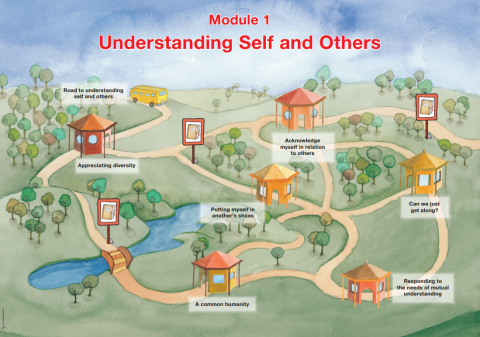 Learning to live together: poster Corporate author: United Nations Children's Fund (UNICEF) | Interfaith Council on Ethics Education for Children | Arigatou Foundation The poster is for the Learning to Live Together programme. The Learning to Live Together programme is built on two complementary learning modules, ‘Understanding Self and Others’ and ‘Transforming the World Together,’ based on four core ethical values: respect, empathy, responsibility and reconciliation.
  The Role of UNESCO in the Search for Peace Year of publication: 2019 Author: Inuk Kang | Sunghae Kim | Jihon KIM | Jieun Seong | Seongsang YOO | Dongjoon Jo | Dongju Choi | Kyungkoo Han Corporate author: Korean National Commission for UNESCO UNESCO's international intellectual cooperation for peace has achieved substantive tangible results in education and culture. Though some problems have been politicized and have produced limitations along the way, UNESCO has played a leading role in education and culture while setting the direction of international cooperation and activities in this regard.UNESCO has regretfully not played an active role in fostering broader, more diverse, and more extensive new research and practices related to peace, even with the international Cold War realities. While UNESCO was an international organization created explicitly for peace, it has neither led to momentous peace-related academic discourse nor does it lead to theoretical development in this regard. The concept of a "Culture of Peace," for example, was first mentioned in the Ivory Coast (Cote d'Ivoire) in 1989. However, it was not until 1997 that UNESCO started its "Toward a Culture of Peace Program" and the U.N. General Assembly declaring 2000 as the "Year of Peace."UNESCO's situation provides an opportunity for South Korea to play a more active role. South Korea needs to break with its history of taking a passive stance focused on short-term national interests and its preoccupation with "situational tracking" responses aimed at fostering national prestige when such opportunities present themselves. Instead, while prioritizing a "global community" founded on world peace and the well-being of humanity-as long-term shared benefits to all nations-and by sharing the financial burdens involved, the country can increase its international status and become a moral leader raising a "global citizenship power."
  Conferencia mundial de la UNESCO sobre la educación para el desarrollo sostenible, 31 de Marzo-2 de Abril 2009, Bonn, Alemania: actas Year of publication: 2009 Corporate author: German Federal Ministry of Education and Research (BMBF) | German Commission for UNESCO As the United Nations Decade of Education for Sustainable Development (DESD) approached its midpoint, the “UNESCO World Conference on Education for Sustainable Development – Moving into the Second Half of the UN Decade” was held from 31 March to 2 April 2009 in Bonn, Germany. It brought together 900 participants from 147 countries, among them 49 Ministers and Deputy-Ministers. Participants included representatives of UNESCO Member States, UN agencies, civil society organizations, education institutions, youth, and the private sector, as well as individual experts. The Conference was organized by UNESCO and the German Federal Ministry of Education and Research, in cooperation with the German Commission for UNESCO. The programme was developed in consultation with an international advisory group.