
Resources
Explore a wide range of valuable resources on GCED to deepen your understanding and enhance your research, advocacy, teaching, and learning.
3,229 Results found
 Ciudadanía y desarrollo en las ciudades del siglo XXI: ¿polis y civitas o sólo urbs? Year of publication: 2016 Author: Joselito Fernández Tapia El artículo tiene por objetivo determinar la problemática de la ciudad como polis, civitas y urbs, para identificar sus características y enfatizar el grave problema que significa la centralidad de la urbs en la ciudad moderna. Analiza los aspectos del espacio público, la ciudadanía y la ciudad de forma interrelacional; recupera los estudios desde el análisis urbanístico, político y social de la ciudad para caracterizar mejor la problemática de ésta. A partir de la reflexión teórica y los estudios existentes se encuentra que civitas y polis están en crisis, reducidas y en peligro de desaparición para dar lugar a una urbs utilitaria y con cada vez menos valor simbólico. El resultado de ello es pobreza, mayores desigualdades y fragmentación social; miedo, inseguridad, aislamiento, debilitamiento de la civitas y de la polis como proceso de desciudadanización, despolitización y deshumanización frente a la urbanización hegemónica de las inmobiliarias y el mercado. En conclusión, la urbs es dominante, por tanto, así como la problemática de la ciudad necesita repensarse desde la civitas y la polis.
  Learning to Leapfrog: Innovative Pedagogies to Transform Education Year of publication: 2019 Author: David Istance | Alejandro Paniagua | Rebecca Winthrop | Lauren Ziegler Corporate author: Center for Universal Education at Brookings This report follows up on the book “Leapfrogging Inequality: Remaking Education to Help Young People Thrive,” published in 2018 by the Center for Universal Education (CUE) at the Brookings Institution. The book argued the importance of education leapfrogging–creating transformative shifts rather than incremental evolution by harnessing the power of innovation to advance a breadth of skills. The book put forth a framework for leapfrogging that outlined two core elements (teaching and learning, and recognition of learning) and two support elements (people and places, and technology and data).This report focuses on the teaching and learning element of the leapfrog framework, especially on pedagogical approaches and the role of teachers, but draws on the others as relevant. It does not attempt to be exhaustive and does not pretend to address neither all education policy variables, nor critical system factors such as political will and adequate funding, nor demand-side factors such as student and parent support for innovative approaches.
  Education at a Glance 2019: OECD Indicators Year of publication: 2019 Corporate author: Organisation for Economic Co-operation and Development (OECD) Education at a Glance is the authoritative source for information on the state of education around the world. It provides data on the structure, finances and performance of education systems across OECD countries and a number of partner economies.The 2019 edition includes a focus on tertiary education with new indicators on tertiary completion rates, doctoral graduates and their labour market outcomes, and on tertiary admission systems, as well as a dedicated chapter on the Sustainable Development Goal 4. Regards sur l'éducation 2019: Les indicateurs de l'OCDE Year of publication: 2019 Corporate author: Organisation for Economic Co-operation and Development (OECD) Regards sur l’éducation est la publication de référence sur l’état de l’éducation dans le monde. Elle fournit des données clés sur la structure, le financement et la performance des systèmes d’éducation des pays de l’OCDE, ainsi que d’un certain nombre de pays partenaires. Avec plus de 100 tableaux et graphiques – et des liens vers de nombreuses données supplémentaires sur notre base de données consacrée à l’éducation – cette publication présente des données clés sur les résultats des établissements d’enseignement ; l’impact de l’apprentissage dans les différents pays ; l’accès, la participation et la progression au sein des systèmes d’éducation ; les ressources financières investies dans l’éducation ; et les enseignants, l’environnement d’apprentissage et l’organisation scolaire.L'édition 2019 inclut un éclairage spécifique sur l'enseignement tertiaire, avec de nouveaux indicateurs sur le taux de réussite à ce niveau, sur les doctorants et leurs perspectives sur le marché du travail, sur les systèmes d'admission dans l'enseignement tertiaire, ainsi qu'un chapitre dédié au quatrième Objectif de développement durable.
  Regional Capacity Development Resource Book on Monitoring SDG4-Education 2030 in Asia-Pacific Year of publication: 2019 Corporate author: UNESCO Bangkok | UNICEF East Asia and the Pacific The Education 2030 Agenda calls for robust monitoring, reporting, and evaluating indicators from Early Childhood Education (ECE) to adult education. The new agenda demands clear indicators and measurement to generate evidence-based international discourses and advocacy. Ensuring availability of education data and statistics for evidence based policy making and planning is also crucial. Countries’ capacity to respond to these demands will depend on quality mechanism for monitoring in place and technical capacity of data providers and users. The modules included in the this Regional Capacity Development Resource Book on Monitoring SDG 4-Education 2030 in Asia Pacific covers various topics that are relevant to building an effective national monitoring system, such as the creation of a national indicator framework and the development of national strategies for education statistics; strengthening the administrative data production system; and increasing the household survey application in monitoring education at the national level, as well as reporting at the global level.
 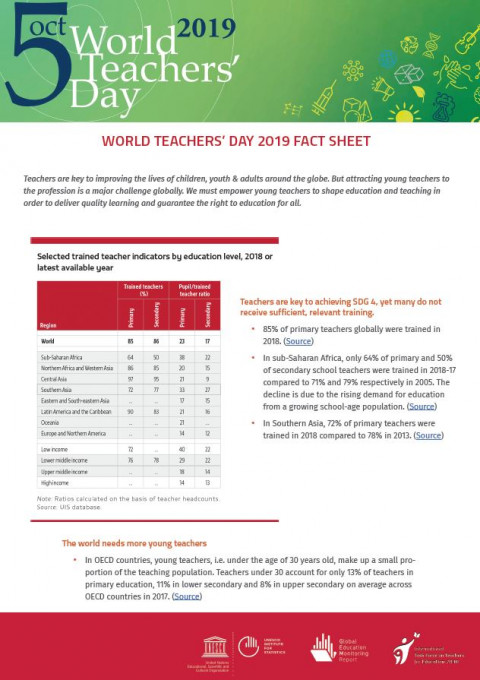 World Teachers' Day 2019: Fact sheet Year of publication: 2019 Corporate author: UNESCO Institute for Statistics (UIS) | International Task Force on Teachers for Education 2030 To mark World Teachers’ Day, GEM(Global education monitoring) report partnered with the UNESCO Institute for Statistics (UIS) and the International Task Force on Teachers for Education 2030 to pull together key facts and statistics on challenges for teachers around the world.The new factsheet provides the latest UIS data on trained teachers, the global indicator for SDG target 4.c. Globally, 85% of primary teachers were trained in 2018 but only 64% in sub-Saharan Africa. The proportion of teachers that are trained in sub-Saharan Africa is falling, mostly due to the rising demand for education from a growing school-age population.
  NISSEM Global Briefs: Educating for the Social, the Emotional and the Sustainable Year of publication: 2019 Author: Andy Smart | Margaret Sinclair | Aaron Benavot | Jean Bernard | Colette Chabbott | S. Garnett Russell | James Williams Corporate author: Networking to Integrate SDG Target 4.7 and SEL skills into Educational Materials (NISSEM) The NISSEM global briefs are a collection of peer-reviewed essays from over 60 contributors with standing within the field of education. At the junction of SDG Target 4.7, SEL, and education in post conflict and low-resource settings, the NISSEM global briefs are a key resource for current research and practice.NISSEM is a Networking to Integrate SDG Target 4.7 and SEL(Social and emotional learning) into Educational Materials launched in March, 2018.
  "Education First" - UN Secretary-General's video message Year of publication: 2012 Author: United Nations. Secretary-General, 2007-2016 (Ban, Ki-moon) UN Secretary-General, Mr. Ban Ki-moon launched a Global Initiative on Education (Education First), which aims to achieve quality, relevant and inclusive education for every child on 26 September, 2012. "Education First" - UN Secretary-General's video message Year of publication: 2012 Author: United Nations. Secretary-General, 2007-2016 (Ban, Ki-moon) Secrétaire général de l'ONU, M. Ban Ki-moon, a lancé une initiative Mondiale sur lÉducation (Education First), qui vise à atteindre une qualité, une éducation pertinente et inclusive pour tous les enfants le 26 Septembre, de 2012. Active citizens: globally connected, locally engaged; facilitator's toolkit Year of publication: 2014 Corporate author: British Council This toolkit has been created to help facilitators to design and deliver the Active Citizens programme all over the world. Active Citizens is a social leadership programme which promotes intercultural dialogue and social responsibility as key leadership competencies in the 21st century. Active Citizens is run by the British Council working with civil society organisations all over the world. It began in 2009 and has been delivered in Europe, the Middle East, Africa and South Asia. It has reached more than 100,000 people to date through its training, conferences, social research and International Study Visits. The toolkit is in five sections - the introduction to the programme, preparing a workshop, delivering a workshop and post-workshop. There is also a large resource of workshop activity plans to support facilitators throughout the training cycle. The Active Citizens programme promotes community-led social development. It motivates members of communities to take responsibility for their social needs and gives them the knowledge, skills and experience to address them. The main audiences for the programme are community leaders working in, and with marginalised communities. They are people and institutions established, trusted and valued in the community - CSOs, NGOs, religious leaders, politicians, youth workers etc. They are influential and working to improve the lives of people living in their community. The programme develops skills and knowledge to identify and engage networks to help achieve goals as well as skills to plan and implement a project. The networks are between individuals at community level; institutions engaged in social action at community level; and institutions engaged in social policy dialogue at a national level. It includes cross-sectoral networking e.g. with the business community, media, etc. The building of these networks increases social inclusion, community resilience to conflict and increases social development in communities. See Diagram 1 on page 9. The programme is flexible and adaptable. It has been delivered to diverse groups, from rural communities in North-West Frontier Province Pakistan to urban communities in East London UK, to communities vulnerable to post-election violence in Kenya and internally displaced persons (IDPs) in Sri Lanka.