
Resources
Explore a wide range of valuable resources on GCED to deepen your understanding and enhance your research, advocacy, teaching, and learning.
3,229 Results found
 Des Citoyens Actifs: connecté globalement recrutés sur place; la boîte à outils de l'animateur Year of publication: 2014 Corporate author: British Council Cette boîte à outils a été créé pour aider les animateurs à concevoir et à exécuter le programme des citoyens actifs partout dans le monde. Citoyens actifs est un programme de leadership social qui favorise le dialogue interculturel et la responsabilité sociale comme compétences clés en leadership au 21e siècle. Citoyens actifs est géré par le British Council travaille avec des organisations de la société civile partout dans le monde. Il a commencé en 2009 et a été livré en Europe, au Moyen-Orient, en Afrique et en Asie du Sud. Il a atteint plus de 100.000 personnes à ce jour par le biais de sa formation, les conférences, la recherche sociale et visites d'étude internationaux. La boîte à outils est en cinq sections - l'introduction au programme, la préparation d'un atelier, offrant un atelier et post-atelier. Il y a aussi une ressource importante de l'activité de l'atelier prévoit de soutenir les animateurs tout au long du cycle de formation. Le programme des citoyens actifs favorise le développement social dirigé par la communauté. Il motive les membres des communautés à prendre en charge leurs besoins sociaux et leur donne les connaissances, les compétences et l'expérience nécessaires pour y remédier. Les principaux publics pour le programme sont des leaders communautaires qui travaillent dans et avec les communautés marginalisées. Ce sont des gens et des institutions établies, fiables et appréciés dans la communauté - OSC, les ONG, les chefs religieux, les politiciens, les travailleurs de la jeunesse, etc. Ils sont influents et travaille à améliorer la vie des personnes vivant dans leur communauté. Le programme développe les compétences et les connaissances pour identifier et engager des réseaux pour aider à atteindre les objectifs ainsi que les compétences nécessaires pour planifier et mettre en œuvre un projet. Les réseaux sont entre les individus au niveau de la communauté; les institutions engagées dans l'action sociale au niveau communautaire; et les institutions engagées dans un dialogue de politique sociale au niveau national. Il comprend la mise en réseau intersectoriel par exemple avec la communauté des affaires, des médias, etc. La construction de ces réseaux augmente l'inclusion sociale, la résilience des communautés aux conflits et augmente le développement social dans les communautés. Voir diagramme 1 à la page 9. Le programme est flexible et adaptable. Il a été remis à divers groupes, des communautés rurales en North-West Frontier Province du Pakistan aux communautés urbaines à East London au Royaume-Uni, aux communautés des personnes vulnérables à la violence post-électorale au Kenya et déplacées à l'intérieur (PDI) au Sri Lanka.
 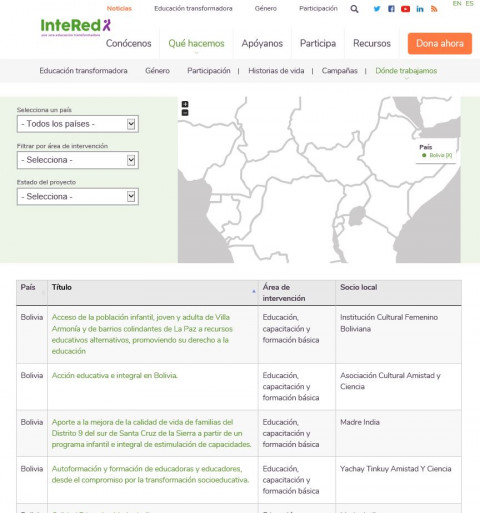 InteRed. Educational Projects in Bolivia Year of publication: 2019 Corporate author: InteRed InteRed carries out educational projects to solve specific social problems around the planet. The projects tackle things such as poverty, health, access to education, Human Rights, access to food, among other things. InteRed. Proyectos educativos en Bolivia Year of publication: 2019 Corporate author: InteRed InteRed lleva a cabo projectos educacionales intentando resolver problemas específicos en el planeta. Los proyectos abordan cuestiones como pobreza, salud, acceso a la educación, Derechos Humanos, acceso a alimentos, entre otras cosas.
  우리나라의 아동권리 이행을 위한 과제: 유엔아동권리위원회 제5·6차 최종견해를 중심으로 (아동권리 이슈포커스 17호) Year of publication: 2019 Corporate author: 굿네이버스 우리나라는 2019년 9월 유엔아동권리협약의 이행에 대한 제5·6차 심의를 받았고, 그 결과를 바탕으로 유엔 아동권리위원회는 2019년 10월 아동의 권리보장을 위한 개선사항을 권고하는 제5·6차 최종견해를 발표하였다.본 원고에서는 유엔아동권리협약 채택 30주년을 맞이하여, 유엔아동권리협약이 아동권리 보장에 있어서 가지는 의미가 무엇인지 확인하고 1991년 유엔아동권리협약 비준 이후 현재 우리나라의 아동권리 보장 수준은 어떠한지, 그리고 아동권리 보장을 위한 이행 과제와 고려점이 무엇인지 유엔아동권리위원회의 대한민국 제5·6차 최종견해를 중심으로 살펴보고자 한다.
  A Study on the Support Methods of Education for Sustainable Development in Connection with Global Citizenship Education (Journal of Education & Culture; Vol.24, No.4) Year of publication: 2018 Author: Youngsoon Kim | Hyunhee Yoon Corporate author: Inha University. Education Research Institute The purpose of this study is to explore supportive measures for revitalizing education for sustainable development linked to global citizenship education and to discuss the practical ways of activation in educational field. The researchers interviewed nine experts on global citizenship education and education for sustainable development for the project. It also collected opinions on how to promote sustainable development education linked to global citizenship education. As a result of the research, experts have presented three tasks as a support measure for promoting sustainable development programs associated with global citizenship education. It was to provide classroom support, enhance teacher skills, and establish a network of related institutions. To improve the quality of the classes, practical operational materials are required, such as textbooks, supplementary materials, and the development of class models and programs. In addition, systematic and continuous training is required to enhance the capabilities of teachers. Lastly, it is necessary to share roles of education-related organizations, such as the Education Ministry, education office, civic groups, local governments and schools, and to establish a network system. Based on the above research results, the Commission discussed future tasks required to support the promotion of sustainable development programs related to international citizens ' education. 세계시민교육 연계 지속가능발전교육활성화를 위한 지원방안 탐색 (교육문화연구; Vol.24, No.4) Year of publication: 2018 Author: 김영순 | 윤현희 Corporate author: 인하대학교 교육연구소 이 연구의 목적은 세계시민교육 연계 지속가능발전교육 활성화를 위한 지원방안을 탐색하여 교육 현장에서의실제적인 활성화 방안을 논의하고자 하는데 있다. 연구 수행을 위해 환경, 사회・문화, 경제, 시민교육 등의 영역별로구성된 9명의 전문가 인터뷰를 실시하였다. 이를 통해 세계시민교육과 지속가능발전교육 활성화를 위한 지원 방안에대한 의견을 수렴하였고, 매트릭스 분석법을 활용하여 코딩 및 해석을 실시하였다.연구 결과, 전문가들은 세계시민교육 연계 지속가능발전교육 활성화를 위한 지원방안으로 수업 지원, 교사 역량강화, 관련 기관 네트워크 구축의 3가지 과제를 제시하였다. 세계시민교육 연계 지속가능발전교육을 위한 수업의질을 높이기 위해서는 관련 교과서나 보충교재, 수업모델 및 프로그램 개발을 통해 실제적인 운영 자료가 제공될필요가 있다. 또한, 수업을 운영하는 교사의 역량을 강화할 수 있는 교사 연수가 체계적이고 지속적으로 이루어져야한다. 마지막으로 교육부, 교육청, 시민단체, 지방자치단체, 학교 등 교육 관련 기관들의 역할 분담과 네트워크 체제구축이 필요함을 강조하였다. 이상의 연구결과를 바탕으로, 세계시민교육 연계 지속가능발전교육 활성화 지원을위해 앞으로 요구되는 추후 과제에 대해 논의하였다.
  미래사회를 위한 세계시민교육 재개념화 연구 Year of publication: 2018 Author: 조윤정 | 이지영 | 권순정 | 서화진 | 윤선인 Corporate author: 경기도교육연구원 교통 및 통신의 발달로 국가 간 상호연결성이 증대되고 새로운 국제문제들이 발생하면서 국가 내의 계층적, 문화적, 인종적 갈등과 공존의 문제가 아니라 국가를 넘어서 전 지구적 문제 해결을 위해 전 지구적 수준의 연대와 협력을 강조하는 교육에 대한 필요성이 증대되고 있다. 특히 미래사회에는 불평등의 심화와 환경생태계의 위기, 그리고 세계화의 심화로 발생하는 다양한 문제 등으로 인하여 전 지구적 수준의 연대와 협력을 통해 문제를 해결할 필요성이 높아지고 있다. 그런 의미에서 세계시민교육은 미래사회를 살아갈 구성원들에게 꼭 필요한 교육이라고 할 수 있다. 그러나 세계시민교육의 개념에 대한 이론적 합의가 이루어지지 못하고 있으며 세계시민교육에 대한 지나치게 폭넓은 스펙트럼이 존재하기 때문에 세계시민교육에 대한 오해와 오개념을 불러일으키고 있다. 보다 구체적으로 표현하면, 학교현장에서는 세계시민성 개념을 이해하기 어렵고 다문화교육, 인권교육, 평화교육, 국제이해교육, 지속가능발전교육 등 유사개념과의 명확한 구분 없이 세계시민교육이라는 용어를 사용함으로써 세계시민교육을 구호나 국제교류와 관련된 교육이나 기존의 다문화교육이나 지속가능발전교육의 새로운 이름으로 오해하는 상황이 벌어지고 있다. 이로 인하여 학교현장에서는 세계시민교육의 원래의 취지와 방향성에서 벗어나는 내용으로 수업이나 프로그램을 구성하고 있으며 이러한 사례가 확산되면서 세계시민교육에 대한 오개념이 고착화되고 있다. 이처럼 세계시민교육에 대한 정확하고 명료한 이해를 방해하고, 세계시민교육의 실천기반을 약화시키면서 학교현장에서의 풍부한 실천을 저해하고 있는 상황에서 세계시민의 취지와 목적에 부합하는 실천이 이루어질 수 있도록 세계시민교육에 대한 재개념화 작업을 실시할 필요가 있는 것이다.본 연구의 목적은 세계시민교육에 대한 재개념화를 통해 세계시민교육의 이론적 기반과 개념을 명확히 정립하고, 이를 통해 세계시민교육 실천현장에 실천기준과 방향성을 제시하고자 하는 것이다. 이러한 연구목적을 달성하기 위해 설정한 연구문제는 다음과 같다.첫째, 세계시민교육에 대한 재개념화를 통해 도출한 세계시민교육의 정의, 세계시민성의 구성요소 및 속성, 영역상 강조점과 세계시민교육의 특징은 무엇인가?둘째, 학교현장에서 이루어지고 있는 세계시민교육의 실천사례는 어떠한가?셋째, 재정립된 세계시민교육 개념을 학교현장에 정착시키고 세계시민교육을 활성화하기 위한 정책적 방향성과 정책과제는 무엇인가?
  Do All Students Have Equal Opportunities to Learn Global and Intercultural Skills at School? (PISA in Focus; No.109) Year of publication: 2020 Author: Tarek Mostafa Corporate author: Organisation for Economic Co-operation and Development (OECD) Many education systems seek to create an open, diverse and tolerant society, as education can play a significant role in countering racial, ethnic and national prejudice among children and adolescents. Education for living in an interconnected and diverse world could also contribute to forming generations of citizens who care about global and intercultural issues and who are able and willing to take action for sustainable development and collective well-being.In its 2018 assessment, PISA assessed the competences needed to live in an interconnected and diverse world. Global competence is defined in PISA 2018 as a multi-dimensional capacity that encompasses the ability to: 1) examine issues of local, global and cultural significance; 2) understand and appreciate the perspectives and worldviews of others; 3) engage in open, appropriate and effective interactions across cultures; and 4) take action for collective well-being and sustainable development. This PISA in Focus examines the equity of the learning opportunities for global and intercultural skills.
  Regional Consultations of the National Human Rights Institutions of Central Asia: Conference Proceedings Year of publication: 2016 Corporate author: UN. Office of the United Nations High Commissioner for Human Rights (UN. OHCHR) | United Nations Development Programme (UNDP) For the first time, the conference became a platform for consultations of national human rights institutions (NHRIs) of Central Asia to help strengthen partnerships and provide opportunities for mutual support and exchange of expertise. Special attention the role of NHRIs in their interaction with the government and other partners in the country, as well as the role of NHRIs in terms of achieving the Sustainable Development Goals (SDGs). Региональные консультации национальных правозащитных учреждений стран Центральной Азии: Отчет о конференции Year of publication: 2016 Corporate author: UN. Office of the United Nations High Commissioner for Human Rights (UN. OHCHR) | United Nations Development Programme (UNDP) Конференция впервые стала площадкой для консультаций национальных правозащитных учреждений (НПЗУ) Центральной Азии в целях содействия укреплению партнерских отношений и обеспечения возможностей взаимной поддержки и обмена экспертным опытом. Особое вниманиеуделено роли НПЗУ в их взаимодействии с правительством и другими партнерами в стране, а также роли НПЗУ в части достижения Целей Устойчивого Развития (ЦУР).