
Resources
Explore a wide range of valuable resources on GCED to deepen your understanding and enhance your research, advocacy, teaching, and learning.
3,446 Results found
 L’interculturel en classe: pour une prise en compte de la spécificité culturelle dans l’intervention Year of publication: 2011 Author: Geneviève Audet Corporate author: McGill University. Faculty of Education Cet article présente des résultats issus d’une analyse de récits de pratique d’éducation interculturelle en maternelle, analyse ayant mené à un ordonnancement en sept jalons en progression vers un idéaltype d’engagement envers l’enfant « d’une autre culture ». Plus spécifiquement, c’est la mise en dynamique de récits témoignant de deux de ces jalons qui nous permettra de pointer la nécessité d’une prise en compte de la spécificité culturelle dans l’intervention, sous l’angle du rapport à l’Autre qu’elle permet d’instaurer.
  Together in Citizenship Education: Intervention Principles to Support the Social Participation of People with Intellectual Disabilities Year of publication: 2016 Author: Raphaëlle Beaudoin | Émilie Raymond Corporate author: Service social This article presents the outcomes of an intervention’s evaluation that was intended to contribute to the renewal of practices in favour of greater social participation of people with intellectual disabilities (ID). Although much has been achieved for the social integration of this population since deinstitutionalization, these citizens still frequently see their rights and their independence questioned, presenting obstacles to the full achievement of life habits. To address these challenges, this intervention project took the form of a citizenship education group led by adults with ID. This intervention project aimed to highlight the prospects of intervention, inspired by an empowerment approach, the most likely to support these people to lead a participatory and self-determined life. Based on the Disability Creation Process model (DCP), this project involved both personal and environmental factors, which are recognized as key elements for social participation. In doing so, it stands out from most intervention programs created to date, which tend to focus on the individual experiences of people, omitting the influence of structural conditions. Yet, the results of this intervention support the relevance of focusing on the interaction between these factors, illustrated through three promising intervention principles: to build on an active learning process, to create a new distribution of power and to seek a balance between support and freedom. This approach asks social professionals to consider the impact of their intervention on self-determination in attaining social participation. It also aims to better equip these professionals to avoid reproducing the dynamics of oppression and to become true facilitators of the social participation of people with ID.
  Teachers of History and the History and Citizenship Education Program: From the Transmission of a Memory to an Open and Subjective Citizenship Year of publication: 2013 Author: Louis LeVasseur | Sabrina Moisan | Jean-François Cardin Corporate author: Phronesis The current program «History and Citizenship Education» for the second cycle of secondary education, on the Quebec history, raised many comments in intellectual circles because of its content since 2006. Some argue that the transmission of major historical events that shape the collective or national memory is non-existent, others argue that it should promote the development of critical thinking and citizenship skills, thus the autonomy of the student facing the memory collective or national. What position secondary teachers do they have in this debate? It’s findable out through the teachers perceptions about program and its three skills. Les enseignants d’histoire et le programme d’Histoire et éducation à la citoyenneté: de la transmission de la mémoire à une citoyenneté « subjective » et ouverte Year of publication: 2013 Author: Louis LeVasseur | Sabrina Moisan | Jean-François Cardin Corporate author: Phronesis L’actuel programme d’« Histoire et éducation à la citoyenneté » pour le 2e cycle du secondaire, portant sur l’histoire du Québec, a suscité depuis 2006 de nombreux commentaires dans les milieux intellectuels en raison de son contenu. Certains affirment que la transmission des grands événements historiques qui structurent la mémoire collective ou nationale y est inexistante, d’autres soutiennent qu’il doit favoriser le développement des compétences critiques et citoyennes, donc, l’autonomie de l’élève face à la mémoire collective ou nationale. Quelle position les enseignants du secondaire occupent-ils dans ce débat ? Il est possible de le découvrir par l’entremise de la perception qu’ils se font du programme et de ses trois compétences.
  Citizenship and Citizenship Education: Gabonese Secondary School Teachers’ Point of Views Year of publication: 2013 Author: René Casimir Zoo Eyindanga Corporate author: McGill University. Faculty of Education The purpose of this paper is to identify the meanings that secondary school teachers (male and female) in Gabon give to citizenship and citizenship education. Sixty teachers, many of whom teach citizenship education, were surveyed. Set against a background of new social demands, the context of democracy is discussed, the latter requiring a renewed critical look at citizenship education in schools. The points of view expressed by the teachers taking part in the study echo their personal and professional experiences. Although open to participation, they reflect a normative conceptualization of citizenship education as well as an obligation to ensure a stronger citizenship education despite social and educational obstacles. Citoyenneté et éducation à la citoyenneté: points de vue d’enseignants et d’enseignantes du secondaire au Gabon Year of publication: 2013 Author: René Casimir Zoo Eyindanga Corporate author: McGill University. Faculty of Education Le présent article vise à dégager les significations que des enseignants et enseignantes de quelques écoles secondaires du Gabon attribuent à la citoyenneté et à l’éducation à la citoyenneté sur la base d’un sondage effectué auprès d’une soixantaine d’entre eux, dont plusieurs enseignent l’éducation civique. Le contexte de la démocratie est évoqué, sur fond d’exigences sociales nouvelles, contexte qui commande un regard renouvelé sur l’éducation civique dispensée à l’école. Les points de vue exprimés, qui font écho à l’expérience personnelle et professionnelle des pédagogues concernés, rendent compte d’une conception quelque peu normative de la citoyenneté bien qu’ouverte sur la participation, mais aussi de l’obligation qu’a l’école d’assurer une éducation civique plus robuste malgré les obstacles sociaux et scolaires rencontrés.
 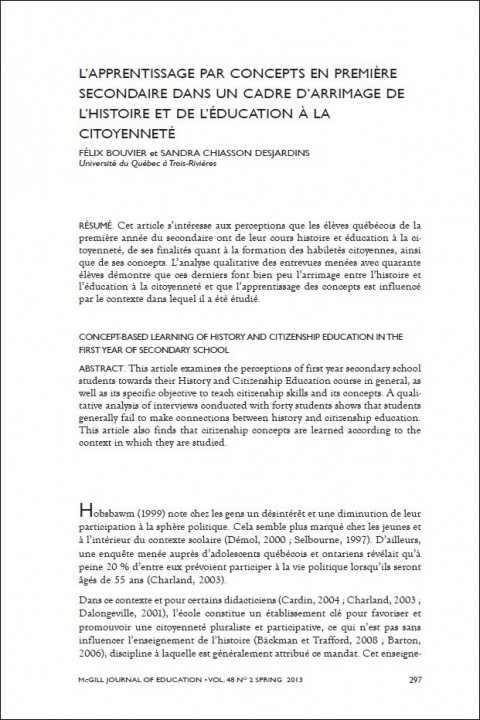 Concept-Based Learning of History and Citizenship Education in the First Year of Secondary School Year of publication: 2013 Author: Félix Bouvier | Sandra Chiasson Desjardins Corporate author: McGill University. Faculty of Education This article examines the perceptions of first year secondary school students towards their History and Citizenship Education course in general, as well as its specific objective to teach citizenship skills and its concepts. A qualitative analysis of interviews conducted with forty students shows that students generally fail to make connections between history and citizenship education. This article also finds that citizenship concepts are learned according to the context in which they are studied. L’apprentissage par concepts en première secondaire dans un cadre d’arrimage de l’histoire et de l’éducation à la citoyenneté Year of publication: 2013 Author: Félix Bouvier | Sandra Chiasson Desjardins Corporate author: McGill University. Faculty of Education Cet article s’intéresse aux perceptions que les élèves québécois de la première année du secondaire ont de leur cours histoire et éducation à la citoyenneté, de ses finalités quant à la formation des habiletés citoyennes, ainsi que de ses concepts. L’analyse qualitative des entrevues menées avec quarante élèves démontre que ces derniers font bien peu l’arrimage entre l’histoire et l’éducation à la citoyenneté et que l’apprentissage des concepts est influencé par le contexte dans lequel il a été étudié.
 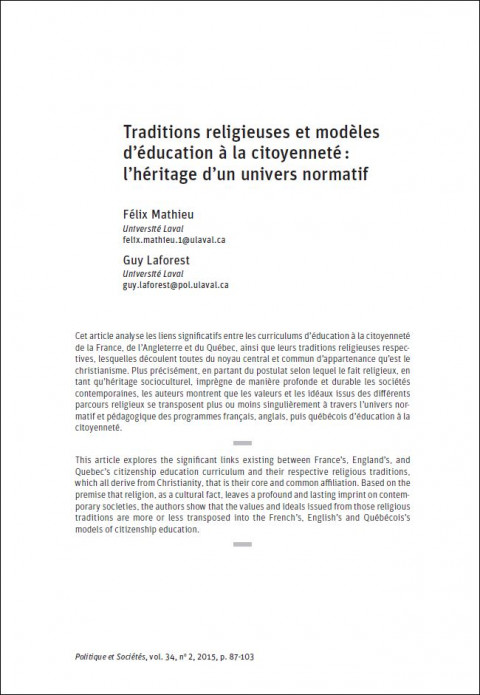 Religious Traditions and Models of Citizenship Education: The Heritage of a Normative Universe Year of publication: 2015 Author: Félix Mathieu | Guy Laforest Corporate author: Politique et Sociétés (Canada) This article explores the significant links existing between France’s, England’s, and Quebec’s citizenship education curriculum and their respective religious traditions, which all derive from Christianity, that is their core and common affiliation. Based on the premise that religion, as a cultural fact, leaves a profound and lasting imprint on contemporary societies, the authors show that the values and ideals issued from those religious traditions are more or less transposed into the French’s, English’s and Québécois’s models of citizenship education. Traditions religieuses et modèles d’éducation à la citoyenneté: l’héritage d’un univers normatif Year of publication: 2015 Author: Félix Mathieu | Guy Laforest Corporate author: Politique et Sociétés (Canada) Cet article analyse les liens significatifs entre les curriculums d’éducation à la citoyenneté de la France, de l’Angleterre et du Québec, ainsi que leurs traditions religieuses respectives, lesquelles découlent toutes du noyau central et commun d’appartenance qu’est le christianisme. Plus précisément, en partant du postulat selon lequel le fait religieux, en tant qu’héritage socioculturel, imprègne de manière profonde et durable les sociétés contemporaines, les auteurs montrent que les valeurs et les idéaux issus des différents parcours religieux se transposent plus ou moins singulièrement à travers l’univers normatif et pédagogique des programmes français, anglais, puis québécois d’éducation à la citoyenneté.