
Resources
Explore a wide range of valuable resources on GCED to deepen your understanding and enhance your research, advocacy, teaching, and learning.
3,387 Results found
 한국사회와 지속가능발전목표 16: 우리의 지속가능한 평화 Year of publication: 2019 Author: 김성경 | 이성훈 | 이재영 | 이향규 | 정성헌 | 김명신 Corporate author: 유네스코한국위원회 유네스코한국위원회는 좀더 많은 사람들이 SDGs를 쉽게 이해하도록 돕기 위해 ‘한국사회와 지속기능발전목표’ 라는 이름 아래 SDGs 해설서를 발간하고 있습니다.16번 해설서인 『한국사회와 지속가능발전목표 16: 우리의 지속가능한 평화』 는 남북 분단 상황 속에서 점차 다문화사회로 변화해가는 오늘날 우리의 일상이 어떻게 하면 더욱 포용적으로 발전할 수 있을지에 대한 이야기로 독자 여러분의 이해를 돕기 위해 각 분야의 전문가들을 인터뷰한 내용으로 구성돼 있습니다.
  Education for Develpment (EdD) in a Diverse World: Comparative Study of Education for Global Citizenship (EdGC) in Paraguay and Spain Year of publication: 2017 Author: Ángela Alcaide Capilla | María Jesús Martínez Usarralde Corporate author: University of Valencia According to the summary of the author: "This article aims to collect a comparative analysis regarding Global Citizenship Education in two different contexts: Spain and Paraguay. The objective is to discover the main characteristics of this education, in meaning and practice, focusing on the diversity of views and constraints of reality, which enrich existing theory speeches, opening this field of knowledge to the experience of its application. In fact, this is the objective and the conclusion. The research justifies the value of this information in the field of study, based on interviews with experts from which relevant information that eludes the rhetorical speeches can be extracted." La Educación para el Desarrollo (EpD) en un mundo diverso: estudio comparativo de la Educación para la Ciudadanía Global (EpCG) en Paraguay y España Year of publication: 2017 Author: Ángela Alcaide Capilla | María Jesús Martínez Usarralde Corporate author: University of Valencia Según el resumen de los autores: "El presente artículo pretende acometer un análisis comparado en relación a la Educación para a la Ciudadanía Global en dos contextos diferentes: España y Paraguay. Se pretende con ello reconocer los rasgos principales de esta educación, en significado y práctica, bajo la premisa de destacar la diversidad de visiones y condicionantes de la realidad, que conceden a los discursos ya existentes en la teoría una gran riqueza, abriendo su campo de conocimiento a la experiencia que de su aplicación se extrae. En sí, este es objetivo y conclusión. Con la investigación se justifica el valor que esta información tiene para el campo de estudio, a partir de entrevistas a personas expertas de las que se extrae información relevante que escapa a la retórica."
  The Paraguayan Educational System Facing the Social Challenges of the 21st Century: A Historical Evolution Towards the Educational Goals Program 2021 Year of publication: 2018 Author: Carlos Novella García Corporate author: Autonomous University of Madrid In the summary the author sustains: "In 2011 the Iberoamerican States Organization for Education and Culture assumed the responsibility of coordinatin the actions and follow a challenging educative programa called "Educative Goals 2021: the education that we want for the generations of the bicentenary". This article pretends to learn the full details of this program and analyze the progresses and achievements made by Paraguay, one of the countries that signed this project. Different national and international reports were analysed in order to know, in detail and in a reliable way, the results of the application and development of the eleven goals of the program regarding education in the Paraguayan context. Nevertheless, due to the extension of this article, the authors focused on three of the eleven goals and obtained very relevant results concerning the absences and achievements of the objectives of these goals. The data evidences considerable progress in the education policies since 2011 although education, selection and professional development of teachers is still lacking development." I would add that the author highlights the importance of an international and Iberoamerican citizenship. El sistema educativo paraguayo ante los desafíos sociales del siglo XXI: una evolución histórica hacia el programa metas educativas 2021 Year of publication: 2018 Author: Carlos Novella García Corporate author: Autonomous University of Madrid En el resumen el autor sostiene: "En el año 2011 la Organización de Estados Iberoamericanos para la Educación y la Cultura asumió la responsabilidad de coordinar las acciones y realizar el seguimiento de un programa educativo muy ambicioso llamado “Metas Educativas 2021: la educación que queremos para la generación de los bicentenarios”. Este artículo pretende conocer con más detalle los fines de este programa y analizar los avances y logros alcanzados por Paraguay uno de los países firmantes de este proyecto. Para dicho análisis nos servimos de informes nacionales e internacionales que nos permitieran conocer con detalle y fiabilidad los resultados de la aplicación y desarrollo de las once metas del programa en materia educativa en el contexto educativo paraguayo. No obstante, por extensión de este artículo nos centramos en tres de estas once metas consiguiendo resultados muy relevantes respecto a los logros y a las ausencias de los objetivos de las metas analizadas. Los datos reflejan un avance considerable de las políticas educativas desde el 2011 hasta la actualidad aunque siguen existiendo carencias notables en aspectos relacionados, principalmente, con la formación, la selección y el fortalecimiento de la profesión docente." Agregaría que el autor subraya la importancia de una ciudadanía internacional e Iberoamericana.
  Intercultural Communication Human and Social Dimensions of Higher Education Year of publication: 2016 Author: Ingrid Steinbach Méndez Corporate author: Universidad Privada de Santa Cruz de la Sierra The starting point of this work is verifying the absence of and disregard for the human and social dimensions (knowing how to be and knowing how to coexist) in university education, including deficient intercultural communication manifested in discrimination ora lack of acknowledgement of the other. The problem is studied from the standpoints of the institution, the students and the faculty of the Faculty of Humanities and Communication of the Universidad Privada de Santa Cruz de la Sierra, Bolivia (FHC-UPSA). Using a qualitative quantitative methodology and a hermeneutic interpretation, voids are confirmed in the areas of "knowing how to be" and "knowing how to coexist" in the curricular designs as well as in the practices, behaviors and attitudes (habitus) of the students and faculty when faced with diversity. Comunicación intercultural, en la dimensión humana y social de la educación universitaria Year of publication: 2016 Author: Ingrid Steinbach Méndez Corporate author: Universidad Privada de Santa Cruz de la Sierra El trabajo parte de constatar una ausencia y despreocupación por la dimensión humana y social (saber ser y saber convivir) en la educación universitaria y como parte de ello, la deficiente comunicación intercultural expresada en signos de discriminación o desconocimiento del otro.La problemática es estudiada desde el ámbito institucional, estudiantil y docente de la Facultad de Humanidades y Comunicación de la Universidad Privada de Santa Cruz de la Sierra, Bolivia (FHC-UPSA). Utilizando una metodología cuali-cuantitativa, y una interpretación hermenéutica, se confirman vacíos en el "saber ser" y el "saber convivir" tanto en los diseños curriculares como también en las prácticas, comportamientos y actitudes (hábitus) de los estudiantes y docentes frente a la diversidad.
 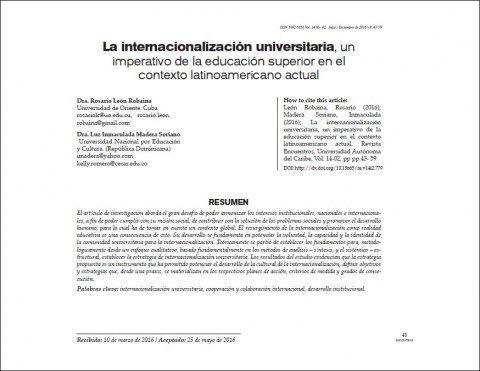 University Internationalization: A Higher Education Imperative in the Latin American Context Year of publication: 2016 Author: Rosario Leon Robaina | Luz Inmaculada Madera Soriano According to the author: "The article analyzes the challenge of being able to harmonize institutional, national and international interests, in order to fulfill the social mission of contributing to solving social problems and promoting human development, for which a global context has to be taken into account. The resurgence of educational internationalization is actually a consequence of this. Its development is founded on the will to enhance the capacity and identity of the university community for internationalization. Theoretically, the researchers started setting up the foundations from a qualitative approach, methodologically based on structural and systemic action research to establish the university internationalization strategy. The results show that the proposed strategy is an instrument that has enhanced the development of the internationalization culture, defining objectives and strategies, which from the praxis, are materialized in different action plans, using specific measurement criteria, and levels of achievement" The authors argument that a socially committed globalization is promoted. La internacionalización universitaria: un imperativo de la educación superior en el contexto latinoamericano actual Year of publication: 2016 Author: Rosario Leon Robaina | Luz Inmaculada Madera Soriano Segùn el autor: "El artículo de investigación aborda el gran desafío de poder armonizar los intereses institucionales, nacionales e internacionales, a fin de poder cumplir con su misión social, de contribuir con la solución de los problemas sociales y promover el desarrollo humano, para lo cual se ha de tomar en cuenta un contexto global. El resurgimiento de la internacionalización como realidad educativa es una consecuencia de esto. Su desarrollo se fundamenta en potenciar la voluntad, la capacidad y la identidad de la comunidad universitaria para la internacionalización. Teóricamente se partió de establecer los fundamentos para, metodo- lógicamente desde un enfoque cualitativo, basado fundamentalmente en los métodos de análisis – síntesis, y el sistémico – es- tructural, establecer la estrategia de internacionalización universitaria. Los resultados del estudio evidencian que la estrategia propuesta es un instrumento que ha permitido potenciar el desarrollo de la cultura de la internacionalización, definir objetivos y estrategias que, desde una praxis, se materializan en los respectivos planes de acción, criterios de medida y grados de consecución." Argumenta que se promueve una globalización soliidaria.
 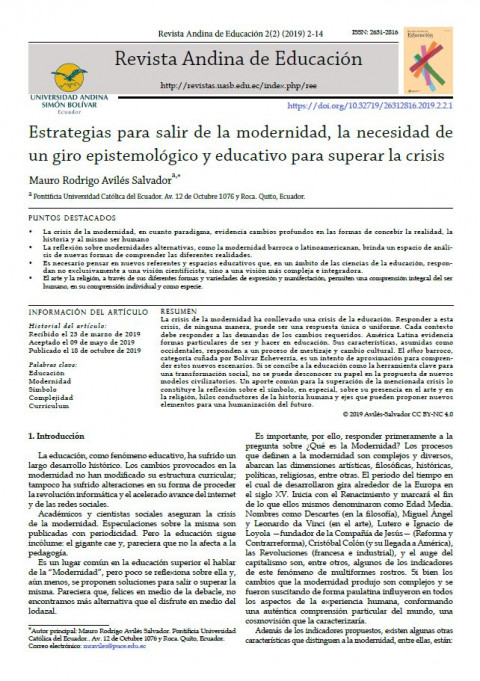 Strategies to Exit Modernity: The Need of an Educative and Epistemological Turn to Overcome the Crisis Year of publication: 2019 Author: Mauro Rodrigo Avilés Salvador According to the author: "the crisis of modernity has led to a crisis in education; and by no means can this crisis be tackled in a unique or uniform way. Every context has to respond to the demands of change that are requested. If education is conceived as the key tool for social transformation, its role in promoting new civilization models cannot be neglected. One way of overcoming the crisis may be by reflecting about the symbol, its presence in art and religion, areas that may promote new elements for a future humanization." Then, in the article, from a critical pespective, the author enfatizes the role of Latin America a leader for a "different" kind of change, a change based on the cultural latinamerican ethos. The author quotes Edgar Morin, and mentions the need of a plural education that favours democracy, based on Human Rights. However, although he mentions universal aspects, he does not mention a planetary citizenship and he criticizes the european model.