
Resources
Explore a wide range of valuable resources on GCED to deepen your understanding and enhance your research, advocacy, teaching, and learning.
328 Results found
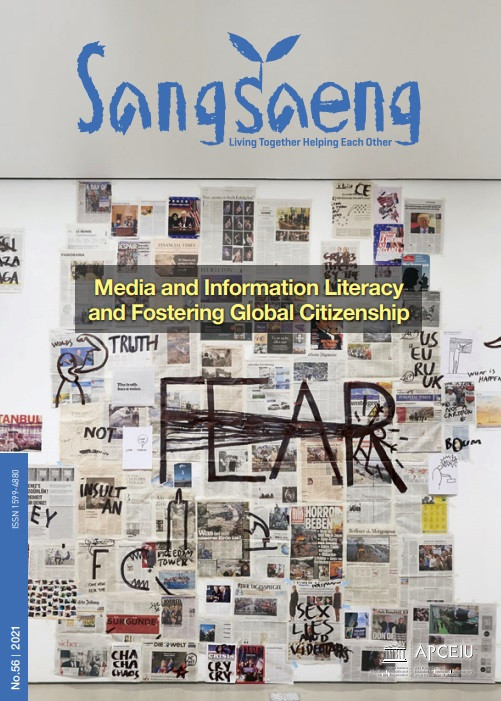 Media and Information Literacy and Fostering Global Citizenship (SangSaeng no.56, 2021) Year of publication: 2023 Corporate author: APCEIU In today’s digital age, we increasingly rely on media content and information mostly shared online to keep us informed and connected. Those issues of hate speech and stigma during the COVID-19 pandemic are closely related to the spread of fake news and disinformation. Thus, media and information literacy (MIL) has become more crucial than ever for global citizenship. In this context, the 56th edition of SangSaeng focuses on “Media and Information Literacy and Fostering Global Citizenship.” Contents 03 Editor’s Note 04 Special Column Media and Information Literacy to Ensure Rights, Freedoms / Milena Dragicevic Sesic 09 FOCUS: Media and Information Literacy and Fostering Global Citizenship09 Inclusive Media Education Promotes Media and Information Literacy / Sirkku Kotilainen13 Emotional Awareness in Age of Misinformation and Media and Information Literacy / Lisa van Wyk17 Empowering Youth to Shape Our Digital Future / Amie Kim20 A Narrative in Peace(s) / Bushra Ebadi 25 Best Practices25 Building a FaMiLLi* of MIL Educators in Namibia and Beyond / Uajorokisa Akwenye29 Youth Promoting Literacy for Life through HILA Alliance / Beatrice Bonami 33 Special Report33 Peace as an End and a Process – Dialogue with Dr. Betty Reardon on Peace Education / APCEIU38 Learn for Our Planet, Act for Sustainability – Highlights of World Conference on ESD / Alexander Leicht and Won Jung Byun 42 Story TimeGalap & Jomo / Sirhajwan Idek 44 GCED Youth NetworkYes, We Hear You, We See You / GCED Youth Network Core Group 48 LetterFostering Cultural and Language Diversity in Georgia / Marika Sikharulidze 50 APCEIU in Action
 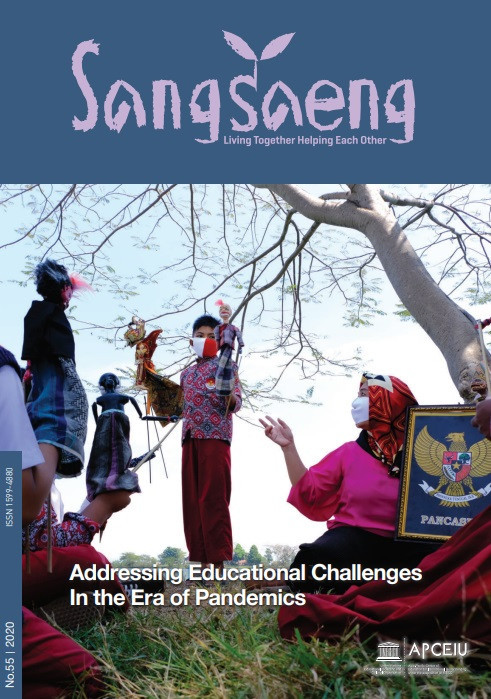 Addressing Educational Challenges In the Era of Pandemics (SangSaeng no.55, 2020) Year of publication: 2023 Corporate author: APCEIU With the prolonged COVID-19 pandemic, the global crisis has further aggravated various multifaceted challenges to humanity. We are forced to prepare for another paradigm shift or, in other words, a “New Normal.” With this in mind, the 55th edition of SangSaeng focuses on “Addressing Educational Challenges in the Era of Pandemics.” Contents03 Editor’s Note04 Special ColumnTowards Sustainability: Implications of Pandemic and How to Create the Future We All Want / Jae C. Choe 08 FOCUS: Addressing Educational Challenges in the Era of Pandemics08 Rethinking Education in the Shadow of the Pandemic / Edward Vickers12 Reimagining Education System to Reduce Social Inequalities / Paul R. Carr16 Reshaping Kenya for Beyond COVID / Jane Wanjiru Nyaga19 Rethinking Human Rights Education in the Pandemic / Abraham Magendzo K.22 Prioritizing GCED in Recovery of Pandemic: Challenges and Opportunities / Romina Kasman 26 Best Practices26 Loxo Yakaar: Hands of Hope / Karima Grant and Chakera McIntosh29 Care for Tomorrow Starts Today / Tina Trdin 32 Special ReportReport on the Round Table: “Next Normal” We Make / IGCED, APCEIU 36 Story TimeHow Do You Paint? / Recka Olasiman 38 Peace in My MemoryGive Me Peace on Earth / Libby Giles 41 Understanding the Asia-Pacific RegionWater Heritage in Southeast Asia / Karen Chin Ai Ying 45 GCED Youth NetworkMeaningful Spaces to Exchange and Learn Together / GCED Youth Network Core Group 48 LetterPromoting GCED in Sri Lanka / Deshamanya A.L.S. Abeywickrama 50 APCEIU in Action
 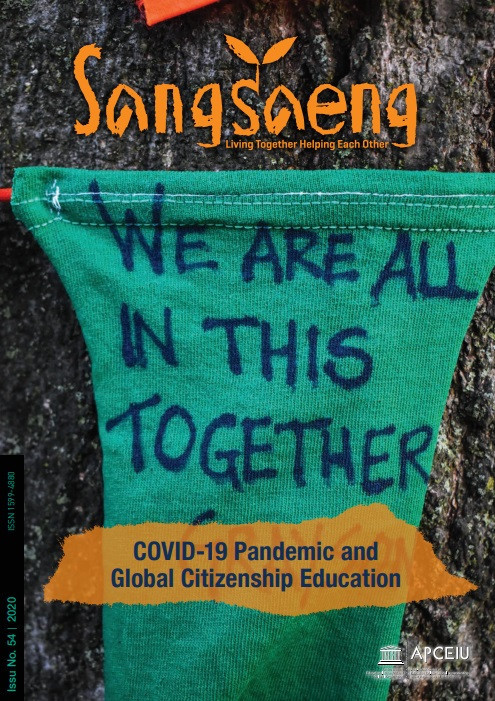 COVID-19 Pandemic and Global Citizenship Education (SangSaeng no.54, 2020) Year of publication: 2023 Corporate author: APCEIU Considering the significance of the global pandemic crisis, the 54th edition of SangSaeng focuses on the “COVID-19 Pandemic and Global Citizenship Education.” This issue invites readers to explore how the pandemic has affected the global community and reflect on how we should and can work together to address our common, multifaceted challenges while enhancing global citizenship and solidarity. Contents03 Editor’s Note04 Special Column What Changes Do We Want in the Post-Coronavirus World? / Hyun Mook Lim 08 FOCUS: COVID-19 Pandemic and Global Citizenship Education08 Reflecting on Global Citizenship Education in the Era of the Pandemic / Soon-Yong Pak12 Choosing Our Post-Pandemic World / Ilan Kelman16 Political Economy of COVID-19 and Global Cooperation / Chang-Yup Kim21 Peace in the Time of Global Pandemic / Yonas Adaye Adeto25 The Pandemic Stall of 2020 / Virginia A. Miralao30 Marine Conservation Efforts in Uncertain Times / Kerstin Forsberg35 Plague, Prejudice and Protest: The Role of Education in Pandemic World / Lynn Davies39 Media and Information Literacy Matters in Preparing for Post-Pandemic World / Divina Frau-Meigs 44 GCED Youth NetworkYouth Voices on the COVID-19 Pandemic and a New Work / Diego Manrique, Tshering Zangmo and Zanji Sinkala in collaboration with Hadi Althib 50 APCEIU in Action
 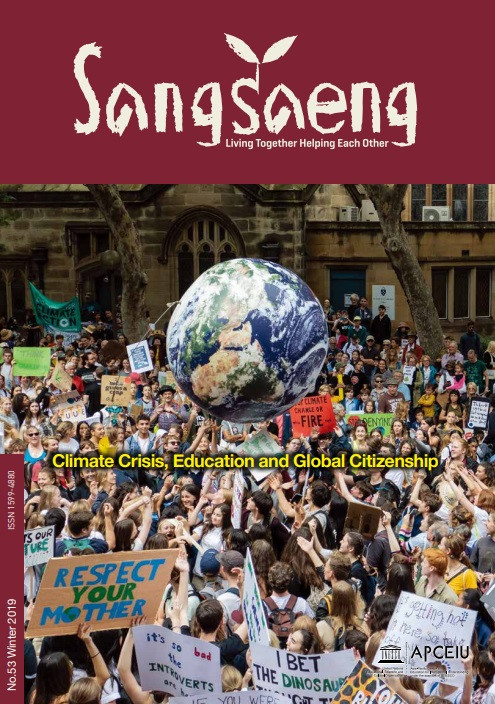 Climate Crisis, Education and Global Citizenship (SangSaeng no.53, 2019) Year of publication: 2023 Corporate author: APCEIU In view of the rapidly growing concerns about the climate crisis, the 53rd issue of SangSaeng focuses on how we should respond to the challenge under the theme of “Climate Crisis, Education and Global Citizenship.” Contents 03. Editor’s Note 04. Special Column Reimagining Our Future in Light of the Climate Crisis/Helena Norber-Hodge, 08. Focus 08 Empowering Learners for Climate Action and Transformation /Alexander Leicht 12 Changing Education, Not the Planet /Sun-kyung Lee 16 Power of a Global Classroom/Lynette Shultz and Carrie Karsgaard 19 Sustainability Starts with Teachers/Shepherd Urenje 24. Best Practices 24 Y-Adapt Inspires Youth-led Climate Change Action/ Brigitte Rudram 29 Local Energy Transition, from Imagination to Everyday Life/ Soyoung Kim 32. Story Time Pluto, a Stubborn Planet / Aprilia Sanie 34. Peace in My Memory 34 Global Citizenship Education in a Divided World / Makoto Kobayashi, 37 Clearing Streets of Burkina Faso / Francois Compaore 40. Understanding the Asia and the Pacific Melting Discoveries in Altai Plateau /In Uk Kang 44. GCED Youth Network Youth as the motor for GCED /Diego Manrique and GCED Youth Network 48. Letter The Journey of Making Peace in the Arab World /Khalaf Al'Abri, 50. APCEIU in Action
  Teaching Across Borders: A Guide to Follow-up Activities for APTE Alumni Teachers Year of publication: 2023 Corporate author: APCEIU | Korea R. Ministry of Education IntroductionLaunched in 2012, the Asia-Pacific Teacher Exchange for Global Education (APTE) marks its 10th anniversary this year with a solid record of steady growth. The Programme started with only two countries— Mongolia and the Philippines—and has since added five more: Cambodia, Indonesia, Lao PDR, Malaysia, and Thailand. Even the COVID-19 pandemic has not impeded the APTE’s development and instead provided the basis for an online form of educational exchange. Over the past decade, more than 2,000 teachers in Korea and the partner countries participated in the APTE and guided numerous students. This was thanks to the unwavering support of teachers who sought dissemination of the value of Global Citizenship Education, a key element of UNESCO’s educational agenda. We express our deepest appreciation to the teachers and students who took part in the APTE. Human ties going beyond national borders are rare and precious. This project has tied many people around the world, with the teachers and students who participated continuing efforts to further consolidate their ties. To assist and facilitate teachers’ efforts toward follow-up activities after participating in the APTE, the Asia-Pacific Centre of Education for International Understanding (APCEIU) under the auspices of UNESCO has released these guidelines on follow-up activities. Encouraging all teachers who are determined to continue Global Citizenship Education in the wider world, we extend our heartfelt gratitude to the writers and researchers for their dedication toward the publication of this book. We sincerely hope that these guidelines promote follow-up activities for international education exchange and its sustainability
 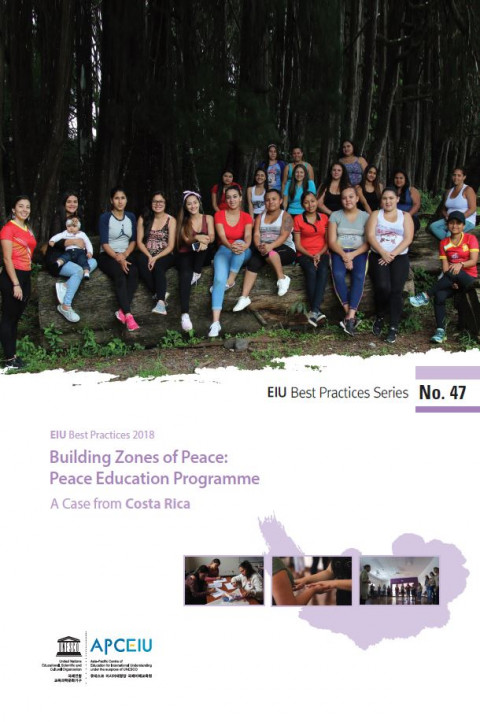 EIU Best Practices Series No. 47: Building Zones of Peace: Peace Education Programme; A Case from Costa Rica Year of publication: 2018 Corporate author: APCEIU Building Zones of Peace (BZP) is a non-formal peace and global citizen education programme created to promote peace and prevent violence in vulnerable urban communities in Costa Rica. The programme aims to encourage participants to develop a critical view of their contexts and explore different ways of taking action to transform the world we live in, and by recognizing how individual and collective efforts have a positive and direct impact in our personal, family and community spheres as well as nationally and globally.In 2017, BZP was conducted to a group of secondary education students ages 13 to 17. This year (2018), participants are young women, ages 18 to 22, all of the mothers who live in extreme poverty. These women have been selected by a governmental office whose aim is to reduce poverty by empowering them. Several resources and networks of support have been created in different areas such as health, employment, childcare and education to achieve this goal. In this sense, our programme was chosen to contribute significantly in this process.
 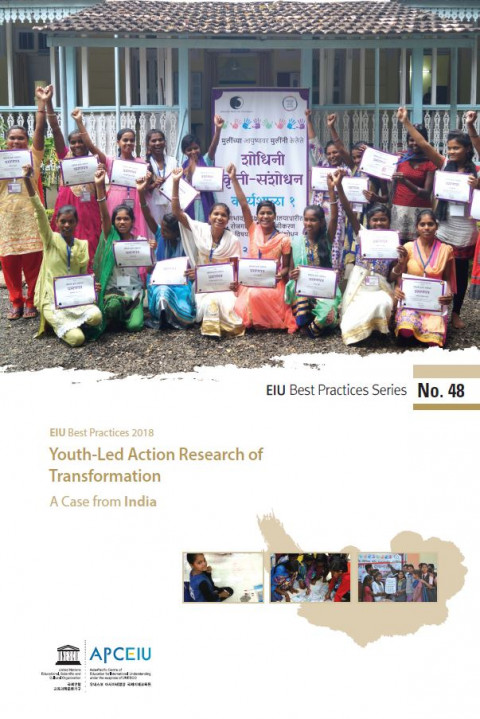 EIU Best Practices Series No. 48: Youth-Led Action Research of Transformation; A Case from India Year of publication: 2018 Corporate author: APCEIU This action research project is about the education for livelihood and life skills of marginalized young girls. This project was based from my experience in the Youth-Led Action Research Project organized by ASPBAE and UNESCO Institute of Lifelong Learning (UIL), which gradually led to the conception of the present action research project for the empowerment of the marginalized rural girls suppressed by patriarchal social systems. The Shodhinis are the subjects and objects of this action research. A hundred girls from ten villages conducted action research on the topics of gender, education, livelihood and life skills to young marginalized young girls aged between 14 to 25 years old in their respective communities. The Shodhinis discovered the joys of learning as they took positive steps in discovering and empowering themselves. The research enabled them to conduct various research methods like census and in-depth surveys of their fellow girls in their villages. As part of the research process, the girls also drew up a community map to understand their village. The relevance of this project to GCED values cannot be overemphasized especially in developing the cognitive, emotional and the behavioral dimensions of the girls themselves.This project not only focuses on analyzing the findings derived from the gathered data but also on generating action based on the data. It helped improve the way Shodhinis looked at themselves, their families, and their communities, inspiring them to become agents of change in their own lives as well as those of other girls in their villages. By amplifying their voices and opinions in the decision making processes at the family and community levels – for instance, by lobbying for the construction of libraries – the Shodhinis were able to demonstrate their leadership skills in shaping the development of their villages, thereby enhancing their dignity and self-worth.
 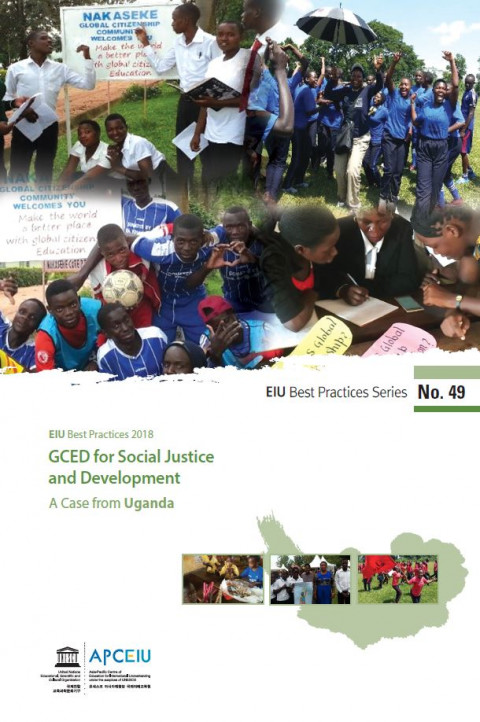 EIU Best Practices Series No. 49: GCED for Social Justice and Development; A Case from Uganda Year of publication: 2018 Corporate author: APCEIU Creating a peaceful, trusting and supportive learning environment is a strong driver for a nation’s sustainable development. Any society whose citizens have no cognitive, socio-emotional and behavioral values like respect for self and humanity, is doomed for chaos. The concepts of Education for International Understanding(EIU) and Global Citizenship Education(GCED) in this programme emerge from the need for harmonious living in the society. Sustainable human and economic development is built upon the successful dissemination and implementation of EIU/GCED practices. To understand this better, let’s use the analogy of a bird that gains its momentum to fly from its feet, lungs and wings.The contributor uses this analogy to illustrate that EIU/GCED is the foundation that exerts momentum for social development.The contributor saw it necessary that for any sustainable development to flourish in Ugandan society, pragmatic values have to be perfectly blended with public awareness for they serve as the foundation of all economic, social, cultural and political efforts. The national value system should be based on a strong foundation on which all national efforts are rooted. The social aspirations of the citizens should be the ones that propel development needs and national priorities.To effect sustainable development, we need to see schools as strategic intervention points. Recent times have, however, witnessed that the level of discipline and value inculcation gradually declined to near extinction. The distortion of the social setting that inculcated the ethical values in the young generation has called for a need to remedy the gap. The EIU/GCED is strategically tailored to inculcate Table of Contents moral principles and values in the children through the direct contact and support of the teachers of Early Childhood Development (ECD), both primary and postprimary levels.The Nakaseke Core Primary Teachers’ College (PTC) is mandated to mainstream and promote the social uprightness of the community being a primary stakeholder in the integration of EIU/GCED in the Ugandan Primary Schools (PS) and Primary Teachers Education (PTE) Curriculum. Consequently, the training programmes were designed to enhance the capacity of PTC’s administrators, tutors and support staff, pre-service student teachers, district education officers and primary school teachers to inculcate the EIU/GCED moral values and principles among the learners. Students are then expected to apply EIU/GCED principles to their families and communities, and uphold the values of integrity, honesty, justice, responsibility, respect for humanity, hard work, unity and creativity.
 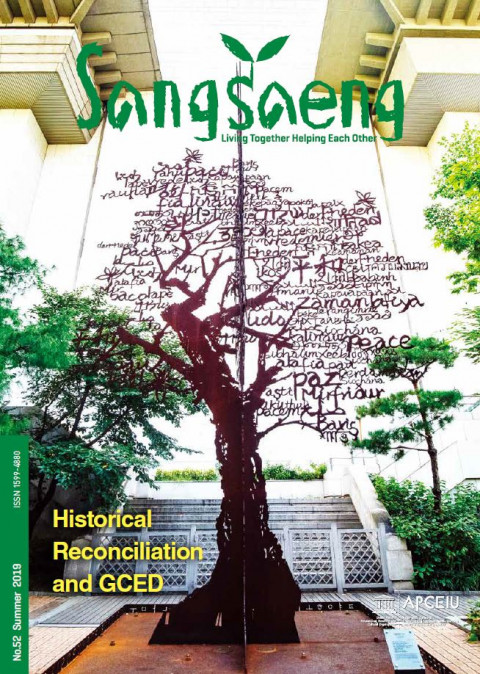 Historical Reconciliation and GCED (SangSaeng no. 52 Summer 2019) Year of publication: 2019 Corporate author: APCEIU The 52th issue of SangSaeng has been published with the theme “Historical Reconciliation and GCED.” This issue explores various endeavours aimed at attaining historical reconciliation and peace, as well as the important role education plays to achieve this goal. How we teach and learn about our past and present conflicts is critical in shaping our future. It can help enhance global citizenship and lead us to peaceful reconciliation and peacebuilding, or it can intensify the hatred of others and build up more conflicts. 3 Editor’s Note4 Special ColumnToward Reconciliation in a Divided, Dangerous World / Jonathan Jansen8 Focus: Historical Reconciliation and GCED8 Historical Dialogue among Korea, China and Japan / Jeongin Kim12 Teaching Shared Histories in Southeast Asia / Doung Bich Hanh16 Learning about Europe’s Common History / Dominik Pick19 Dual Narrative to Teach History / Sami Adwan21 Mystic of ‘General History of Afica’ / Ali Moussa Iye 24 Best Practices24 The Power of Silence / Dylan Wray27 Mobile Library / Andri Nurcahyani31 Special Report31 Migration, Displacement and Education: Building Bridges, Not Walls / Manos Antoninis33 Harmonizing ‘Heart, Head and Hand’ in Hanoi / APCEIU37 InterviewFour Students for One Common Good / Sabine Detzel41 Understanding the Asia-Pacific RegionUniting Under Legends of Ghandhara / Nadeem Omar Tarar44 Youth NetworkHELP Nurtures Youth Citizenship through Collaboration / Nephtaly Pierre-Louis and Meaghan Balzer48 LetterSpeaking Silently in the Loud World / Elvira Sarsenova50 APCEIU in Action
  Reconciliation, Peace and Global Citizenship Education: Pedagogy and Practice Year of publication: 2019 Corporate author: APCEIU The Asia-Pacific Centre of Education for International Understanding launched the publication entitled Reconciliation, Peace and Global Citizenship Education: Pedagogy and Practices. This book is the result of the fruitful discussions and presentations made during the 4th International Conference on Global Citizenship Education held on 3-4 September 2019 in Seoul, Republic of Korea.The intention of this publication is not only to continue and deepen the discourses made by the speakers of the Conference, but also to provide the readers with opportunity to explore how pedagogy and practices of Global Citizenship Education can contribute to building peace and reconciliation across the globe. Part. I Global Citizenship Education for peace and reconciliation: OverviewLearning to live together and a life worth livingHow GCED can contribute to peace, reconciliation and sustainable developmentTransformative pedagogy for building peacePromoting peace through mindfulness programmes in schoolsGlobal memory, global citizenship and reconciliationThe role of Media and Information Literacy Part. II Global Citizenship Education for peace and reconciliation: Putting it into practiceFacing History and Ourselves in South AfricaClassrooms in Peace in ColombiaPreparing young people to be global citizens through integrated schools in Northern Ireland Part. III Global Citizenship Education for peace and reconciliation: Supporting effective implementationPolicy development and implementationChallenges in curriculum and textbook development for low-and middle-income country